
Home / Research Articles / Retatrutide TRIUMPH-1 Phase 3 Results: Up to 30% Weight Loss
Retatrutide TRIUMPH-1 Phase 3 Results: Up to 30% Weight Loss
Key Takeaways
- Eli Lilly announced TRIUMPH-1 Phase 3 topline results on May 21, 2026 — Retatrutide produced up to 30% body weight reduction at 104 weeks in a severe obesity subgroup of 532 participants.
- The full 2,339-participant trial demonstrated 25.0% average body weight reduction at 80 weeks on 12mg dose, establishing Retatrutide as the highest-efficacy GLP-1-class obesity compound.
- Discontinuation rates were 11.3% on 12mg vs 4.9% placebo, with predominantly gastrointestinal adverse events including nausea, diarrhea, constipation, and vomiting during escalation.
- The 4mg maintenance dose showed 17.6% weight loss with placebo-comparable discontinuation rates, suggesting potential clinical positioning balancing efficacy and tolerability.
- Retatrutide remains investigational and not approved by any regulatory agency; the data informs research but does not change research-grade compound regulatory status.
On May 21, 2026, Eli Lilly announced positive topline results from TRIUMPH-1, a Phase 3 clinical trial of Retatrutide in adults with obesity or overweight with at least one weight-related condition [Ref. 1]. The data represent the largest weight loss documented in any GLP-1-class Phase 3 trial to date — up to 30% body weight reduction in participants with severe obesity escalated to maximum tolerated dose at 104 weeks — and they materially expand the scientific case for triple-agonist incretin pharmacology that has been building since the 2023 Phase 2 trial.
This article addresses what the TRIUMPH-1 data shows, how the results compare to the existing GLP-1 Phase 3 trial literature, and what the data means for the broader research understanding of Retatrutide as the leading triple-agonist research compound. The article is news + analysis — Retatrutide remains investigational, and the trial results do not change the compound’s regulatory status anywhere in the world.
What TRIUMPH-1 Tested
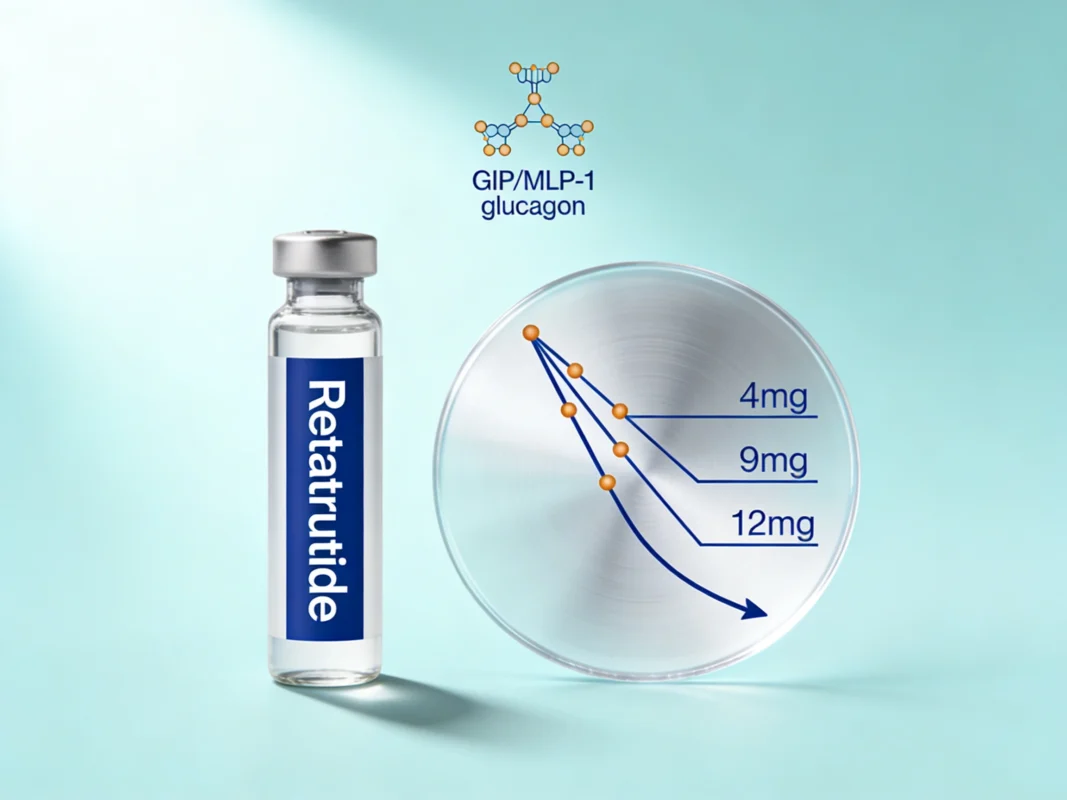
The TRIUMPH-1 trial enrolled 2,339 adults with obesity or overweight and at least one weight-related medical complication, randomized to receive Retatrutide at 4mg, 9mg, or 12mg weekly (with a gradual dose escalation from 2mg every four weeks), or placebo [Ref. 1, Ref. 2]. The primary endpoint was percent change in body weight at 80 weeks. The trial registry is documented as NCT05929066 on ClinicalTrials.gov [Ref. 3].
A secondary protocol element extended the trial in a specific subgroup: 532 participants with BMI ≥35 at baseline who had tolerated their assigned dose were escalated to the maximum tolerated dose (9mg or 12mg) for an additional 24 weeks, with assessment at 104 weeks total trial duration. This subgroup represents the participants with the most severe obesity at baseline and the longest exposure to maximum-dose Retatrutide in the trial.
The Headline Numbers
At 80 weeks, mean body weight reduction across the four trial arms:
| Trial arm | Mean weight loss at 80 weeks |
|---|---|
| Retatrutide 4mg | 17.6% |
| Retatrutide 9mg | 23.7% |
| Retatrutide 12mg | 25.0% |
| Placebo | 3.9% |
In the 532-participant BMI ≥35 subgroup escalated to maximum tolerated dose for an additional 24 weeks, weight reduction reached up to 30% at 104 weeks [Ref. 2]. This is the figure that has driven most of the press coverage of the trial results, and it is the largest weight loss documented in any GLP-1-class Phase 3 trial to date.
The dose-response pattern visible in the four trial arms — 17.6% to 23.7% to 25.0% to 3.9% — confirms what the earlier Phase 2 Jastreboff 2023 trial established [Ref. 4]: Retatrutide’s weight loss effects scale with dose across the studied range, with diminishing but still meaningful incremental gains as dose increases. The smaller difference between the 9mg and 12mg arms (1.3 percentage points) versus the larger difference between the 4mg and 9mg arms (6.1 percentage points) suggests the dose-response curve is beginning to plateau at the higher doses, though escalation in the BMI ≥35 subgroup demonstrated additional weight loss with sustained maximum-dose exposure.
Lead investigator Ania Jastreboff, professor of medicine and pediatrics at the Yale School of Medicine, noted that “clear improvements in assessed cardiometabolic health measures” were also recorded during the trial [Ref. 2]. Detailed cardiometabolic endpoints are anticipated in the full presentation at the 86th American Diabetes Association Scientific Sessions in New Orleans in June 2026.
How TRIUMPH-1 Compares to Existing GLP-1 Phase 3 Data
The TRIUMPH-1 results extend the comparative analysis covered in our existing Semaglutide vs Tirzepatide vs Retatrutide research comparison with new direct Phase 3 outcome data.
The previously published Phase 3 data on currently approved GLP-1-class compounds:
| Compound | Trial | Weight loss | Duration |
|---|---|---|---|
| Semaglutide 2.4mg (Wegovy) | STEP UP | ~20% | 72 weeks |
| Tirzepatide 15mg (Zepbound) | SURMOUNT-1 | ~22.5% | 72 weeks |
| Retatrutide 12mg | TRIUMPH-1 | 25.0% | 80 weeks |
| Retatrutide max tolerated (BMI ≥35 escalation) | TRIUMPH-1 | up to 30% | 104 weeks |
A direct cross-trial comparison requires several caveats. The trial durations differ (72 weeks for Semaglutide and Tirzepatide; 80-104 weeks for Retatrutide), so the longer trial durations alone account for some of the difference. The patient populations differ in obesity severity, comorbidity profiles, and baseline characteristics across trials. And direct head-to-head Phase 3 trial data does not yet exist — TRIUMPH-5 is the closest active-comparator trial currently active in the Retatrutide Phase 3 program.
With those caveats, the TRIUMPH-1 results indicate Retatrutide produces meaningfully larger weight loss than the currently approved dual-agonist (Tirzepatide) or single-agonist (Semaglutide) compounds across comparable trial designs. The triple-agonist mechanism — adding glucagon receptor agonism to the GIP/GLP-1 dual mechanism of Tirzepatide — appears to translate to measurably larger weight outcomes in the Phase 3 setting, matching the prediction the Phase 2 Jastreboff 2023 data already supported [Ref. 4].
Safety Profile From TRIUMPH-1
Common adverse events at the 12mg Retatrutide dose, per the Eli Lilly press release [Ref. 1]:
| Adverse event | 12mg dose |
|---|---|
| Nausea | 42.4% |
| Diarrhea | 32.0% |
| Constipation | 26.1% |
| Vomiting | 25.3% |
Dysesthesia and urinary tract infections were reported in approximately one in ten patients at the higher doses, generally mild to moderate, with the majority resolving during treatment.
Discontinuation rates due to adverse events:
| Trial arm | Discontinuation rate |
|---|---|
| Retatrutide 4mg | 4.1% |
| Retatrutide 9mg | 6.9% |
| Retatrutide 12mg | 11.3% |
| Placebo | 4.9% |
The safety profile is qualitatively similar to Semaglutide and Tirzepatide — gastrointestinal adverse events dominate, with frequency increasing as dose increases. The 11.3% discontinuation rate at the 12mg dose is meaningfully higher than the 4mg dose (4.1%) and the placebo arm (4.9%), confirming that the larger weight loss outcomes at the higher doses come with measurably higher tolerability burden. Real-world treatment decisions would weight this tradeoff carefully — the 4mg dose delivered an average 17.6% weight loss (comparable to Wegovy outcomes) with discontinuation rates indistinguishable from placebo.
Hannah Beba, clinical lead for obesity at the West Yorkshire Health and Care Partnership, characterized the topline results as “genuinely striking” in commentary published in the Pharmaceutical Journal, noting that the 30% weight loss figure is “a level long associated with bariatric surgery” [Ref. 2].
What TRIUMPH-1 Doesn’t Change
The trial results are scientifically substantial but do not change Retatrutide’s regulatory status or clinical availability. Several points worth being clear about.
Retatrutide remains investigational and unapproved. No regulatory agency has approved Retatrutide for any indication. The FDA, Health Canada, EMA, MHRA, and every other major regulatory agency continue to treat the compound as investigational pending complete Phase 3 evidence review and formal regulatory submission. Regulatory approval is not anticipated before 2027 at the earliest, based on Eli Lilly’s stated timeline and the typical pace of post-Phase 3 regulatory review.
Trial data is topline only. The Eli Lilly press release [Ref. 1] provides topline results — primary endpoint outcomes, key secondary endpoints, and high-level safety data. Detailed cardiometabolic results, subgroup analyses, and peer-reviewed publication are anticipated at the American Diabetes Association Scientific Sessions in June 2026 and in subsequent peer-reviewed journals. Full evaluation of the data requires the peer-reviewed publication, not the topline announcement.
Research-grade material remains research-grade material. Kinetic Compounds sells Retatrutide exclusively as research-grade material for laboratory research purposes only. The TRIUMPH-1 results do not change the regulatory framing for research-grade Retatrutide — it remains intended for laboratory research, not for human therapeutic use. Researchers using research-grade Retatrutide should continue to apply standard research-grade compound considerations regardless of the strength of the clinical trial data emerging from the pharmaceutical product evaluation.
Additional TRIUMPH program readouts are pending. TRIUMPH-1 is one of multiple Phase 3 trials in the Retatrutide development program. Earlier results have already been announced from TRIUMPH-4 (obesity with knee osteoarthritis, December 2025) and TRANSCEND-T2D-1 (type 2 diabetes, March 2026). Seven additional Phase 3 readouts are anticipated through 2026 across obesity, type 2 diabetes, knee osteoarthritis, obstructive sleep apnea, chronic low back pain, cardiovascular and renal outcomes, and metabolic dysfunction-associated steatotic liver disease (MASLD). The complete safety and efficacy profile will only become clear as the full Phase 3 program reports.
What the Results Mean for Research Understanding
The TRIUMPH-1 data advances the scientific case for triple-agonist incretin pharmacology that has been building since the original 2017 Coskun mechanism paper and the 2023 Jastreboff Phase 2 obesity trial. Several specific implications for the broader research understanding.
The triple-agonist hypothesis is empirically supported at Phase 3 scale. Before TRIUMPH-1, the proposition that adding glucagon receptor agonism to the GIP/GLP-1 dual mechanism would produce larger weight loss outcomes was a Phase 2 finding awaiting Phase 3 confirmation. TRIUMPH-1 provides that confirmation at scale with 2,339 participants over 80-104 weeks. The triple-receptor mechanism translates to measurably larger Phase 3 weight outcomes than the dual-agonist or single-agonist mechanisms across comparable trial designs.
Dose-response continues to scale at higher exposure. The 532-participant BMI ≥35 subgroup escalation result (up to 30% at 104 weeks versus 25.0% in the broader population at 80 weeks) suggests Retatrutide’s weight effects continue to accumulate with sustained maximum-dose exposure beyond the 80-week primary endpoint. This has implications for protocol design in future research and for clinical practice if and when the compound reaches regulatory approval.
The mechanism understanding from Article 6 holds up. Our Retatrutide deep dive and GLP-1 comparison frame Retatrutide as the leading triple-agonist research compound with the largest weight outcomes in Phase 2 data and substantial Phase 3 program activity. TRIUMPH-1 confirms that framing with Phase 3 evidence — the compound is now the empirically leading triple-agonist incretin therapy in Phase 3 development.
Cardiometabolic data is the next analytical priority. Jastreboff’s reference to “clear improvements in assessed cardiometabolic health measures” [Ref. 2] flags that the primary weight endpoint is not the only relevant outcome from TRIUMPH-1. Cardiovascular risk reduction, glycemic effects, lipid profile changes, and blood pressure outcomes will inform the broader pharmacological understanding of the compound when the detailed data is presented in June 2026.
Sourcing Research-Grade Retatrutide
For researchers studying triple-agonist incretin pharmacology in laboratory contexts, Retatrutide is available through the Kinetic Compounds catalog with batch-specific Certificates of Analysis from Janoshik Analytical published on the product page. The complete mechanistic background is covered in our Retatrutide deep dive, and head-to-head comparison with Semaglutide and Tirzepatide is covered in our GLP-1 research comparison.
Research-grade Retatrutide is intended exclusively for laboratory research. The TRIUMPH-1 clinical trial results do not change this — the compound remains unapproved by any regulatory agency for human therapeutic use, and research-grade material is not interchangeable with any pharmaceutical product.
The complete mechanism and research applications for Retatrutide are covered in our Retatrutide deep dive, and head-to-head comparison with Semaglutide and Tirzepatide is covered in our GLP-1 research comparison. Research-grade Retatrutide and related GLP-1 compounds are available through our research peptide catalog with current Certificates of Analysis on every product page.
Available for Research
Research Tools
Quality Promise
very batch independently tested by Janoshik Analytical. 98% purity minimum.
Frequently Asked Questions
What were the TRIUMPH-1 trial results?
<p>Eli Lilly announced on May 21, 2026 that participants on Retatrutide 12mg achieved an average 25.0% body weight reduction at 80 weeks, compared to 3.9% on placebo. A subgroup of 532 participants with severe obesity (BMI ≥35) who were escalated to maximum tolerated dose for an additional 24 weeks achieved up to 30% body weight reduction at 104 weeks — the largest weight loss documented in any GLP-1-class Phase 3 trial.</p>
How does TRIUMPH-1 compare to Wegovy and Zepbound trials?
<p>TRIUMPH-1's headline 25.0% weight loss at 80 weeks on Retatrutide 12mg substantially exceeds the approximately 20% weight loss documented for Wegovy (Semaglutide 2.4mg) in STEP UP and the approximately 22.5% for Zepbound (Tirzepatide 15mg) in SURMOUNT-1 at 72 weeks. Trial durations and patient populations differ, so direct comparison requires caveats, but the trend is consistent with the Phase 2 data showing Retatrutide's triple-agonist mechanism produces larger weight outcomes than dual-agonist or single-agonist compounds.</p>
Is Retatrutide approved now that TRIUMPH-1 has reported?
<p>No. Retatrutide remains investigational and is not approved by FDA, Health Canada, EMA, MHRA, or any other regulatory agency. Topline trial results do not change regulatory status — full peer-reviewed publication, regulatory submission, and review are required. Eli Lilly's stated timeline does not anticipate regulatory approval before 2027 at the earliest.</p>
What are the safety concerns from TRIUMPH-1?
<p>Common gastrointestinal adverse events — nausea (42.4%), diarrhea (32.0%), constipation (26.1%), vomiting (25.3%) at the 12mg dose — are qualitatively similar to other GLP-1-class compounds but quantitatively higher at the maximum dose. The 11.3% discontinuation rate at 12mg versus 4.9% on placebo is the most notable tolerability finding. The 4mg dose delivered substantial weight loss (17.6%) with discontinuation rates indistinguishable from placebo.</p>
When will the full TRIUMPH-1 results be published?
<p>Detailed TRIUMPH-1 results, including cardiometabolic endpoints and subgroup analyses, are anticipated at the 86th American Diabetes Association Scientific Sessions in New Orleans in June 2026, with peer-reviewed publication to follow.</p>
What other Retatrutide Phase 3 trials are ongoing?
<p>Seven additional Phase 3 readouts are anticipated through 2026 across obesity, type 2 diabetes, knee osteoarthritis, obstructive sleep apnea, chronic low back pain, cardiovascular and renal outcomes, and metabolic dysfunction-associated steatotic liver disease (MASLD). Earlier results have already been announced from TRIUMPH-4 (obesity + knee osteoarthritis, December 2025) and TRANSCEND-T2D-1 (type 2 diabetes, March 2026).</p>
Can I purchase pharmaceutical Retatrutide as a result of TRIUMPH-1?
<p>No. Retatrutide remains investigational and is not available as a prescription product anywhere in the world. Research-grade Retatrutide is available for laboratory research purposes only and is not interchangeable with any pharmaceutical product.</p>
References
- Ref. 1 — Eli Lilly and Company (May 21, 2026). "Lilly's triple agonist, retatrutide, delivered powerful weight loss in pivotal Phase 3 obesity trial."
- Ref. 2 — Robertson J. "Phase III retatrutide study demonstrates 30% weight loss." The Pharmaceutical Journal (May 22, 2026).
- Ref. 3 — TRIUMPH-1 Trial Registry — NCT05929066. ClinicalTrials.gov.
- Ref. 4 — Jastreboff AM, Kaplan LM, Frías JP, et al. (2023). "Triple-Hormone-Receptor Agonist Retatrutide for Obesity — A Phase 2 Trial." New England Journal of Medicine, 389(6):514-526.
Continue Reading
For Research Use Only Products described on this site are intended for laboratory research purposes only. They are not approved by Health Canada for human consumption, diagnosis, treatment, or prevention of any medical condition.