
Home / Research Articles / Epitalon: Mechanism, Research, and Applications
Epitalon: Mechanism, Research, and Applications
Key Takeaways
- Epitalon is a synthetic tetrapeptide (Ala-Glu-Asp-Gly) developed from the natural pineal extract Epithalamin through research by Vladimir Khavinson at St. Petersburg's bioregulation institute.
- The mechanism centers on pineal-melatonin signaling modulation, telomerase activity effects in cell culture, and broader aging-related cellular and gene expression effects.
- Research applications span circadian rhythm research, sleep research, telomerase and cellular aging research, and broader aging-related research in Russian and international literature.
- The compound has Russian clinical research history but is not approved by FDA, Health Canada, EMA, or any Western regulatory agency for human therapeutic use.
- The molecular weight is ~390 g/mol — among the smallest research peptides; research-grade Epitalon is intended for laboratory research only, not therapeutic applications.
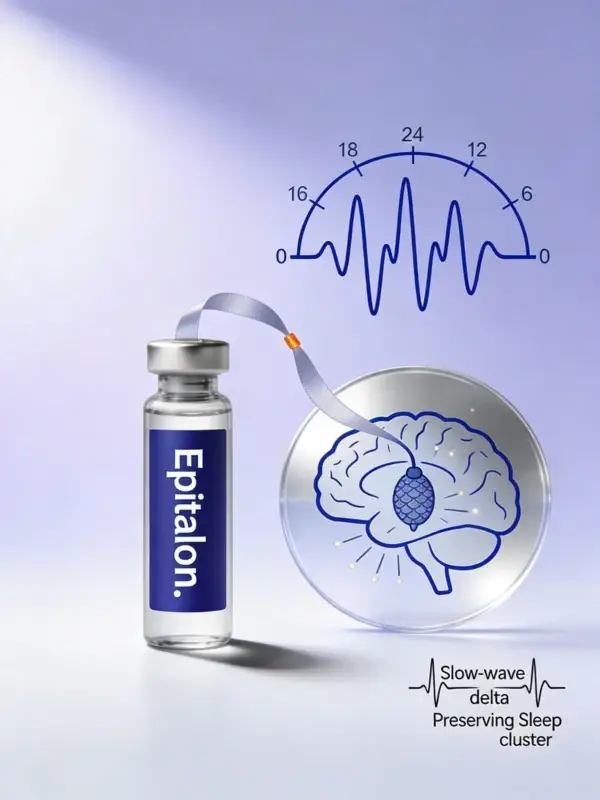
Epitalon — also commonly written Epithalon or Epithalone — extends the Kinetic Compounds Sleep peptide cluster with a compound whose research profile differs substantially from the namesake sleep-inducing peptide DSIP. Where DSIP’s research base spans sleep architecture, stress response, and analgesia across several decades of Western and international literature, Epitalon’s research profile is more concentrated: a sustained Russian research program led by Vladimir Khavinson at the St. Petersburg Institute of Bioregulation and Gerontology, focused on pineal gland function, melatonin synthesis, circadian rhythm, telomerase activity, and aging-related endpoints.
This article addresses Epitalon as a research compound — its structural origins from the natural Epithalamin pineal extract, the multi-target mechanism centered on pineal-melatonin signaling, the research applications spanning sleep, circadian rhythm, telomerase activity, and aging, and the reconstitution and sourcing considerations researchers should understand before working with the compound.
What Is Epitalon?
Epitalon is a synthetic tetrapeptide — a chain of four amino acids — with the sequence Ala-Glu-Asp-Gly. The molecular weight is approximately 390 g/mol, and the CAS registry number is 307297-39-8.
The compound’s origins trace to research on a complex natural extract called Epithalamin, prepared from the pineal glands of cattle and studied since the 1970s in the Soviet Union for effects on aging, immunological function, and circadian rhythms. The Khavinson research group at the Institute of Bioregulation and Gerontology in St. Petersburg identified the tetrapeptide sequence Ala-Glu-Asp-Gly as a representative active fragment from the larger Epithalamin extract and developed it into a synthesizable research compound [Ref. 1]. The synthetic tetrapeptide can be produced reproducibly in laboratory settings, unlike the complex biological extract it was derived from.
Epitalon’s structural simplicity — only four amino acids, all standard residues, no unusual modifications — distinguishes it from larger or more complex research peptides. The compound is among the smallest active peptides in common research use, and its synthesis is straightforward. The structural simplicity has implications for both stability (the compound is stable as a lyophilized powder and reasonably stable in aqueous solution) and analytical verification (the small molecular weight makes mass spectrometry verification unambiguous).
Epitalon has not been approved by FDA, Health Canada, EMA, MHRA, or any other Western regulatory agency for human therapeutic use. The compound has been studied in Russian clinical research and is referenced in some Russian medical contexts, but it does not have prescription pharmaceutical status outside that jurisdiction. Research-grade Epitalon sold for laboratory research is intended exclusively for that purpose.
Mechanism of Action
Epitalon’s mechanism is multi-target, like the other CNS-active peptides in the Sleep and Cognitive clusters. The compound modulates several biological systems through pathways that have been characterized to varying degrees in the published literature.
The mechanistic literature converges on several pathways operating in combination.
Pineal-melatonin signaling. The pineal gland’s primary biochemical role is the synthesis and rhythmic secretion of melatonin, the hormone that regulates circadian rhythm and sleep-wake cycles. Epitalon’s research base centers on the pineal as the primary mechanistic target — the compound has documented effects on melatonin synthesis, melatonin secretion patterns, and pineal cellular activity across multiple research models [Ref. 1, Ref. 3]. This pineal-melatonin pathway is the mechanistic foundation that connects Epitalon to circadian rhythm and sleep architecture research.
Telomerase activation. The most-discussed mechanistic finding in the popular literature surrounding Epitalon is telomerase activation — the compound has been reported to increase telomerase enzymatic activity and to slow telomere shortening in cultured cell systems [Ref. 2]. This finding is the basis for much of the popular interest in Epitalon as a longevity-adjacent research compound. The mechanistic detail has been characterized primarily in the Khavinson group’s research, with less extensive replication in independent Western laboratories.
Antioxidant and gene expression modulation. Epitalon has documented effects on oxidative stress markers and on the expression of genes related to antioxidant defense, DNA repair, and aging-related cellular processes [Ref. 5].
Hypothalamic-pituitary axis modulation. The pineal gland sits within a broader neuroendocrine context, and Epitalon’s research base includes effects on broader hypothalamic-pituitary signaling beyond the direct pineal-melatonin pathway. These effects connect Epitalon mechanistically to immune function, stress response, and broader aging-related neuroendocrine changes.
Chromatin and nuclear effects. Some Khavinson group research has examined Epitalon’s effects on chromatin structure and nuclear organization, providing candidate cellular-level mechanisms for the broader gene expression and aging-related findings [Ref. 5].
The mechanism understanding for Epitalon is more incomplete than for compounds with single dominant receptor targets. The compound clearly modulates multiple biological systems, but the receptor-level details for most of these effects have not been fully characterized in the published literature.
Research Applications
Epitalon research clusters into several primary domains, with substantial Russian clinical research base alongside Western preclinical work.
Circadian rhythm and sleep architecture research
The pineal-melatonin pathway is Epitalon’s primary research domain, and circadian rhythm and sleep-related research is the largest single application area. Studies have examined Epitalon’s effects on melatonin secretion patterns, sleep timing, and circadian rhythm restoration in animal models of aging and circadian rhythm disruption [Ref. 1, Ref. 3]. Clinical research in elderly populations has examined effects on sleep quality, sleep timing, and related quality-of-life endpoints, with findings broadly consistent across the published literature.
Aging-related research
The largest body of Russian clinical and animal research on Epitalon has examined effects in aging populations and aging animal models. Endpoints have included mortality rates, age-related disease incidence, cognitive function, immune function, and various measures of cellular aging [Ref. 4]. The Khavinson group’s mortality and tumor incidence findings in long-term rat studies are the most-cited specific findings in this domain, though replication in independent Western laboratories has been less extensive than for some other research peptides.
Telomerase and cellular aging research
The cell culture research on Epitalon’s effects on telomerase activity and telomere length is the most-discussed mechanistic finding in the popular literature [Ref. 2]. These findings have positioned Epitalon for research interest in cellular aging mechanisms, replicative senescence, and the broader telomere biology literature.
Immunological research
Russian clinical research has examined Epitalon’s effects on immunological parameters in aging populations, including T-cell function, immune cell proliferation, and various inflammatory markers. The pineal-immune axis is a documented physiological connection that provides a plausible mechanistic substrate for these effects.
Cardiovascular and metabolic research
Smaller bodies of research have examined Epitalon’s effects on cardiovascular endpoints and metabolic parameters in aging populations and animal models. These domains are less central to the compound’s overall research profile but contribute to the broader aging-related research base.
Comparative neuropeptide research
Researchers studying CNS-active peptides commonly compare Epitalon with other compounds covered in this research library. Epitalon’s pineal-melatonin emphasis distinguishes it from DSIP‘s broader sleep architecture and stress effects, Selank‘s anxiolytic mechanisms, and Semax‘s neurotrophic emphasis. The compounds operate through different mechanisms but address overlapping research domains in CNS function and aging.
Across all research domains, Epitalon is intended for laboratory research only in the Kinetic Compounds context. The compound has not been evaluated by FDA, Health Canada, or any other Western regulatory agency for human therapeutic use.
Dosing & Reconstitution for Research
Researchers working with lyophilized Epitalon reconstitute the compound with bacteriostatic water before use. The reconstitution math follows the standard concentration-equals-mass-divided-by-volume principle covered in our reconstitution tutorial.
A 10 mg vial of Epitalon reconstituted with 2 mL of bacteriostatic water yields 5 mg/mL. A 20 mg vial in 2 mL yields 10 mg/mL. Epitalon’s small molecular weight (~390 g/mol) places it among the smallest research peptides in common use — molar concentrations are very high per mg compared to larger peptides.
A consideration specific to Epitalon: the compound has a short systemic half-life due to rapid peptidase degradation in plasma. Research protocols designed to maintain Epitalon exposure over extended windows typically use frequent administration or extended-cycle dosing approaches rather than single-administration designs. Russian clinical research protocols commonly use multi-day or multi-week administration cycles.
Researchers can verify their concentration math against our peptide reconstitution calculator, which handles the conversion automatically.
This article does not provide dosing guidance for any therapeutic purpose. Epitalon is not approved for human therapeutic use.
Storage & Handling
Lyophilized Epitalon is stable at room temperature during shipping but should be moved to long-term storage at -20°C (-4°F), protected from light, on receipt. Under proper lyophilized conditions, the compound remains stable for 24 months or longer.
Once reconstituted, Epitalon should be stored at 2–8°C and used within 28 days. The general storage principles for research peptides apply directly — see our storage and stability guide for detailed protocols including freeze-thaw considerations and aliquoting strategies.
Every vial should be visually inspected before use. The reconstituted solution should be clear and free of particulates. Cloudiness, discoloration, or visible sediment indicates degradation, and the vial should not be used in research.
For full handling protocols across the broader peptide catalog, see our storage and reconstitution guide.
Sourcing Verified Epitalon for Research
Epitalon’s very small size (~390 Da) makes mass spectrometry verification straightforward — the molecular weight is small enough to be measured with exceptional accuracy on standard analytical equipment, and the compound’s four-amino-acid sequence is distinctive enough that any mislabeling is easy to detect with proper testing.
A credible Certificate of Analysis for Epitalon should show HPLC purity expressed as a percentage, mass spectrometry confirmation matching ~390 Da, and a clear distinction between peptide content and peptide mass. The principles of reading a research peptide COA are covered in detail in our reading a Certificate of Analysis article, and our specific third-party testing methodology is documented in our Janoshik Analytical methodology article.
Kinetic Compounds tests every batch of Epitalon through Janoshik Analytical, an independent third-party laboratory. Current batch reports are published on the Epitalon product page. Our broader testing methodology is documented on our lab testing and COA page.
For researchers working across CNS-active and aging-related research peptides, DSIP, Selank, and Semax are mechanistically distinct but research-adjacent compounds in the Kinetic Compounds catalog. The full research peptide catalog is available through our shop.
Researching pineal-melatonin signaling, circadian rhythm, telomerase activity, and aging-related peptides? Our complete research peptide catalog covers Epitalon, DSIP, and related research compounds — all independently lab-tested with current Certificates of Analysis available on each product page.
Available for Research
Research Tools
Quality Promise
very batch independently tested by Janoshik Analytical. 98% purity minimum.
Frequently Asked Questions
What is Epitalon?
<p>Epitalon (also written Epithalon or Epithalone) is a synthetic tetrapeptide with the sequence Ala-Glu-Asp-Gly, derived from the natural pineal gland extract Epithalamin. The compound was developed by Vladimir Khavinson's research group at the St. Petersburg Institute of Bioregulation and Gerontology and is studied for pineal-melatonin signaling, circadian rhythm modulation, telomerase activity, and aging-related research applications.</p>
Is Epitalon the same as Epithalamin?
<p>No. Epithalamin is the natural complex extract from cattle pineal glands that contains numerous peptides, lipids, and other constituents. Epitalon is the synthetic tetrapeptide (Ala-Glu-Asp-Gly) identified as a representative active fragment from the Epithalamin extract. Synthetic Epitalon has the advantage of being reproducibly synthesizable, while the natural Epithalamin extract is more chemically complex and less standardized.</p>
What is Epitalon's relationship to telomerase research?
<p>Cell culture research from the Khavinson group has reported that Epitalon increases telomerase enzymatic activity and slows telomere shortening in cultured cell systems. These findings are the basis for much of the popular interest in Epitalon as a longevity-adjacent research compound. The mechanistic detail has been characterized primarily in the Khavinson group's research with less extensive replication in independent Western laboratories. Researchers should evaluate the published literature carefully when designing research protocols.</p>
Is Epitalon approved as a medication?
<p>No. Epitalon has not been approved by FDA, Health Canada, EMA, MHRA, or any other Western regulatory agency. The compound has been used in Russian clinical research contexts, but it does not have prescription pharmaceutical approval outside that jurisdiction. Research-grade Epitalon is intended for laboratory research only.</p>
How is Epitalon different from DSIP?
<p>Both compounds connect to sleep and circadian rhythm research, but the mechanisms and primary research applications differ. DSIP acts through multi-target CNS mechanisms with emphasis on sleep architecture, stress response, analgesia, and anticonvulsant effects. Epitalon acts primarily through pineal-melatonin signaling with research emphasis on circadian rhythm, telomerase activity, and aging-related endpoints. The compounds address overlapping research domains through distinct mechanisms.</p>
How is Epitalon reconstituted for research?
<p>Lyophilized Epitalon is reconstituted with bacteriostatic water. A 10 mg vial in 2 mL yields 5 mg/mL. Standard peptide reconstitution technique applies — inject bacteriostatic water down the inner wall of the vial, swirl gently. Researchers can verify calculations using our reconstitution calculator.</p>
Is research-grade Epitalon legal in Canada?
<p>Research-grade Epitalon is legal to purchase and possess in Canada for laboratory research purposes only. The compound is not approved by Health Canada for human therapeutic use.</p>
References
- "Identification of Peptide AEDG in the Polypeptide Complex of the Pineal Gland." Bulletin of Experimental Biology and Medicine, 164(1):41-43. — Khavinson VKh, Linkova NS, Diatlova AS, Trofimova SV (2017).
- "Epithalon peptide induces telomerase activity and telomere elongation in human somatic cells." Bulletin of Experimental Biology and Medicine, 135(6):590-592. — Khavinson VKh, Bondarev IE, Butyugov AA (2003).
- "Normalizing effect of the pineal gland peptides on the daily melatonin rhythm in old monkeys and elderly people." Advances in Gerontology, 20(1):74-85. — Korkushko OV, Lapin BA, Goncharova ND, Khavinson VKh, et al. (2007).
- "Pineal peptide preparation epithalamin increases the lifespan of fruit flies, mice and rats." Mechanisms of Ageing and Development, 103(2):123-132. — Anisimov VN, Mylnikov SV, Khavinson VK (1998).
- "Peptide Epitalon activates chromatin at the old age." Neuro Endocrinology Letters, 24(5):329-333. — Khavinson VKh, Lezhava TA, Monaselidze JR, et al. (2003).
Continue Reading
For Research Use Only Products described on this site are intended for laboratory research purposes only. They are not approved by Health Canada for human consumption, diagnosis, treatment, or prevention of any medical condition.