
Home / Research Articles / Sermorelin: Mechanism, Research, and Applications
Sermorelin: Mechanism, Research, and Applications
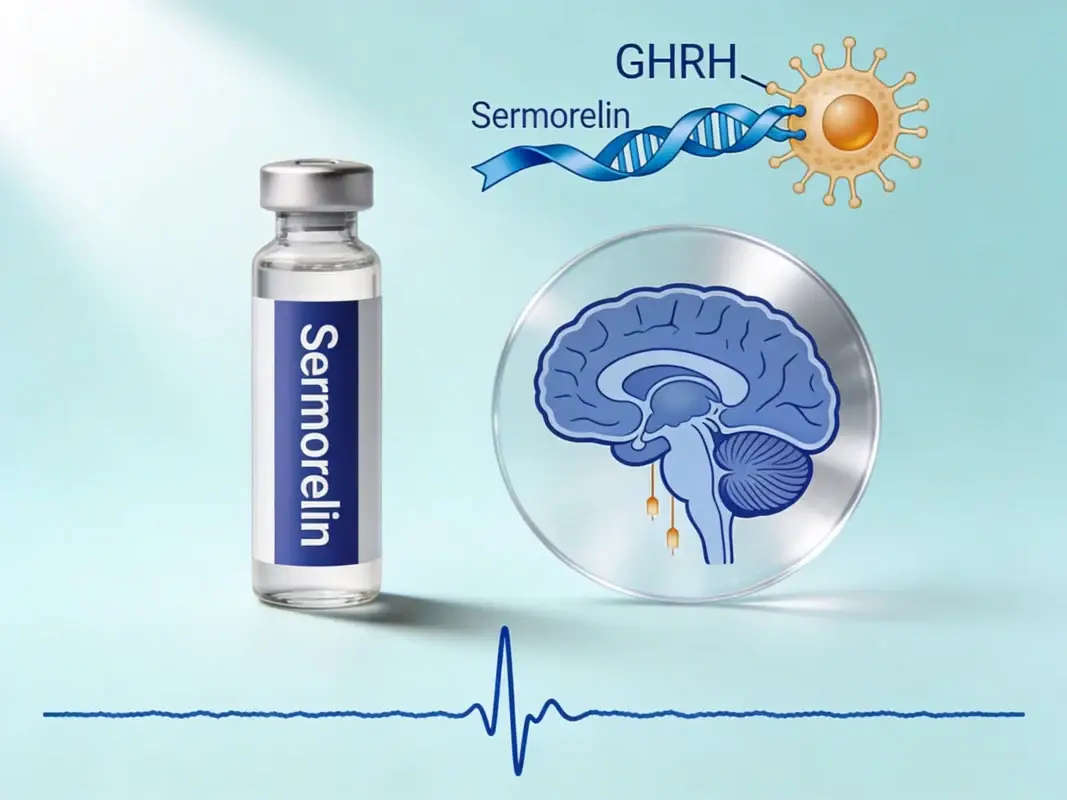
Key Takeaways
- Sermorelin is a synthetic peptide consisting of the first 29 amino acids of growth hormone-releasing hormone (GHRH 1-29) — the minimal active fragment for receptor activation.
- The compound was FDA-approved as Geref by Serono in the 1990s for pediatric growth hormone deficiency and discontinued from commercial markets in the late 2000s for commercial reasons.
- The mechanism is selective GHRH receptor agonism at the anterior pituitary, stimulating natural pulsatile growth hormone release through preserved physiological pathways.
- Research applications include pediatric growth hormone deficiency research, adult GH research, and use as a GHRH stimulation diagnostic agent for pituitary GH reserve assessment.
- The molecular weight is ~3,358 g/mol; research-grade Sermorelin is distinct from any pharmaceutical product and intended for laboratory research only.
Sermorelin extends the Kinetic Compounds Growth Hormone research cluster with a compound that combines several distinctive features within the GHRH-class peptide group: a 29-amino-acid synthetic fragment representing the minimal active GHRH structure, an established Western peer-reviewed literature base spanning four decades, and an FDA approval history (as Geref) that places it alongside Tesamorelin as one of the two GHRH-class peptides to have received Western regulatory approval. Where CJC-1295 represents a modified GHRH analog designed for extended half-life and Tesamorelin is a modified 44-amino-acid analog with N-terminal lipid attachment, Sermorelin is the closest research compound to native GHRH(1-29).
This article addresses Sermorelin as a research compound — its structural relationship to native GHRH, the receptor-canonical mechanism that distinguishes it from multi-target compounds in other clusters, the research applications spanning pediatric GHD, adult GH research, and pituitary function diagnostics, and the reconstitution and sourcing considerations researchers should understand before working with the compound.
What Is Sermorelin?
Sermorelin is a synthetic peptide with the amino acid sequence corresponding to positions 1-29 of human growth hormone-releasing hormone (GHRH). The full sequence is:
Tyr-Ala-Asp-Ala-Ile-Phe-Thr-Asn-Ser-Tyr-Arg-Lys-Val-Leu-Gly-Gln-Leu-Ser-Ala-Arg-Lys-Leu-Leu-Gln-Asp-Ile-Met-Ser-Arg
The molecular weight is approximately 3,358 g/mol, and the CAS registry number is 86168-78-7.
Native human GHRH is a 44-amino-acid peptide (with a 40-amino-acid form also present in some species), and the receptor-active portion of the molecule has been mapped to the N-terminal 29 amino acids. The C-terminal portion of native GHRH (amino acids 30-44) contributes to in vivo stability and circulating half-life but is not required for receptor binding and activation. Sermorelin reproduces the full receptor-active fragment while omitting the C-terminal portion — making it a minimal-structure GHRH receptor agonist [Ref. 1].
Sermorelin was developed in the 1980s and received FDA approval as Geref (Serono Laboratories) in the 1990s for use in the diagnosis and treatment of pediatric growth hormone deficiency [Ref. 2]. The compound was discontinued from commercial pharmaceutical markets in the late 2000s for commercial reasons rather than safety or efficacy concerns — pediatric GHD treatment had shifted predominantly to recombinant growth hormone, reducing commercial demand for GHRH-based therapy. Some pharmacy compounding of Sermorelin continues in the United States under specific regulatory frameworks, though commercial pharmaceutical product is no longer available.
Research-grade Sermorelin sold for laboratory research is distinct from any pharmaceutical product and is intended exclusively for laboratory research purposes.
Mechanism of Action
Sermorelin’s mechanism is receptor-canonical, which distinguishes it from multi-target compounds in the Cognitive and Sleep clusters. The compound binds to the GHRH receptor (GHRHR) — a Class B G protein-coupled receptor expressed predominantly in the anterior pituitary somatotroph cells — and activates intracellular signaling that stimulates growth hormone synthesis and release [Ref. 1, Ref. 3].
The mechanism operates through several specific steps.
GHRH receptor binding. Sermorelin binds to the GHRH receptor at the anterior pituitary, with binding affinity comparable to native GHRH(1-44). The receptor binding produces conformational changes that activate associated G-protein signaling.
cAMP signaling activation. The activated GHRH receptor primarily signals through the Gs/adenylyl cyclase/cAMP pathway, elevating intracellular cAMP levels in somatotroph cells. The cAMP-dependent signaling cascade activates protein kinase A (PKA) and downstream transcription factors that regulate GH gene expression and GH secretory granule release [Ref. 1].
Pulsatile growth hormone release. Sermorelin stimulates pulsatile rather than continuous GH release, preserving the natural rhythmic pattern of endogenous GH secretion. This is mechanistically important because GH biological activity depends on the pulsatile delivery pattern — continuous GH elevation produces different physiological effects than pulsatile elevation, with the latter being closer to the natural physiological pattern [Ref. 5].
Downstream IGF-1 production. GH stimulated by Sermorelin acts on peripheral tissues, particularly the liver, to stimulate production of insulin-like growth factor 1 (IGF-1). IGF-1 mediates many of GH’s biological effects on growth, body composition, and tissue function. Sermorelin’s research outcomes therefore reflect not just direct GH effects but downstream IGF-1-mediated effects as well.
Pharmacokinetics. Sermorelin has a relatively short systemic half-life — approximately 11-12 minutes after intravenous administration in human studies, with somewhat longer effective duration after subcutaneous administration [Ref. 5]. The short half-life means Sermorelin produces a discrete GH pulse following administration rather than sustained GH elevation — distinct from the extended-half-life CJC-1295 with DAC variant that produces sustained GH axis modulation.
Negative feedback respect. Because Sermorelin stimulates endogenous GH release rather than supplying exogenous GH, the resulting GH elevation remains subject to normal negative feedback regulation from circulating IGF-1 and somatostatin. This distinguishes Sermorelin (and other GHRH-class peptides) from exogenous recombinant growth hormone administration, which bypasses the pituitary entirely.
Research Applications
Sermorelin research clusters into several primary domains, with the deepest literature in pediatric growth hormone deficiency where the compound was originally developed and approved.
Pediatric growth hormone deficiency research
The original FDA-approved indication and the deepest body of Sermorelin clinical research. Pediatric GHD research evaluated Sermorelin both as a diagnostic agent (the GHRH stimulation test, used to evaluate pituitary GH reserve in children with growth failure) and as a therapeutic compound (extended Sermorelin administration to stimulate endogenous GH release in children with hypothalamic-origin GHD) [Ref. 2]. The clinical research demonstrated efficacy in well-selected pediatric GHD populations — specifically children with intact pituitary function and GHD arising from hypothalamic GHRH deficiency rather than pituitary GH-cell deficiency.
Adult growth hormone axis research
A substantial body of research has examined Sermorelin’s effects on the adult growth hormone axis, including studies in healthy adults of various ages and adults with various conditions affecting GH/IGF-1 signaling [Ref. 3]. The research has explored GH/IGF-1 dynamics, body composition effects, sleep architecture effects (GH release is heavily concentrated during slow-wave sleep), and various endpoints relevant to the broader understanding of GH biology in adults.
GHRH stimulation test diagnostic research
The use of Sermorelin as a diagnostic agent for evaluating pituitary GH reserve is well-established in the clinical research literature. The GHRH stimulation test administers Sermorelin and measures the subsequent GH response, providing information about pituitary somatotroph function distinct from what other GH stimulation tests (insulin tolerance, arginine, clonidine) provide [Ref. 4].
Comparative GHRH-class research
Researchers studying GHRH-class peptides commonly compare Sermorelin with other compounds in the Kinetic Compounds GH cluster. The relevant comparisons:
- Versus CJC-1295 without DAC (Modified GRF 1-29): essentially the same active receptor structure with additional stability-enhancing modifications in CJC-1295
- Versus CJC-1295 with DAC: substantially longer half-life with sustained GH axis elevation rather than pulsatile pulse
- Versus Tesamorelin: different structural strategy (N-terminal lipid attachment, full 44-amino-acid backbone) and different approved indication profile
- Versus Ipamorelin: different receptor (ghrelin/GHS-R1a rather than GHRH receptor), often used in combination with GHRH-class compounds
Combination protocol research
GHRH-class compounds like Sermorelin are commonly studied in combination with ghrelin receptor agonists like Ipamorelin. The mechanism rationale is that activating both upstream pathways (GHRH receptor + ghrelin receptor) produces synergistic GH release compared to either compound alone. The full mechanism and protocol design is covered in our CJC-1295 + Ipamorelin combination protocol article — the same combination logic applies to Sermorelin + Ipamorelin protocols, with the pharmacokinetic differences between CJC-1295 and Sermorelin (longer half-life vs shorter half-life) being the relevant variable for protocol design.
Across all research domains, Sermorelin is intended for laboratory research only in the Kinetic Compounds context.
Dosing & Reconstitution for Research
Researchers working with lyophilized Sermorelin reconstitute the compound with bacteriostatic water before use. The reconstitution math follows the standard concentration-equals-mass-divided-by-volume principle covered in our reconstitution tutorial.
A 5 mg vial of Sermorelin reconstituted with 2 mL of bacteriostatic water yields 2.5 mg/mL. A 10 mg vial in 2 mL yields 5 mg/mL. Sermorelin’s molecular weight (~3,358 g/mol) places it in a similar range to CJC-1295 without DAC and is substantially smaller than full-length Tesamorelin (~5,135 g/mol).
A consideration specific to Sermorelin: the compound’s short systemic half-life (11-12 minutes IV) means that research protocols designed to maintain GHRH receptor activation require frequent administration. This is mechanistically appropriate for protocols designed to preserve pulsatile GH release patterns but creates operational considerations for chronic administration research. Research protocols using single-administration designs to study acute GH responses align well with Sermorelin’s pharmacokinetic profile.
Researchers can verify their concentration math against our peptide reconstitution calculator, which handles the conversion automatically.
This article does not provide dosing guidance for any therapeutic purpose. Research-grade Sermorelin is intended for laboratory research only.
Storage & Handling
Lyophilized Sermorelin is stable at room temperature during shipping but should be moved to long-term storage at -20°C (-4°F), protected from light, on receipt. Under proper lyophilized conditions, the compound remains stable for 24 months or longer.
Once reconstituted, Sermorelin should be stored at 2–8°C and used within 28 days. The general storage principles for research peptides apply directly — see our storage and stability guide for detailed protocols.
Every vial should be visually inspected before use. The reconstituted solution should be clear and free of particulates. Cloudiness, discoloration, or visible sediment indicates degradation, and the vial should not be used in research.
For full handling protocols across the broader peptide catalog, see our storage and reconstitution guide.
Sourcing Verified Sermorelin for Research
Sermorelin’s structural simplicity (a contiguous 29-amino-acid sequence with no unusual modifications) makes both HPLC purity verification and mass spectrometry identity confirmation straightforward. The compound’s molecular weight (~3,358 g/mol) is distinctive enough from other GH cluster compounds — Ipamorelin at ~711 g/mol, full Tesamorelin at ~5,135 g/mol, CJC-1295 variants at ~3,367 and ~3,648 g/mol — that mass spectrometry verification can clearly distinguish the compounds.
A credible Certificate of Analysis for Sermorelin should show HPLC purity expressed as a percentage, mass spectrometry confirmation matching ~3,358 Da, and a clear distinction between peptide content and peptide mass. The principles of reading a research peptide COA are covered in detail in our reading a Certificate of Analysis article, and our specific third-party testing methodology is documented in our Janoshik Analytical methodology article.
Kinetic Compounds tests every batch of Sermorelin through Janoshik Analytical, an independent third-party laboratory. Current batch reports are published on the Sermorelin product page. Our broader testing methodology is documented on our lab testing and COA page.
For researchers working across the GH cluster, CJC-1295, Ipamorelin, and Tesamorelin are mechanistically related but structurally distinct compounds in the Kinetic Compounds catalog. The full research peptide catalog is available through our shop.
Researching the growth hormone axis and GHRH-class research peptides? Our complete research peptide catalog covers Sermorelin, CJC-1295, Ipamorelin, Tesamorelin, and related GH research compounds — all independently lab-tested with current Certificates of Analysis available on each product page.
Related Peptides
Related peptides will load here via PHP snippet.
Available for Research
Research Tools
Quality Promise
very batch independently tested by Janoshik Analytical. 98% purity minimum.
Frequently Asked Questions
What is Sermorelin?
<p>Sermorelin is a synthetic peptide consisting of the first 29 amino acids of growth hormone-releasing hormone (GHRH), the minimal active fragment responsible for GHRH's pituitary-stimulating activity. The compound acts as a selective GHRH receptor agonist at the anterior pituitary, stimulating natural pulsatile growth hormone release.</p>
Is Sermorelin FDA-approved?
<p>Sermorelin was FDA-approved as Geref (Serono Laboratories) for pediatric growth hormone deficiency in the 1990s and was discontinued from commercial pharmaceutical markets in the late 2000s for commercial reasons rather than safety or efficacy concerns. The historical approval distinguishes Sermorelin from compounds that have never been approved, but the commercial pharmaceutical product is not currently marketed. Research-grade Sermorelin sold for laboratory research is distinct from any pharmaceutical product.</p>
How is Sermorelin different from CJC-1295?
<p>CJC-1295 without DAC (Modified GRF 1-29) has essentially the same active receptor structure as Sermorelin but with amino acid modifications that increase enzymatic stability. CJC-1295 with DAC adds a drug affinity complex that produces substantially extended half-life and sustained GH axis elevation. Sermorelin produces shorter, more pulsatile GH responses; CJC-1295 with DAC produces sustained GH axis modulation.</p>
Is Sermorelin used in combination with Ipamorelin?
<p>Yes, Sermorelin and Ipamorelin combinations are studied in research the same way CJC-1295 + Ipamorelin combinations are studied — by activating both the GHRH receptor (with Sermorelin) and the ghrelin receptor (with Ipamorelin) for synergistic GH release. The pharmacokinetic difference (Sermorelin's shorter half-life vs CJC-1295's longer half-life) influences protocol design.</p>
What is the GHRH stimulation test?
<p>The GHRH stimulation test administers Sermorelin and measures the subsequent growth hormone response. It is a diagnostic test for evaluating pituitary GH reserve, providing information about pituitary somatotroph function distinct from other GH stimulation tests like the insulin tolerance test. The test is used clinically in evaluating suspected growth hormone deficiency.</p>
How is Sermorelin reconstituted for research?
<p>Lyophilized Sermorelin is reconstituted with bacteriostatic water. A 5 mg vial in 2 mL yields 2.5 mg/mL. Standard peptide reconstitution technique applies — inject bacteriostatic water down the inner wall of the vial, swirl gently. Researchers can verify calculations using our reconstitution calculator.</p>
Is research-grade Sermorelin legal in Canada?
<p>Research-grade Sermorelin is legal to purchase and possess in Canada for laboratory research purposes only. The compound is not currently approved by Health Canada as a marketed pharmaceutical product.</p>
References
- "Regulation of the pituitary somatotroph cell by GHRH and its receptor." Recent Progress in Hormone Research, 55:237-266. — Mayo KE, Miller T, DeAlmeida V, Godfrey P, Zheng J, Cunha SR (2000).
- "Sermorelin: a review of its use in the diagnosis and treatment of children with idiopathic growth hormone deficiency." BioDrugs, 12(2):139-157. — Prakash A, Goa KL (1999).
- "The Safety and Efficacy of Growth Hormone Secretagogues." Sexual Medicine Reviews, 6(1):45-53. — Sigalos JT, Pastuszak AW (2018).
- "Cut-off limits of the GH response to GHRH plus arginine test and IGF-I levels for the diagnosis of GH deficiency in late adolescents and young adults." European Journal of Endocrinology, 157(6):701-708. — Corneli G, Di Somma C, Prodam F, Bellone J, Baldelli R, Rovere S, Schneider HJ, Gasco V, Ghigo
- "Human pulsatile growth hormone (GH) secretion and the somatomedins." Endocrine Reviews / Pulsatile GH Release Pharmacology. — Veldhuis JD, Bowers CY (2001).
Continue Reading
For Research Use Only Products described on this site are intended for laboratory research purposes only. They are not approved by Health Canada for human consumption, diagnosis, treatment, or prevention of any medical condition.