
Home / Research Articles / Survodutide SYNCHRONIZE-1: 16.6% Weight Loss in Phase 3 Dual Agonist Trial
Survodutide SYNCHRONIZE-1: 16.6% Weight Loss in Phase 3 Dual Agonist Trial
Key Takeaways
- Survodutide is an investigational dual GLP-1/glucagon receptor agonist developed by Boehringer Ingelheim and Zealand Pharma, currently in Phase 3 clinical trials.
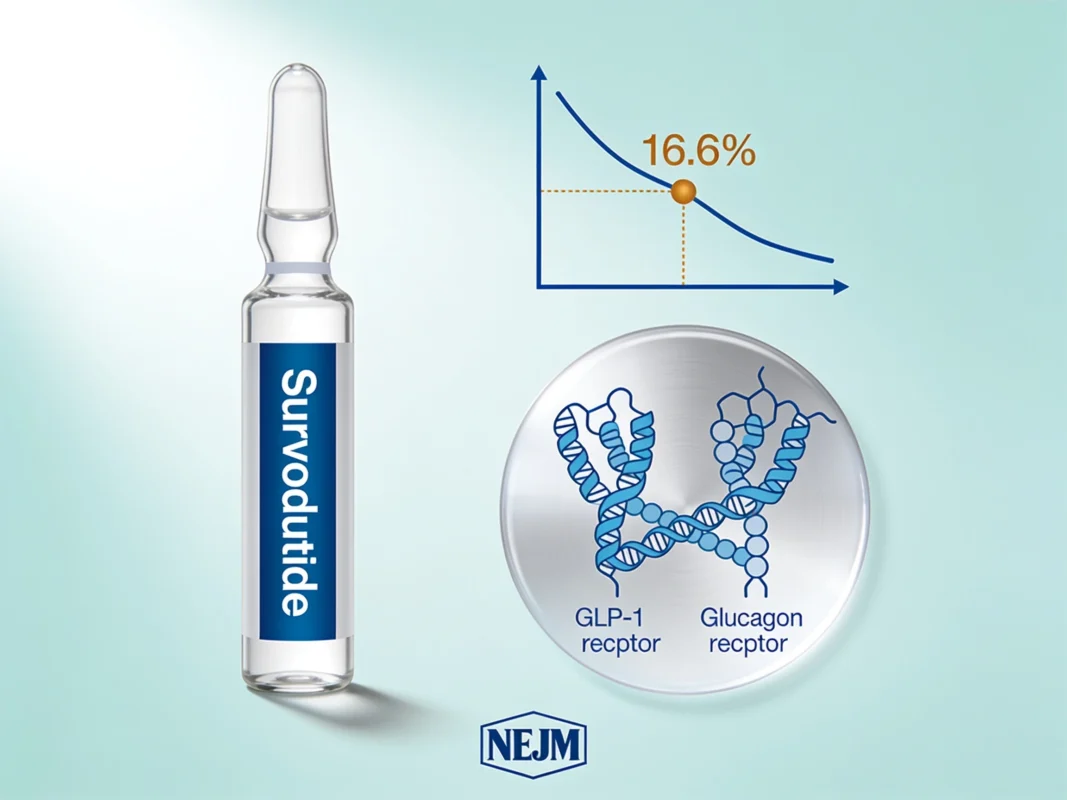
- The Phase 3 SYNCHRONIZE-1 trial showed survodutide delivered 16.6% average weight loss at 76 weeks in adults with obesity or overweight without type 2 diabetes.
- The trial met both co-primary endpoints — 85.1% of survodutide patients achieved ≥5% body weight reduction at 76 weeks versus much lower placebo rates.
- SYNCHRONIZE-1 results were simultaneously published in The New England Journal of Medicine at the 2026 ADA Scientific Sessions — peer-reviewed validation of the data.
- Survodutide is investigational and not approved by FDA, Health Canada, or any regulatory agency — the trial outcomes inform research but do not change current regulatory status.
Boehringer Ingelheim and Zealand Pharma announced detailed Phase 3 SYNCHRONIZE-1 results at the American Diabetes Association’s 86th Scientific Sessions in New Orleans on June 7, 2026, with simultaneous publication in The New England Journal of Medicine [Ref. 1]. The 725-participant trial demonstrated that survodutide — an investigational dual GLP-1/glucagon receptor agonist — produced sustained weight loss of 16.6% over 76 weeks in adults with obesity or overweight without type 2 diabetes, establishing the compound as a clinically meaningful entry in the rapidly expanding cardiometabolic peptide pipeline.
This article addresses the SYNCHRONIZE-1 detailed outcomes, what they mean for the broader incretin pharmacology landscape, and how survodutide compares mechanistically to the other major investigational and approved compounds in the GLP-1 class. The article complements our broader ADA 2026 outcomes summary with focused single-compound coverage of one of the conference’s most consequential individual presentations.
SYNCHRONIZE-1 Detailed Results
The Phase 3 SYNCHRONIZE-1 trial was a 76-week, double-blind, randomized, placebo-controlled study that enrolled 725 adults with body mass index (BMI) of 30 or greater, or 27 or greater with at least one obesity-related complication, excluding type 2 diabetes [Ref. 3]. Participants were randomized 1:1:1 to receive once-weekly subcutaneous survodutide adjusted up to 3.6 mg (n=241) or 6.0 mg (n=242), or placebo (n=242), alongside counseling for reduced-calorie diet and increased physical activity.
The headline efficacy outcomes [Ref. 1, Ref. 2, Ref. 3]:
| Endpoint | Survodutide outcome |
|---|---|
| Average weight loss at 76 weeks (efficacy estimand) | 16.6% |
| Placebo arm weight loss at 76 weeks | 3.2% |
| Statistical significance | p<0.0001 |
| Participants achieving ≥5% body weight reduction | Up to 85.1% (survodutide vs lower placebo rate) |
| Co-primary endpoints | Both met using efficacy and treatment-regimen estimands |
Comparator context. The 16.6% weight loss figure places survodutide in the ballpark of Novo Nordisk’s Wegovy (semaglutide 2.4 mg) at originally approved maximum dose — which produced approximately 15-17% weight loss at 68 weeks in the STEP 1 trial. It falls short of Eli Lilly’s Zepbound (tirzepatide) maximum-dose weight loss outcomes (~22.5% in SURMOUNT-1) and substantially short of Retatrutide’s TRIUMPH-1 outcomes (25.0% at 80 weeks on 12 mg, up to 30% in the severe obesity subgroup — covered in our TRIUMPH-1 Phase 3 results article).
Metabolic gains beyond weight loss. A particularly significant element of the SYNCHRONIZE-1 detailed data was reductions in liver fat content and visceral adiposity that appeared disproportionate to overall weight loss — suggesting that survodutide’s dual GLP-1/glucagon mechanism may confer metabolic benefits independent of total pounds shed [Ref. 3]. The compound also showed potentially better preservation of lean mass than other comparable therapies — an early signal that warrants further investigation in head-to-head comparison trials.
What Makes Survodutide Different — The Dual GLP-1/Glucagon Mechanism
Survodutide’s mechanism is what distinguishes it within the broader incretin pharmacology landscape. The compound is designed as a dual receptor agonist that activates both the GLP-1 receptor and the glucagon receptor — a fundamentally different receptor combination than the dual GIP/GLP-1 mechanism of Tirzepatide or the triple GIP/GLP-1/glucagon mechanism of Retatrutide.
The mechanism rationale for combining GLP-1 and glucagon receptor activation:
- GLP-1 component: Provides the established GLP-1 receptor effects — glucose-dependent insulin secretion, glucagon suppression (under normal physiological conditions), gastric emptying delay, and central appetite/food intake effects
- Glucagon component: Adds hepatic effects (glucose production modulation, hepatic lipid metabolism), energy expenditure increases, and potential synergistic body weight effects beyond what GLP-1 alone produces
The mechanism placement sits between Semaglutide (single GLP-1 agonist) and Retatrutide (triple agonist adding GIP) within the broader incretin landscape. Where Tirzepatide adds GIP to the GLP-1 backbone, survodutide adds glucagon — producing different downstream effects through different receptor pathway combinations.
The complete head-to-head comparison of three generations of incretin pharmacology is covered in our Semaglutide vs Tirzepatide vs Retatrutide trilateral comparison. Survodutide will eventually warrant a focused comparison article as the compound progresses through additional Phase 3 trials.
The SYNCHRONIZE Program
SYNCHRONIZE-1 is one part of a comprehensive global Phase 3 obesity program evaluating survodutide across multiple patient populations [Ref. 2]. The complete program includes:
- SYNCHRONIZE-1 — obesity/overweight without type 2 diabetes (results just presented)
- SYNCHRONIZE-2 — obesity/overweight WITH type 2 diabetes
- SYNCHRONIZE-CVOT — long-term cardiovascular safety study in obesity with cardiovascular disease, chronic kidney disease, or cardiovascular risk factors
- SYNCHRONIZE-MASLD — metabolic dysfunction-associated steatotic liver disease with obesity (results also presented at ADA 2026)
- SYNCHRONIZE-HERA — women’s health (initiating later in 2026)
- LIVERAGE and LIVERAGE-Cirrhosis — MASH and fibrosis stages 2-3, and compensated MASH cirrhosis (fibrosis stage 4)
- ELEVATE-LIVER — additional liver disease assessment
The breadth of the SYNCHRONIZE program reflects Boehringer Ingelheim’s ambitious positioning of survodutide as a multi-indication cardiometabolic compound rather than a single-indication obesity drug. Additional trial results are expected to read out through the remainder of 2026.
SYNCHRONIZE-MASLD detail. The companion MASLD trial — also presented at ADA 2026 and simultaneously published in Nature Medicine — showed that 6 out of 10 participants with metabolic dysfunction-associated steatotic liver disease reached liver fat normalization after 48 weeks of survodutide treatment [Ref. 1]. The liver fat normalization finding is clinically significant given the growing focus on MASLD/MASH as a major area of cardiometabolic disease research.
Beyond Survodutide — Boehringer Ingelheim’s Broader Pipeline
Survodutide is the first compound in what Boehringer Ingelheim characterizes as a broader portfolio of obesity and cardiometabolic therapeutics [Ref. 2]. The company has also disclosed an investigational triple GLP-1/GIP/NPY2 receptor agonist peptide (BI 3034701) — distinct from Retatrutide’s GLP-1/GIP/glucagon triple agonist mechanism — entering Phase 2 trials. The NPY2 receptor addition represents a novel mechanism direction not present in any currently approved or near-approval obesity compound.
This pipeline depth signals that Boehringer Ingelheim is positioning itself as a serious competitor to Eli Lilly and Novo Nordisk in the cardiometabolic peptide space — with mechanism diversity that explores receptor combinations beyond the GIP-focused dual and triple agonists that have defined the field over the past several years.
How Survodutide Sits in the Broader Obesity Pipeline
The post-ADA 2026 obesity pipeline landscape includes several compounds with confirmed Phase 3 data:
| Compound | Mechanism | Phase 3 weight loss benchmark | Regulatory status |
|---|---|---|---|
| Semaglutide (Wegovy) | Single GLP-1 agonist | ~15-17% at 68 weeks (STEP 1, 2.4 mg) | FDA-approved |
| Tirzepatide (Zepbound) | Dual GIP/GLP-1 agonist | ~22.5% at 72 weeks (SURMOUNT-1, 15 mg) | FDA-approved |
| Survodutide | Dual GLP-1/glucagon agonist | 16.6% at 76 weeks (SYNCHRONIZE-1) | Investigational |
| Retatrutide | Triple GIP/GLP-1/glucagon agonist | 25.0% at 80 weeks (TRIUMPH-1, 12 mg) | Investigational |
| CagriSema | Cagrilintide + semaglutide combination | 14.2% at 68 weeks in T2D (REIMAGINE 2) | Investigational |
The clinical positioning of survodutide depends substantially on how its mechanism-specific benefits (liver fat reduction, lean mass preservation, metabolic gains beyond weight loss) compare against the higher-magnitude weight loss outcomes of Tirzepatide and Retatrutide. The full clinical positioning will become clearer as additional SYNCHRONIZE program trials read out and as eventual head-to-head comparison trials inform comparative effectiveness understanding.
What This Means for Research
The SYNCHRONIZE-1 outcomes inform the broader peptide research landscape in several ways relevant for researchers working with research-grade compounds.
Dual GLP-1/glucagon mechanism Phase 3-validated. The dual GLP-1/glucagon receptor agonist mechanism has now received Phase 3 validation. This is mechanistically significant — establishing that glucagon receptor co-activation alongside GLP-1 activation produces meaningful clinical outcomes distinct from GLP-1 alone or GIP/GLP-1 dual mechanism.
Mechanism diversity continues expanding. The broader incretin landscape now includes Phase 3-validated single-agonist (Semaglutide), dual GIP/GLP-1 (Tirzepatide), dual GLP-1/glucagon (Survodutide), triple GIP/GLP-1/glucagon (Retatrutide), and amylin/GLP-1 combination (CagriSema) approaches. The mechanism diversity supports research designs comparing across receptor combinations.
MASLD becomes a major Phase 3 endpoint. The SYNCHRONIZE-MASLD liver fat normalization data positions metabolic dysfunction-associated steatotic liver disease as a major active research area for cardiometabolic peptides. This complements the broader 2026 ADA Standards of Care emphasis on cardiometabolic risk reduction beyond glycemic control alone.
Regulatory framing remains unchanged. Survodutide remains investigational and not approved by FDA, Health Canada, EMA, or any other regulatory agency regardless of the strength of the Phase 3 data presented. Research-grade material continues to be intended for laboratory research only.
Sourcing Research-Grade Compounds
Survodutide is not currently available as research-grade material from Kinetic Compounds as the compound is still in active Phase 3 clinical development. For researchers studying GLP-1-class compounds in laboratory contexts, Semaglutide, Tirzepatide, and Retatrutide are available through the Kinetic Compounds catalog with batch-specific Certificates of Analysis from Janoshik Analytical published on each product page.
Complete mechanism and research background for these compounds is covered in our individual deep dives: Semaglutide, Tirzepatide, and Retatrutide, with head-to-head comparisons in our GLP-1 trilateral comparison and Semaglutide vs Retatrutide focused comparison.
Research-grade material is intended exclusively for laboratory research and is not a substitute for any approved pharmaceutical product or investigational compound in clinical trials.
For deeper research background on the GLP-1-class compounds available as research-grade material, see our deep dives on Semaglutide, Tirzepatide, and Retatrutide. Research-grade material for laboratory research is available through our research peptide catalog with current Certificates of Analysis on every product page.
Available for Research
Research Tools
Quality Promise
very batch independently tested by Janoshik Analytical. 98% purity minimum.
Frequently Asked Questions
What is survodutide?
<p>Survodutide (also known as BI 456906) is an investigational dual receptor agonist developed by Boehringer Ingelheim and Zealand Pharma that simultaneously activates the GLP-1 receptor and the glucagon receptor. The compound is being studied for obesity, type 2 diabetes, metabolic dysfunction-associated steatotic liver disease (MASLD), and broader cardiometabolic conditions.</p>
What did SYNCHRONIZE-1 show?
<p>The Phase 3 SYNCHRONIZE-1 trial showed that survodutide produced 16.6% average weight loss at 76 weeks in 725 adults with obesity or overweight without type 2 diabetes, versus 3.2% in the placebo arm (p<0.0001). The trial met both co-primary endpoints, with up to 85.1% of survodutide patients achieving at least 5% body weight reduction. Results were simultaneously published in The New England Journal of Medicine.
</p>
Is survodutide FDA-approved?
<p>No. Survodutide is investigational and not approved by FDA, Health Canada, EMA, or any other regulatory agency. The compound has FDA Fast Track and Breakthrough Therapy designations supporting accelerated regulatory review pathways, but no formal approval has been granted. Phase 3 trials are ongoing.</p>
How does survodutide compare to Wegovy and Zepbound?
<p>Survodutide's 16.6% weight loss at 76 weeks is similar to Wegovy (semaglutide 2.4 mg, ~15-17% at 68 weeks in STEP 1) but falls short of Zepbound (tirzepatide, ~22.5% at 72 weeks in SURMOUNT-1). The compound's unique mechanism — dual GLP-1/glucagon receptor activation rather than the dual GIP/GLP-1 of Tirzepatide — produces different downstream effects including potential metabolic gains beyond pure weight loss, lean mass preservation signals, and liver fat reduction effects.</p>
What is the SYNCHRONIZE program?
<p>SYNCHRONIZE is a comprehensive global Phase 3 obesity program evaluating survodutide across multiple patient populations — SYNCHRONIZE-1 (obesity without T2D), SYNCHRONIZE-2 (obesity with T2D), SYNCHRONIZE-CVOT (cardiovascular outcomes), SYNCHRONIZE-MASLD (metabolic dysfunction-associated steatotic liver disease), and SYNCHRONIZE-HERA (women's health). Additional trials read out through 2026 and beyond.</p>
What is the difference between survodutide and retatrutide?
<p>Both are investigational multi-receptor incretin agonists, but the receptor combinations differ. Survodutide is a dual GLP-1/glucagon receptor agonist (Boehringer Ingelheim/Zealand Pharma). Retatrutide is a triple GIP/GLP-1/glucagon receptor agonist (Eli Lilly). Retatrutide adds GIP receptor activation to the GLP-1/glucagon combination, producing larger weight loss magnitude (25-30% in TRIUMPH-1 vs 16.6% in SYNCHRONIZE-1).</p>
Is survodutide available as research-grade material?
<p>Survodutide is not currently available as research-grade material from Kinetic Compounds as the compound is still in active Phase 3 clinical development. For research-grade GLP-1-class compounds, Semaglutide, Tirzepatide, and Retatrutide are available for laboratory research only through our catalog with full Certificates of Analysis.</p>
References
- "Boehringer Ingelheim's novel glucagon/GLP-1 dual agonist survodutide achieved significant weight loss of 16.6% delivering meaningful metabolic improvement in people with obesity or overweight in Phase III trial." Boehringer Ingelheim press release. — Boehringer Ingelheim (June 7, 2026).
- "Boehringer Ingelheim announces positive topline results from Phase III SYNCHRONIZE-1 obesity trial." Boehringer Ingelheim press release. — Boehringer Ingelheim (April 28, 2026).
- "Survodutide Phase 3 Data Signal Metabolic Gains Beyond Weight Loss." American Journal of Managed Care. — AJMC Editorial Team (June 2026).
- "Boehringer links dual agonist to 16.6% weight loss in Phase 3, leaves key questions unanswered." FierceBiotech. — FierceBiotech Editorial Team (June 2026).
- "GLP-1 Drugs 2026: ADA Sessions Close as New Standards End Single-Goal Diabetes Care." TechTimes. — TechTimes Editorial Team (June 8, 2026).
Continue Reading
For Research Use Only Products described on this site are intended for laboratory research purposes only. They are not approved by Health Canada for human consumption, diagnosis, treatment, or prevention of any medical condition.