
Home / Research Articles / Kisspeptin: Mechanism, Research, and Applications
Kisspeptin: Mechanism, Research, and Applications
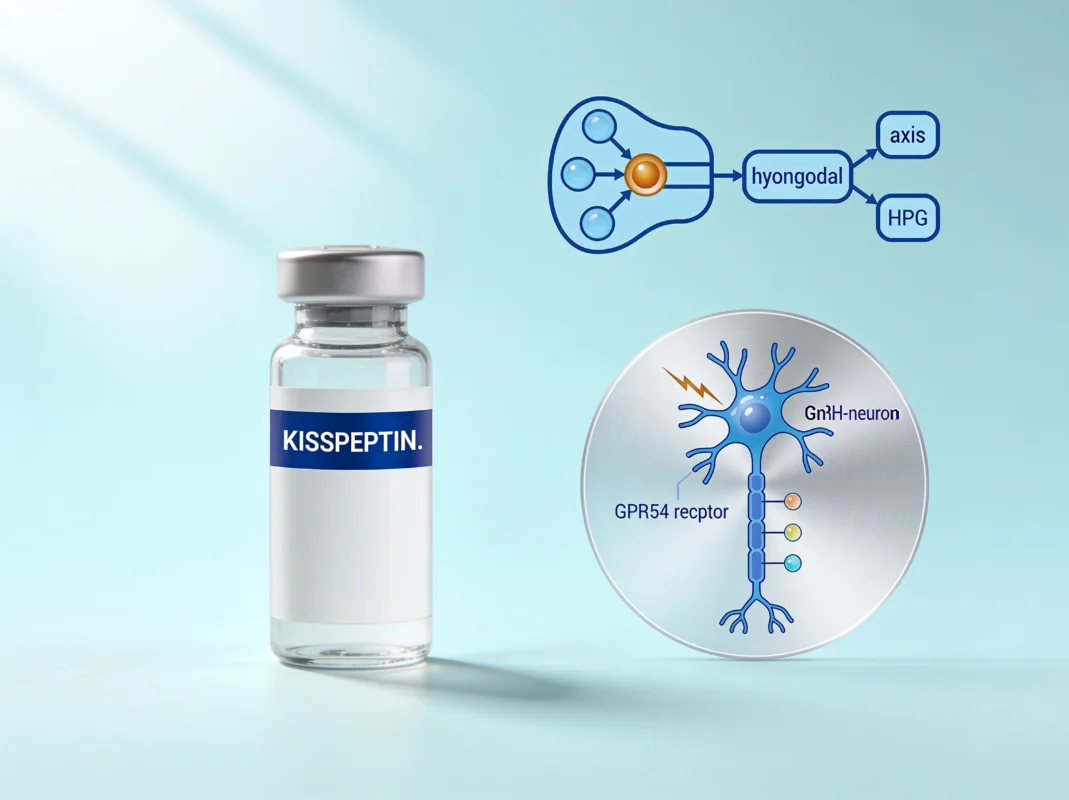
Key Takeaways
- Kisspeptin (the KP-10 decapeptide, Metastin 45–54) is the shortest biologically active fragment of the KISS1 gene product — sequence Tyr-Asn-Trp-Asn-Ser-Phe-Gly-Leu-Arg-Phe-NH2.
- Its mechanism is high-affinity agonism at the KISS1R/GPR54 receptor on GnRH neurons, driving GnRH secretion and downstream LH and FSH release.
- Research applications cluster around the hypothalamic-pituitary-gonadal (HPG) axis and reproduction, plus a distinct body of work on sexual and emotional brain processing.
- Kisspeptin is not approved by FDA, Health Canada, EMA, or any Western regulatory agency for human therapeutic use — research-grade only.
- Molecular weight is approximately 1302 g/mol; supplied as lyophilized powder for reconstitution with bacteriostatic water, with a notably short plasma half-life in research models.
Kisspeptin extends the Kinetic Compounds Sexual Function research cluster with a compound that acts at the very top of the reproductive hormonal cascade. Where PT-141 (bremelanotide) operates through central melanocortin receptors to influence sexual arousal, Kisspeptin works one level further upstream in reproductive neuroendocrinology — it is one of the most potent known stimulators of gonadotropin-releasing hormone (GnRH) neurons, the master switch of the hypothalamic-pituitary-gonadal axis. This places Kisspeptin at the center of two overlapping but distinct research conversations: the control of reproduction and fertility, and the neuroscience of sexual and emotional behavior.
This article addresses Kisspeptin — specifically the active KP-10 decapeptide — as a research compound: its structural origin as the shortest active fragment of the KISS1 gene product, the GPR54-mediated mechanism that makes it such a potent activator of the reproductive axis, the research applications spanning HPG-axis physiology through sexual and emotional brain processing, and the reconstitution and sourcing considerations researchers should understand before working with the compound.
What Is Kisspeptin?
The kisspeptins are a family of peptides encoded by the KISS1 gene. The research compound supplied as Kisspeptin is the decapeptide KP-10 — ten amino acids, sequence Tyr-Asn-Trp-Asn-Ser-Phe-Gly-Leu-Arg-Phe-NH₂ — corresponding to residues 112–121 of the KISS1 gene product, also known as Metastin (45–54). The molecular weight is approximately 1302 g/mol (formula C₃₃H₈₃N₁₇O₁₄), and the C-terminus is amidated, a feature important to its receptor activity.
The KISS1 gene product is cleaved into several peptides of differing lengths — most notably kisspeptin-54 (KP-54, the original “metastin”) and shorter fragments down to KP-10. All share the same C-terminal decapeptide region, and that shared region is what binds the receptor. As a result, KP-10 retains essentially the full receptor-binding capacity of the larger variants, acting as a complete, high-affinity agonist at the kisspeptin receptor (KISS1R, also called GPR54) with in-vitro potency comparable to kisspeptin-54 [Ref. 1]. A practical research distinction is that the longer KP-54 tends to show more potent and longer-lasting effects in vivo, attributed in part to KP-10’s shorter plasma half-life and more rapid degradation.
Because kisspeptin sits at the apex of the reproductive axis, its biology has been studied intensively since the discovery that loss-of-function mutations in GPR54 cause hypogonadotropic hypogonadism and absent puberty in humans and mice — establishing kisspeptin-GPR54 signaling as essential for normal reproductive function [Ref. 1].
Kisspeptin has not been approved by FDA, Health Canada, EMA, MHRA, or any other Western regulatory agency for human therapeutic use. The compound is currently in preclinical and clinical research stages, with research interest in reproductive neuroendocrinology and sexual/emotional brain processing driving most current investigation. Research-grade Kisspeptin sold for laboratory research is intended exclusively for that purpose.
Mechanism of Action
Kisspeptin’s mechanism centers on a single high-affinity receptor target — KISS1R/GPR54 — but its downstream effects ripple through the entire reproductive endocrine cascade.
KISS1R/GPR54 receptor agonism. Kisspeptin binds GPR54, a Gq-coupled G-protein-coupled receptor expressed densely on GnRH neurons in the hypothalamus [Ref. 1]. This is the defining action of the compound and the reason it is studied as a research tool for probing the reproductive axis.
GnRH neuron activation via PLCβ signaling. Receptor binding activates phospholipase C-beta (PLCβ), which cleaves PIP₂ into the second messengers IP₃ and DAG. Functionally, kisspeptin inhibits A-type and inwardly rectifying potassium currents while activating non-selective TRPC cation currents, producing a long-lasting depolarization and a marked increase in GnRH neuron action-potential firing [Ref. 4]. The net result is potent, sustained stimulation of GnRH release.
Downstream gonadotropin secretion. Increased GnRH release acts on the anterior pituitary to drive secretion of luteinizing hormone (LH) and follicle-stimulating hormone (FSH). In human research, Kisspeptin administration produces significant increases in circulating LH — and increases LH pulse frequency — with accompanying rises in FSH and downstream gonadal steroids such as estradiol and testosterone [Ref. 2]. This places the compound functionally upstream of the entire HPG hormonal output.
Central nervous system effects beyond the hypothalamus. Kisspeptin receptors are also expressed in limbic brain regions involved in emotion and sexual behavior. Functional imaging research shows Kisspeptin administration modulates activity and connectivity in these structures, independent of its classical hypothalamic role [Ref. 3]. This dual central action — reproductive-axis driver and limbic modulator — is a defining feature of kisspeptin neurobiology.
Compound distinction. Unlike PT-141, which acts through central melanocortin receptors, Kisspeptin acts through the entirely separate KISS1R/GPR54 system and influences sexual and reproductive physiology by a different route — upstream hormonal activation plus limbic modulation rather than melanocortin signaling. This makes the two compounds mechanistically distinct research tools within the same broad domain.
Research Applications
Kisspeptin research clusters into two primary domains, with the deepest literature in reproductive-axis physiology and a rapidly growing body of work in sexual and emotional neuroscience.
Hypothalamic-pituitary-gonadal (HPG) axis and reproduction. The most extensively studied Kisspeptin domain. Both central and peripheral administration stimulate the HPG axis in animal models, and human studies have repeatedly documented robust LH responses [Ref. 2]. Research has examined Kisspeptin as a probe of reproductive-axis function across the lifespan — including changes in axis responsiveness during the pubertal transition, age-dependent differences in healthy men, and reactivation of the hypothalamic-pituitary-ovarian axis in models of hyperprolactinemia-associated amenorrhea. Because kisspeptin is required for the onset of puberty and for follicular development, oocyte maturation, and ovulation, it is a central tool in fertility and reproductive-endocrinology research.
Sexual and emotional brain processing. A distinct and influential research domain. Functional MRI studies have shown that Kisspeptin administration enhances activity in limbic brain structures in response to sexual and romantic stimuli, modulates resting-state brain connectivity including the default mode network, and is associated with reduced sexual aversion and enhanced mood-related connectivity [Ref. 3][Ref. 5]. This work has driven research interest in kisspeptin as a probe of psychosexual and emotional regulation, distinct from its hormonal role.
Broader research domains. Kisspeptin has additionally been studied across:
- Puberty onset and timing research
- Female reproductive physiology (follicular development, ovulation)
- Hypothalamic amenorrhea and reproductive dysfunction models
- KISS1 signaling in non-reproductive tissues (the gene was originally identified as a metastasis-suppressor)
- Comparative pharmacology with kisspeptin-54 and other KISS1R agonists
Combination and comparative research with cluster siblings. Within the Sexual Function cluster, Kisspeptin and PT-141 are mechanistically non-overlapping — kisspeptin acting upstream through the reproductive axis and limbic system, PT-141 through central melanocortin receptors. Comparative research designs examining the two address different nodes of sexual and reproductive physiology. See our PT-141 (Bremelanotide) article for context on the melanocortin mechanism.
Across all research domains, research-grade Kisspeptin is intended for laboratory research only in the Kinetic Compounds context. The compound has not been evaluated by FDA, Health Canada, or any other Western regulatory agency for human therapeutic use.
Dosing & Reconstitution for Research
Researchers working with lyophilized Kisspeptin reconstitute the compound with bacteriostatic water before use. The reconstitution math follows the standard concentration-equals-mass-divided-by-volume principle covered in our reconstitution tutorial.
A 5 mg vial of Kisspeptin reconstituted with 2 mL of bacteriostatic water yields 2.5 mg/mL. A 10 mg vial in 2 mL yields 5 mg/mL. A consideration specific to Kisspeptin (KP-10) is its short plasma half-life in research models — the compound is degraded relatively rapidly compared with the longer kisspeptin-54 variant, which is a frequent variable in research design and a common reason researchers compare the two fragments directly.
Researchers can verify their concentration math against our peptide reconstitution calculator, which handles the conversion automatically.
This article does not provide dosing guidance for any therapeutic purpose. Research-grade Kisspeptin is intended for laboratory research only.
Storage & Handling
Lyophilized Kisspeptin is stable at room temperature during shipping but should be moved to long-term storage at -20°C (-4°F), protected from light, on receipt. Under proper lyophilized conditions, the compound remains stable for 24 months or longer.
Once reconstituted, Kisspeptin should be stored at 2–8°C and used within 28 days. The general storage principles for research peptides apply directly — see our storage and stability guide for detailed protocols including freeze-thaw considerations and aliquoting strategies.
Every vial should be visually inspected before use. The reconstituted solution should be clear and free of particulates. Cloudiness, discoloration, or visible sediment indicates degradation, and the vial should not be used in research.
For full handling protocols across the broader peptide catalog, see our storage and reconstitution guide.
Sourcing Verified Kisspeptin for Research
Kisspeptin’s defined decapeptide sequence and C-terminal amidation make analytical verification by mass spectrometry straightforward — the expected mass of ~1302 Da and the distinctive ten-residue sequence are readily confirmed, and amidation status is an important quality checkpoint because it affects receptor activity.
A credible Certificate of Analysis for Kisspeptin should show HPLC purity expressed as a percentage, mass spectrometry confirmation matching ~1302 Da, and a clear distinction between peptide content and peptide mass. The principles of reading a research peptide COA are covered in detail in our reading a Certificate of Analysis article, and our specific third-party testing methodology is documented in our Janoshik Analytical methodology article.
Kinetic Compounds tests every batch of Kisspeptin through Janoshik Analytical, an independent third-party laboratory. Current batch reports are published on the Kisspeptin product page. Our broader testing methodology is documented on our lab testing and COA page.
For researchers working across the broader Sexual Function cluster, PT-141 is a mechanistically distinct but complementary research compound in the Kinetic Compounds catalog. The full research peptide catalog is available through our shop.
Available for Research
Research Tools
Quality Promise
very batch independently tested by Janoshik Analytical. 98% purity minimum.
Frequently Asked Questions
What is Kisspeptin?
<p>Kisspeptin is a family of peptides encoded by the KISS1 gene. The active research compound is the decapeptide KP-10 (Metastin 45–54), the shortest biologically active fragment and a high-affinity agonist at the KISS1R/GPR54 receptor.</p>
How is KP-10 different from kisspeptin-54?
<p>Both share the same receptor-binding C-terminal decapeptide and act as agonists at KISS1R/GPR54. KP-10 is the shorter fragment; kisspeptin-54 tends to show more potent and longer-lasting effects in vivo, attributed partly to KP-10's shorter plasma half-life.</p>
What does Kisspeptin research focus on?
<p>Two main domains: the reproductive (HPG) axis, where it potently stimulates GnRH and downstream LH/FSH secretion, and sexual and emotional brain processing, where imaging studies show it modulates limbic activity and brain connectivity.</p>
How does Kisspeptin compare to PT-141?
<p>They are mechanistically distinct. Kisspeptin acts through the KISS1R/GPR54 system, upstream of the reproductive hormone cascade and within limbic circuits. PT-141 acts through central melanocortin receptors.</p>
Is Kisspeptin approved as a medication?
<p>No. Kisspeptin has not been approved by FDA, Health Canada, EMA, MHRA, or any other Western regulatory agency for human therapeutic use. Research-grade Kisspeptin is intended for laboratory research only.</p>
How is Kisspeptin reconstituted for research?
<p>Lyophilized Kisspeptin is reconstituted with bacteriostatic water. A 5 mg vial in 2 mL yields 2.5 mg/mL. Researchers can verify calculations using our reconstitution calculator.</p>
Is research-grade Kisspeptin legal in Canada?
<p>Research-grade Kisspeptin is legal to purchase and possess in Canada for laboratory research purposes only. The compound is not approved by Health Canada for human therapeutic use.</p>
References
- Regulation of the neuroendocrine reproductive axis by kisspeptin-GPR54 signaling
- Kisspeptin-10 Is a Potent Stimulator of LH and Increases Pulse Frequency in Men
- Kisspeptin modulates sexual and emotional brain processing in humans
- Kisspeptin excitation of GnRH neurons
- Modulations of human resting brain connectivity by kisspeptin
Continue Reading
For Research Use Only Products described on this site are intended for laboratory research purposes only. They are not approved by Health Canada for human consumption, diagnosis, treatment, or prevention of any medical condition.