
Home / Research Articles / Thymosin Alpha-1 (Tα1): Mechanism, Research, and Applications
Thymosin Alpha-1 (Tα1): Mechanism, Research, and Applications
Key Takeaways
- Thymosin Alpha-1 (Tα1; synthetic form thymalfasin) is a 28-amino-acid thymic peptide that modulates both innate and adaptive immunity; molecular weight ~3108 Da.
- Its mechanism is signaling through Toll-like receptors TLR-2, TLR-4, and TLR-9, activating NF-κB and IRF3 pathways and maturing dendritic cells and T cells.
- Research spans chronic hepatitis B and C, severe sepsis, cancer immune support, and respiratory infections including ARDS and COVID-19.
- Marketed as Zadaxin (thymalfasin), it is approved in 35+ countries but is not FDA-approved; in the US it is used in research and compounded contexts only.
- Research-grade Thymosin Alpha-1 is supplied as lyophilized powder for reconstitution with bacteriostatic water and is intended for laboratory research only.
Thymosin Alpha-1 (Tα1) anchors the immune corner of the Kinetic Compounds Longevity & Immune research cluster. Unlike the tissue-repair peptides BPC-157 and TB-500 or the anti-inflammatory tripeptide KPV, Thymosin Alpha-1 is a broad immune modulator — a 28-amino-acid thymic peptide that tunes both innate and adaptive immunity through Toll-like receptor signaling. It is also among the most clinically established peptides in this space: in its synthetic form, thymalfasin, it is approved in more than 35 countries and marketed as Zadaxin.
This article addresses Thymosin Alpha-1 as a research compound: its structure as a 28-amino-acid thymic peptide, the Toll-like-receptor mechanism through which it modulates dendritic cells and T cells, the research applications spanning chronic viral hepatitis through sepsis and cancer immune support, its international regulatory status, and the reconstitution and sourcing considerations researchers should understand before working with the compound.
What Is Thymosin Alpha-1?
Thymosin Alpha-1 (Tα1) is a 28-amino-acid peptide naturally produced by the thymus gland, sequence Ac-SDAAVDTSSEITTKDLKEKKEVVEEAEN, with a molecular weight of approximately 3108 Da. Its sequence is highly conserved across mammalian species. The synthetic form used in research and medicine is called thymalfasin.
Thymosin Alpha-1 is classified as a biological response modifier — a molecule that adjusts the activity of the immune system rather than acting on a single target organ. It modulates both innate immunity (the rapid, non-specific first line of defense) and adaptive immunity (the slower, antigen-specific response), which is the basis of its broad research interest across infectious disease, oncology, and immune-support contexts [Ref. 1].
Thymosin Alpha-1 should not be confused with Thymosin Beta-4 (the parent of TB-500). Despite the shared “thymosin” name, they are structurally and functionally distinct: Thymosin Alpha-1 is an immune modulator, whereas Thymosin Beta-4 is an actin-binding peptide studied for tissue repair. See our TB-500 article for that mechanism.
In its synthetic form (thymalfasin, brand name Zadaxin), Thymosin Alpha-1 is approved in more than 35 countries for chronic hepatitis B, chronic hepatitis C, and as an immune enhancer, including in cancer patients. It has not been approved by the FDA; in the United States it is used only in research and off-label compounded contexts. Research-grade Thymosin Alpha-1 sold for laboratory research is not the approved pharmaceutical product and is intended exclusively for laboratory research.
Mechanism of Action
Thymosin Alpha-1’s mechanism is immune modulation through Toll-like receptor signaling, with effects that span the maturation, activation, and regulation of multiple immune cell types.
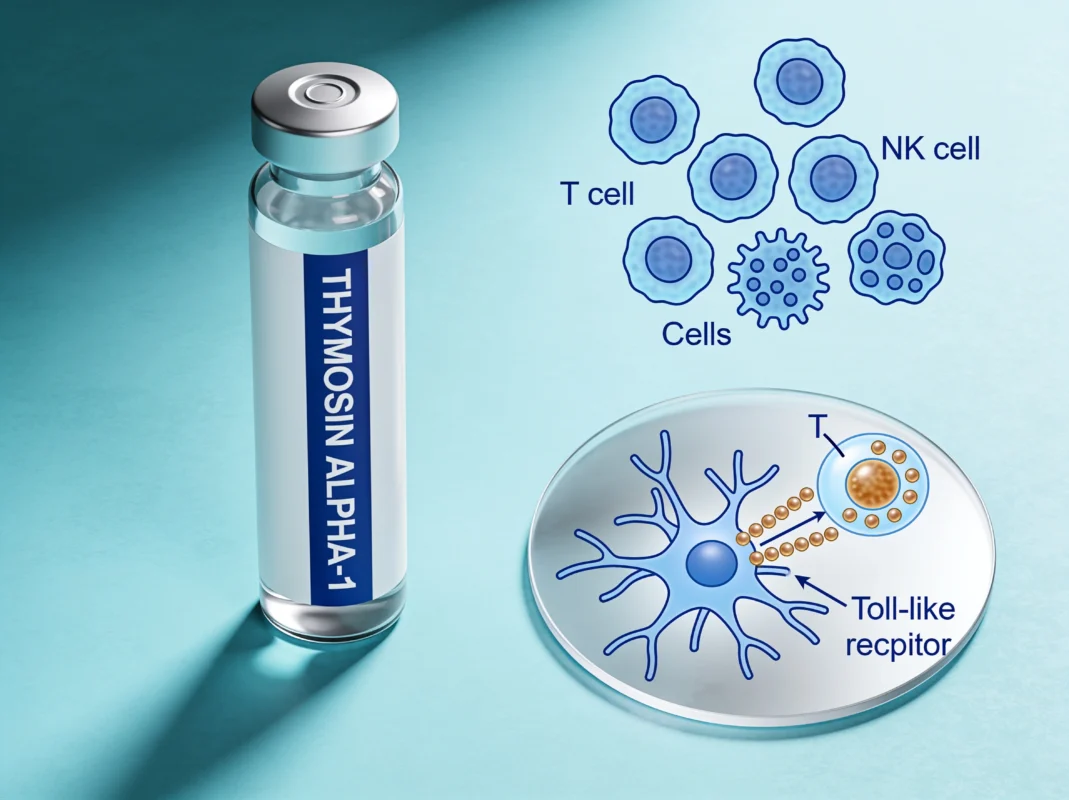
Toll-like receptor signaling. At the molecular level, Tα1 binds Toll-like receptors TLR-2, TLR-4, and TLR-9 on immune cells, activating downstream NF-κB and IRF3 signaling pathways [Ref. 1]. This receptor-level engagement is the upstream event from which its broader immune effects follow.
Dendritic cell maturation and Th1 polarization. Through TLR-9 signaling in dendritic cells, Tα1 promotes dendritic cell maturation and antigen presentation and drives a T-helper-type-1 (Th1) polarized response — a pattern associated with antiviral and antifungal resistance [Ref. 2].
Immune cell activation. This signaling promotes the proliferation and functional activation of key immune cell types including T-helper cells, cytotoxic T cells, natural killer (NK) cells, dendritic cells, and macrophages [Ref. 5]. The breadth of these effects underlies the compound’s use across diverse infectious and oncologic research contexts.
Immune balance and regulation. Tα1 is not solely immunostimulatory. TLR-9 signaling also engages regulatory pathways — including indoleamine 2,3-dioxygenase (IDO) activity, interleukin-10 production, and regulatory T-cell generation — allowing it to support a balance between inflammation and tolerance rather than indiscriminate immune activation [Ref. 2].
Compound distinction. Thymosin Alpha-1 acts as a tunable immune modulator through TLR signaling, distinct from the actin-regulating tissue-repair mechanism of Thymosin Beta-4 (TB-500) and from the localized anti-inflammatory action of KPV. It is the broadest systemic immune modulator in the Kinetic Compounds catalog.
Research Applications
Thymosin Alpha-1 has one of the deepest clinical research literatures of any peptide in this catalog, concentrated in infectious disease and immune support.
Chronic viral hepatitis. The most established application. Thymosin Alpha-1 has been evaluated in multiple randomized controlled trials in chronic hepatitis B, including a phase III multicentre, randomized, double-blind, placebo-controlled study, and is approved for hepatitis B and C (often combined with interferon) in many national formularies [Ref. 3].
Sepsis and critical illness. Thymosin Alpha-1 has been studied in severe sepsis, where immune dysregulation is central to outcomes. The ETASS trial — a multicenter, randomized, controlled study — evaluated Tα1 in severe sepsis as an immune-restorative approach [Ref. 4].
Cancer immune support. As an immune modulator, Tα1 has been studied as an adjuvant in oncology research, with work examining its effects on tumor cell lines and distinct immune cell subsets and its potential to support anti-tumor immune responses [Ref. 5].
Respiratory and other infections. Tα1 has been studied in respiratory infection research including severe acute respiratory syndrome (SARS), acute respiratory distress syndrome (ARDS), COVID-19, and chronic obstructive pulmonary disease, as well as in infections following bone marrow transplant [Ref. 1].
Broader research domains. Thymosin Alpha-1 has additionally been studied across:
- Vaccine adjuvant research (enhancing vaccine responses)
- Immunosenescence and aging-related immune decline
- Post-transplant and immunodeficiency states
- Combination research with antiviral and immunotherapy agents
Combination research with cluster siblings. Within the broader Kinetic Compounds catalog, Thymosin Alpha-1 (systemic immune modulation) is mechanistically distinct from BPC-157 and TB-500 (tissue repair) and KPV (localized anti-inflammatory action), making combination research designs across these compounds mechanistically rational.
Across all research domains, research-grade Thymosin Alpha-1 is intended for laboratory research only in the Kinetic Compounds context. The approved pharmaceutical form (thymalfasin / Zadaxin) is a separate, regulated product available in certain countries.
Dosing & Reconstitution for Research
Researchers working with lyophilized Thymosin Alpha-1 reconstitute the compound with bacteriostatic water before use. The reconstitution math follows the standard concentration-equals-mass-divided-by-volume principle covered in our reconstitution tutorial.
A 10 mg vial of Thymosin Alpha-1 reconstituted with 2 mL of bacteriostatic water yields 5 mg/mL. A 5 mg vial in 2 mL yields 2.5 mg/mL. Researchers can verify their concentration math against our peptide reconstitution calculator, which handles the conversion automatically.
This article does not provide dosing guidance for any therapeutic purpose. Research-grade Thymosin Alpha-1 is intended for laboratory research only.
Storage & Handling
Lyophilized Thymosin Alpha-1 is stable at room temperature during shipping but should be moved to long-term storage at -20°C (-4°F), protected from light, on receipt. Under proper lyophilized conditions, the compound remains stable for 24 months or longer.
Once reconstituted, Thymosin Alpha-1 should be stored at 2–8°C and used within 28 days. The general storage principles for research peptides apply directly — see our storage and stability guide for detailed protocols including freeze-thaw considerations and aliquoting strategies.
Every vial should be visually inspected before use. The reconstituted solution should be clear and free of particulates. Cloudiness, discoloration, or visible sediment indicates degradation, and the vial should not be used in research.
For full handling protocols across the broader peptide catalog, see our storage and reconstitution guide.
Sourcing Verified Thymosin Alpha-1 for Research
Thymosin Alpha-1 is a 28-amino-acid peptide, and its defined sequence and ~3108 Da mass make analytical verification by mass spectrometry straightforward, with HPLC used to confirm purity for a peptide of this length.
A credible Certificate of Analysis for Thymosin Alpha-1 should show HPLC purity expressed as a percentage, mass spectrometry confirmation matching ~3108 Da, and a clear distinction between peptide content and peptide mass. The principles of reading a research peptide COA are covered in detail in our reading a Certificate of Analysis article, and our specific third-party testing methodology is documented in our Janoshik Analytical methodology article.
Kinetic Compounds tests every batch of Thymosin Alpha-1 through Janoshik Analytical, an independent third-party laboratory. Current batch reports are published on the Thymosin Alpha-1 product page. Our broader testing methodology is documented on our lab testing and COA page.
For researchers working across the broader catalog, BPC-157, TB-500, and KPV are mechanistically distinct but complementary research compounds. The full research peptide catalog is available through our shop.
Available for Research
Research Tools
Quality Promise
very batch independently tested by Janoshik Analytical. 98% purity minimum.
Frequently Asked Questions
What is Thymosin Alpha-1?
<p>Thymosin Alpha-1 (Tα1) is a 28-amino-acid peptide naturally produced by the thymus that modulates innate and adaptive immunity. Its synthetic form is called thymalfasin and is marketed as Zadaxin in many countries.</p>
How does Thymosin Alpha-1 work?
<p>It binds Toll-like receptors TLR-2, TLR-4, and TLR-9 on immune cells, activating NF-κB and IRF3 signaling. Through TLR-9 it matures dendritic cells and drives Th1 responses, activating T cells, NK cells, and macrophages while also engaging regulatory pathways for immune balance.</p>
What does Thymosin Alpha-1 research focus on?
<p>Chronic hepatitis B and C (an approved indication in many countries), severe sepsis, cancer immune support, and respiratory infections such as SARS, ARDS, and COVID-19, plus vaccine-adjuvant and aging-immunity research.</p>
Is Thymosin Alpha-1 FDA-approved?
<p>No. In its synthetic form (thymalfasin / Zadaxin) it is approved in more than 35 countries for hepatitis B, hepatitis C, and immune support, but it is not FDA-approved. In the US it is used only in research and off-label compounded contexts, and research-grade material is for laboratory research only.</p>
How is Thymosin Alpha-1 different from Thymosin Beta-4 (TB-500)?
<p>Despite the shared name, they are distinct molecules. Thymosin Alpha-1 is a 28-amino-acid immune modulator acting through Toll-like receptors. Thymosin Beta-4 (the parent of TB-500) is an actin-binding peptide studied for tissue repair.</p>
How is Thymosin Alpha-1 reconstituted for research?
<p>Lyophilized Thymosin Alpha-1 is reconstituted with bacteriostatic water. A 10 mg vial in 2 mL yields 5 mg/mL. Researchers can verify calculations using our reconstitution calculator.</p>
Is research-grade Thymosin Alpha-1 legal in Canada?
<p>Research-grade Thymosin Alpha-1 is legal to purchase and possess in Canada for laboratory research purposes only. The research-grade compound is not approved by Health Canada for human therapeutic use.</p>
References
- Thymosin α1 and Its Role in Viral Infectious Diseases: The Mechanism and Clinical Application
- Thymosin alpha1 primes dendritic cells for Th1 resistance through Toll-like receptor 9 signaling
- Thymosin alpha1 treatment of chronic hepatitis B: phase III randomized, double-blind, placebo-controlled study
- The efficacy of thymosin alpha 1 for severe sepsis (ETASS): a multicenter randomized controlled trial
- The Immunomodulatory Activity of Thymosin Alpha 1 on Tumor Cell Lines and Distinct Immune Cell Subsets
Continue Reading
For Research Use Only Products described on this site are intended for laboratory research purposes only. They are not approved by Health Canada for human consumption, diagnosis, treatment, or prevention of any medical condition.