
Home / Research Articles / IGF-1 LR3 (Long Arg3 IGF-1): Mechanism, Research, and Applications
IGF-1 LR3 (Long Arg3 IGF-1): Mechanism, Research, and Applications
Key Takeaways
- IGF-1 LR3 (Long Arg3 IGF-1) is a synthetic 83-amino-acid analog of IGF-1 with an Arg3 substitution and a 13-residue N-terminal extension; molecular weight ~9.1 kDa.
- The modifications cut its binding to IGF-binding proteins (~10-fold), extending half-life from minutes to roughly 20-30 hours with greater bioactivity per dose.
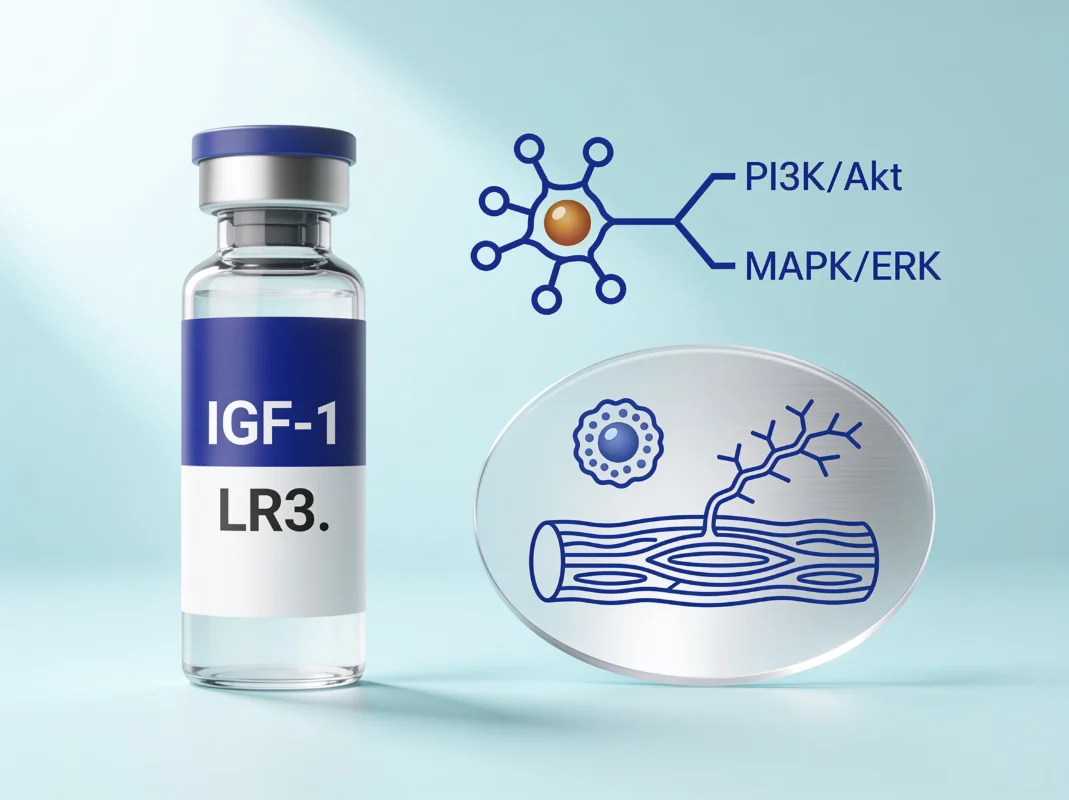
- It activates the IGF-1 receptor, driving PI3K/Akt/mTOR (protein synthesis) and MAPK/ERK (proliferation), and activates muscle satellite cells.
- Research focuses on muscle hypertrophy, satellite-cell proliferation, and models of muscle wasting, trauma recovery, and age-related sarcopenia.
- IGF-1 LR3 is not approved for human use; research-grade material is supplied lyophilized for reconstitution and is for laboratory research only.
IGF-1 LR3 extends the Kinetic Compounds Growth research cluster with a compound that acts at the effector end of the growth-hormone axis. Where GH secretagogues such as Ipamorelin, CJC-1295, and Hexarelin stimulate the body’s own growth hormone (which in turn raises IGF-1), IGF-1 LR3 is a modified form of insulin-like growth factor 1 itself — the downstream mediator through which much of growth hormone’s anabolic signaling is carried out. It is engineered to last far longer in circulation than native IGF-1, making it one of the most studied growth-factor analogs in muscle and tissue research.
This article addresses IGF-1 LR3 as a research compound: its structure as a long-acting IGF-1 analog, the receptor mechanism that drives protein synthesis and cell proliferation, the research applications spanning muscle hypertrophy and satellite-cell biology, and the reconstitution and sourcing considerations researchers should understand before working with the compound.
What Is IGF-1 LR3?
IGF-1 LR3 (Insulin-like Growth Factor 1, Long Arg3) is a synthetic analog of human IGF-1. Native IGF-1 is a 70-amino-acid peptide; IGF-1 LR3 is an 83-amino-acid version with two defining modifications: an arginine substitution at position 3 (replacing glutamic acid) and an additional 13-amino-acid extension at the N-terminus. Its molecular weight is approximately 9.1 kDa.
These modifications change the compound’s pharmacology dramatically. Native IGF-1 binds tightly to IGF-binding proteins (IGFBPs, particularly IGFBP-3) that sequester it in circulation and limit its free half-life to roughly 15–20 minutes. IGF-1 LR3 has approximately 10-fold reduced affinity for IGFBPs while retaining comparable IGF-1 receptor potency, which extends its half-life to roughly 20–30 hours and increases systemic exposure and bioactivity per dose [Ref. 1].
Native IGF-1 (mecasermin) is an approved therapy for severe primary IGF-1 deficiency, but IGF-1 LR3 is a modified research analog and is not an approved pharmaceutical. IGF-1 LR3 has not been approved by FDA, Health Canada, EMA, MHRA, or any other Western regulatory agency for human therapeutic use. Research-grade IGF-1 LR3 sold for laboratory research is intended exclusively for that purpose.
Mechanism of Action
IGF-1 LR3’s mechanism is activation of the IGF-1 receptor, from which two major intracellular signaling pathways branch.
IGF-1 receptor (IGF-1R) activation. IGF-1 LR3 binds the IGF-1 receptor, a receptor tyrosine kinase expressed on muscle cells, bone cells, and many other tissues. Receptor binding phosphorylates the adaptor protein IRS-1, initiating downstream signaling [Ref. 3].
PI3K/Akt/mTOR pathway. One arm of signaling activates PI3K and Akt, driving protein synthesis (via mTOR), glucose uptake, and cell survival. In skeletal muscle, this pathway is central to myofiber hypertrophy and the inhibition of atrophy [Ref. 2].
MAPK/ERK pathway. The second arm activates the ras/raf/MEK/ERK cascade, which primarily amplifies cell proliferation and differentiation [Ref. 1].
Satellite cell activation. In skeletal muscle specifically, IGF-1 signaling activates satellite cells (muscle stem cells), promoting their proliferation and differentiation into mature myofibers — contributing to both hypertrophy (increased fiber size) and the repair of damaged tissue [Ref. 5].
Compound distinction. IGF-1 LR3 acts directly at the IGF-1 receptor, downstream of the GH secretagogues that stimulate the body’s own GH/IGF-1 axis. Its reduced IGFBP binding is what distinguishes it pharmacologically from native IGF-1 and from short-acting IGF-1 fragments.
Research Applications
IGF-1 LR3 research concentrates on muscle and tissue growth, where its long half-life makes it a practical laboratory tool.
Muscle hypertrophy and satellite-cell biology. The most studied domain. IGF-1 signaling drives myotube hypertrophy and activates satellite cells; human myotube studies show IGF-1 increases fusion index, myonuclei number, and myosin heavy chain content — hallmarks of muscle growth and repair [Ref. 5]. IGF-1 LR3’s extended activity makes it a common reagent in these cell-culture models.
Muscle wasting and regeneration models. Because IGF-1 both promotes hypertrophy and inhibits atrophy, IGF-1 LR3 is used as a research candidate in models of muscle wasting, trauma recovery, and age-related sarcopenia [Ref. 4].
Broader research domains. IGF-1 and IGF-1 LR3 have additionally been studied across:
- Connective-tissue and tendon repair research
- Bone and cartilage growth models
- Cell-culture proliferation and survival assays
- Metabolic signaling (glucose uptake via PI3K/Akt)
Across all research domains, research-grade IGF-1 LR3 is intended for laboratory research only in the Kinetic Compounds context. The compound has not been evaluated by FDA, Health Canada, or any other Western regulatory agency for human therapeutic use.
Dosing & Reconstitution for Research
Researchers working with lyophilized IGF-1 LR3 reconstitute the compound with bacteriostatic water before use. The reconstitution math follows the standard concentration-equals-mass-divided-by-volume principle covered in our reconstitution tutorial.
A 1 mg vial of IGF-1 LR3 reconstituted with 2 mL of bacteriostatic water yields 0.5 mg/mL (500 mcg/mL). Because IGF-1 LR3 is typically supplied in small (often 1 mg) quantities, careful concentration calculation matters; researchers can verify their math against our peptide reconstitution calculator.
This article does not provide dosing guidance for any therapeutic purpose. Research-grade IGF-1 LR3 is intended for laboratory research only.
Storage & Handling
Lyophilized IGF-1 LR3 is stable at room temperature during shipping but should be moved to long-term storage at -20°C (-4°F), protected from light, on receipt. Under proper lyophilized conditions, the compound remains stable for 24 months or longer.
Once reconstituted, IGF-1 LR3 should be stored at 2–8°C and used within 28 days. As a growth factor, it is sensitive to handling — see our storage and stability guide for protocols including freeze-thaw considerations and aliquoting strategies.
Every vial should be visually inspected before use. The reconstituted solution should be clear and free of particulates. Cloudiness, discoloration, or visible sediment indicates degradation, and the vial should not be used in research.
For full handling protocols across the broader peptide catalog, see our storage and reconstitution guide.
Sourcing Verified IGF-1 LR3 for Research
IGF-1 LR3 is a larger, structured growth factor, so analytical verification combines HPLC for purity with mass spectrometry confirming the expected ~9.1 kDa mass; correct folding and identity are particularly important for a receptor-binding growth factor.
A credible Certificate of Analysis for IGF-1 LR3 should show HPLC purity expressed as a percentage, mass spectrometry confirmation, and a clear distinction between peptide content and peptide mass. The principles of reading a research peptide COA are covered in detail in our reading a Certificate of Analysis article, and our specific third-party testing methodology is documented in our Janoshik Analytical methodology article.
Kinetic Compounds tests every batch of IGF-1 LR3 through Janoshik Analytical, an independent third-party laboratory. Current batch reports are published on the IGF-1 LR3 product page. Our broader testing methodology is documented on our lab testing and COA page.
For researchers working across the broader Growth and GH-axis cluster, Ipamorelin, CJC-1295, and Tesamorelin are mechanistically distinct but complementary research compounds in the Kinetic Compounds catalog. The full research peptide catalog is available through our shop.
Related Peptides
Related peptides will load here via PHP snippet.
Available for Research
Research Tools
Quality Promise
very batch independently tested by Janoshik Analytical. 98% purity minimum.
Frequently Asked Questions
What is IGF-1 LR3?
<p>IGF-1 LR3 (Long Arg3 IGF-1) is a synthetic 83-amino-acid analog of insulin-like growth factor 1. It is modified to bind IGF-binding proteins far less than native IGF-1, giving it a much longer half-life and greater bioactivity per dose.</p>
How is IGF-1 LR3 different from native IGF-1?
<p>Native IGF-1 is a 70-amino-acid peptide that binds IGF-binding proteins tightly and has a free half-life of minutes. IGF-1 LR3 adds a 13-residue N-terminal extension and an Arg3 substitution, reducing IGFBP binding about 10-fold and extending half-life to roughly 20-30 hours.</p>
How does IGF-1 LR3 work?
<p>It binds the IGF-1 receptor (a receptor tyrosine kinase), phosphorylating IRS-1 and activating two pathways: PI3K/Akt/mTOR, which drives protein synthesis and cell survival, and MAPK/ERK, which drives proliferation. In muscle it also activates satellite cells.</p>
What does IGF-1 LR3 research focus on?
<p>Mainly muscle hypertrophy and satellite-cell biology, plus models of muscle wasting, trauma recovery, and age-related sarcopenia, and broader connective-tissue, bone, and cell-proliferation research.</p>
Is IGF-1 LR3 approved as a medication?
<p>No. Native IGF-1 (mecasermin) is approved for a rare deficiency, but IGF-1 LR3 is a modified research analog that has not been approved by FDA, Health Canada, EMA, or any other Western regulatory agency. Research-grade IGF-1 LR3 is intended for laboratory research only.</p>
How is IGF-1 LR3 reconstituted for research?
<p>Lyophilized IGF-1 LR3 is reconstituted with bacteriostatic water. A 1 mg vial in 2 mL yields 0.5 mg/mL (500 mcg/mL). Researchers can verify calculations using our reconstitution calculator.</p>
Is research-grade IGF-1 LR3 legal in Canada?
<p>Research-grade IGF-1 LR3 is legal to purchase and possess in Canada for laboratory research purposes only. The compound is not approved by Health Canada for human therapeutic use.</p>
References
- Mechanisms of IGF-1-Mediated Regulation of Skeletal Muscle Hypertrophy and Atrophy
- Regulation of skeletal muscle growth by the IGF1-Akt/PKB pathway: insights from genetic models
- The signaling landscape of insulin-like growth factor 1
- Implications of Insulin-Like Growth Factor-1 in Skeletal Muscle and Various Diseases
- Effect of IGF1 on Myogenic Proliferation and Differentiation of Skeletal Muscle Satellite Cells Through PI3K/AKT
Continue Reading
For Research Use Only Products described on this site are intended for laboratory research purposes only. They are not approved by Health Canada for human consumption, diagnosis, treatment, or prevention of any medical condition.