
Home / Research Articles / LL-37: The Human Cathelicidin Antimicrobial Peptide
LL-37: The Human Cathelicidin Antimicrobial Peptide
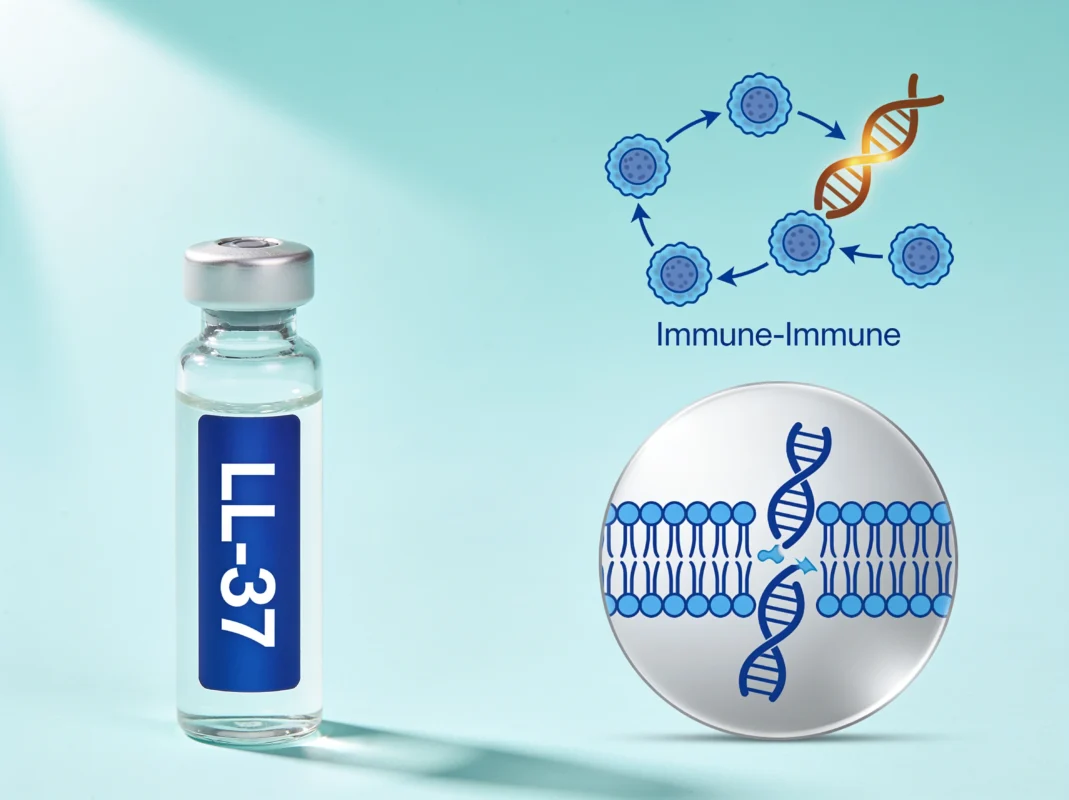
Key Takeaways
- LL-37 is the only human cathelicidin antimicrobial peptide — a 37-amino-acid cationic, amphipathic α-helix from the hCAP18 precursor; molecular weight ~4493 Da.
- It is stored in neutrophil granules and is a front-line innate-immune effector, both killing microbes directly and coordinating immune responses.
- Its antimicrobial action is electrostatic disruption of anionic bacterial membranes plus direct binding and neutralization of LPS endotoxin.
- As an immunomodulator it drives chemotaxis of neutrophils, monocytes, and T cells (via FPRL1) and promotes wound healing and angiogenesis.
- LL-37 is not approved for human use; research-grade material is supplied lyophilized and is intended for laboratory research only.
LL-37 brings a distinct mechanism to the Kinetic Compounds immune research area: it is the human body’s own broad-spectrum antimicrobial peptide. Where Thymosin Alpha-1 tunes the adaptive immune response and KPV and BPC-157 act on inflammation and tissue repair, LL-37 sits at the front line of innate immunity — a peptide that both kills microbes directly and orchestrates the immune cells that follow. It is the only cathelicidin peptide found in humans, which makes it a uniquely human research tool.
This article addresses LL-37 as a research compound: its structure as a cationic, amphipathic cathelicidin, the dual antimicrobial and immunomodulatory mechanisms that define it, the research applications spanning innate immunity through wound healing, and the reconstitution and sourcing considerations researchers should understand before working with the compound.
What Is LL-37?
LL-37 is the only human member of the cathelicidin family of host-defense peptides. It is a 37-amino-acid peptide — sequence LLGDFFRKSKEKIGKEFKRIVQRIKDFLRNLVPRTES — with a molecular weight of approximately 4493 Da and a strong net positive charge (around +6 at physiological pH). It is generated by proteolytic cleavage of the precursor protein hCAP18 (by proteinase 3) and is stored in the secondary granules of neutrophils [Ref. 3].
Structurally, LL-37 forms an amphipathic alpha-helix: a folded shape with separated hydrophobic and positively charged faces. This amphipathic, cationic character is the basis of both of its functions — it allows the peptide to interact with the negatively charged surfaces of microbial membranes and with anionic host molecules such as lipopolysaccharide (LPS), DNA, and RNA [Ref. 3].
LL-37 has not been approved by FDA, Health Canada, EMA, MHRA, or any other Western regulatory agency for human therapeutic use; it is an endogenous human peptide studied as a research compound. Research-grade LL-37 sold for laboratory research is intended exclusively for that purpose.
Mechanism of Action
LL-37 has a dual mechanism — direct antimicrobial action and broad immunomodulation — both stemming from its cationic, amphipathic structure.
Membrane-disrupting antimicrobial action. LL-37’s positive charge draws it to the negatively charged membranes of bacteria; the amphipathic helix then inserts into and disrupts the membrane, killing the microbe. This electrostatic, membrane-targeting mechanism gives it broad-spectrum activity and makes resistance less likely than with conventional antibiotics [Ref. 3].
Endotoxin (LPS) neutralization. LL-37 binds bacterial lipopolysaccharide directly, neutralizing this endotoxin and dampening the excessive inflammatory signaling it would otherwise trigger — an anti-endotoxin activity relevant to sepsis and inflammation research [Ref. 1].
Immune cell recruitment and modulation. Beyond killing microbes, LL-37 is a potent immunomodulator. It acts as a chemoattractant for neutrophils, monocytes, and T cells — in part through the FPRL1 receptor — and modulates cytokine and chemokine production, turning a local antimicrobial event into a coordinated immune response [Ref. 1][Ref. 2].
Scavenger-receptor signaling and angiogenesis. LL-37 also signals through scavenger receptors (such as SR-B1), inducing factors including VEGFA, and promotes angiogenesis — the formation of new blood vessels that supports tissue repair [Ref. 2].
Compound distinction. LL-37 is an innate-immune effector that acts both as a direct antimicrobial and as an immune coordinator, distinct from the adaptive-immune tuning of Thymosin Alpha-1 and the localized anti-inflammatory and repair actions of KPV and BPC-157.
Research Applications
LL-37 research spans antimicrobial defense, immunology, wound healing, and a growing body of oncology work.
Antimicrobial and innate-immunity research. The foundational domain. LL-37 is studied for broad-spectrum activity against bacteria, and for its anti-endotoxin and immune-coordinating roles within the innate immune system [Ref. 1].
Wound healing and angiogenesis. LL-37 promotes multiple stages of wound repair — stimulating migration and proliferation of keratinocytes, fibroblasts, and endothelial cells, supporting re-epithelialization, and inducing angiogenesis. Early-phase human studies of topical wound applications have been conducted [Ref. 2].
Inflammatory and autoimmune research. Because LL-37 both dampens endotoxin signaling and amplifies immune-cell activity, it is studied in inflammatory and autoimmune contexts, where its role can be context-dependent [Ref. 1].
Broader research domains. LL-37 has additionally been studied across:
- Cancer biology, where its role is complex and context-dependent [Ref. 4][Ref. 5]
- Antiviral research
- Skin immunology and barrier function
- Sepsis and endotoxemia models
Across all research domains, research-grade LL-37 is intended for laboratory research only in the Kinetic Compounds context. The compound has not been evaluated by FDA, Health Canada, or any other Western regulatory agency for human therapeutic use.
Dosing & Reconstitution for Research
Researchers working with lyophilized LL-37 reconstitute the compound with bacteriostatic water before use. The reconstitution math follows the standard concentration-equals-mass-divided-by-volume principle covered in our reconstitution tutorial.
A 5 mg vial of LL-37 reconstituted with 2 mL of bacteriostatic water yields 2.5 mg/mL. A 10 mg vial in 2 mL yields 5 mg/mL. Researchers can verify their concentration math against our peptide reconstitution calculator, which handles the conversion automatically.
This article does not provide dosing guidance for any therapeutic purpose. Research-grade LL-37 is intended for laboratory research only.
Storage & Handling
Lyophilized LL-37 is stable at room temperature during shipping but should be moved to long-term storage at -20°C (-4°F), protected from light, on receipt. Under proper lyophilized conditions, the compound remains stable for 24 months or longer.
Once reconstituted, LL-37 should be stored at 2–8°C and used within 28 days. The general storage principles for research peptides apply directly — see our storage and stability guide for detailed protocols including freeze-thaw considerations and aliquoting strategies.
Every vial should be visually inspected before use. The reconstituted solution should be clear and free of particulates. Cloudiness, discoloration, or visible sediment indicates degradation, and the vial should not be used in research.
For full handling protocols across the broader peptide catalog, see our storage and reconstitution guide.
Sourcing Verified LL-37 for Research
LL-37 is a 37-amino-acid peptide whose defined sequence and ~4493 Da mass make analytical verification by mass spectrometry straightforward, with HPLC confirming purity for a peptide of this length.
A credible Certificate of Analysis for LL-37 should show HPLC purity expressed as a percentage, mass spectrometry confirmation matching ~4493 Da, and a clear distinction between peptide content and peptide mass. The principles of reading a research peptide COA are covered in detail in our reading a Certificate of Analysis article, and our specific third-party testing methodology is documented in our Janoshik Analytical methodology article.
Kinetic Compounds tests every batch of LL-37 through Janoshik Analytical, an independent third-party laboratory. Current batch reports are published on the LL-37 product page. Our broader testing methodology is documented on our lab testing and COA page.
For researchers working across the broader immune and healing research area, Thymosin Alpha-1, KPV, and BPC-157 are mechanistically distinct but complementary research compounds in the Kinetic Compounds catalog. The full research peptide catalog is available through our shop.
Available for Research
Research Tools
Quality Promise
very batch independently tested by Janoshik Analytical. 98% purity minimum.
Frequently Asked Questions
What is LL-37?
<p>LL-37 is the only human cathelicidin — a 37-amino-acid host-defense peptide cleaved from the hCAP18 precursor and stored in neutrophils. It is both a direct antimicrobial and a broad immune modulator.</p>
How does LL-37 kill microbes?
<p>Its positive charge draws it to negatively charged bacterial membranes, and its amphipathic helix inserts into and disrupts the membrane. Because this targets a basic feature of microbial membranes, resistance is less likely than with conventional antibiotics. It also binds and neutralizes LPS endotoxin.</p>
What are LL-37's immune functions beyond killing microbes?
<p>LL-37 is a chemoattractant for neutrophils, monocytes, and T cells (partly via the FPRL1 receptor), modulates cytokine and chemokine production, signals through scavenger receptors, and promotes angiogenesis and wound repair.</p>
What does LL-37 research focus on?
<p>Antimicrobial defense and innate immunity, wound healing and angiogenesis, inflammatory and autoimmune contexts, and a growing, context-dependent body of cancer research, plus antiviral and skin-immunology studies.</p>
Is LL-37 approved as a medication?
<p>No. LL-37 is an endogenous human peptide studied as a research compound; it has not been approved by FDA, Health Canada, EMA, or any other Western regulatory agency. Research-grade LL-37 is intended for laboratory research only.</p>
How is LL-37 reconstituted for research?
<p>Lyophilized LL-37 is reconstituted with bacteriostatic water. A 5 mg vial in 2 mL yields 2.5 mg/mL. Researchers can verify calculations using our reconstitution calculator.</p>
Is research-grade LL-37 legal in Canada?
<p>Research-grade LL-37 is legal to purchase and possess in Canada for laboratory research purposes only. The compound is not approved by Health Canada for human therapeutic use.</p>
References
- Immunomodulatory Role of the Antimicrobial LL-37 Peptide in Autoimmune Diseases and Viral Infections
- The Antimicrobial Peptide Cathelicidin Exerts Immunomodulatory Effects via Scavenger Receptors
- Decoding LL-37: Structure and antimicrobial mechanisms against microbial threats
- Renovation as innovation: Repurposing human antibacterial peptide LL-37 for cancer therapy
- The Role of Cathelicidin LL-37 in Cancer Development
Continue Reading
For Research Use Only Products described on this site are intended for laboratory research purposes only. They are not approved by Health Canada for human consumption, diagnosis, treatment, or prevention of any medical condition.