
Home / Research Articles / AOD-9604: Mechanism, Research, and Applications
AOD-9604: Mechanism, Research, and Applications
Key Takeaways
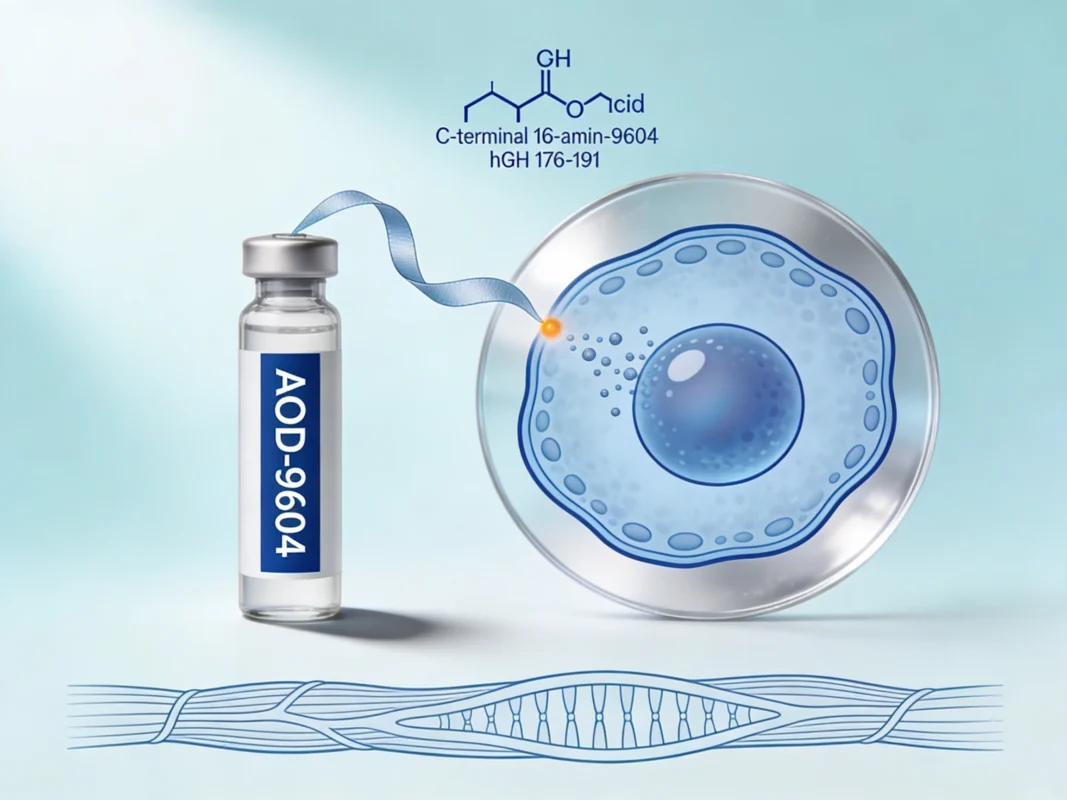
- AOD-9604 is a 16-amino-acid synthetic peptide consisting of the C-terminal residues 176-191 of human growth hormone plus an additional N-terminal tyrosine for stability.
- The compound was developed by Metabolic Pharmaceuticals (Australia) and advanced through Phase IIB obesity clinical trials in the 2000s but did not achieve pharmaceutical approval.
- The mechanism centers on lipolysis stimulation and lipogenesis inhibition through beta-3 adrenergic pathways without the growth-promoting effects of full-length growth hormone.
- AOD-9604 received FDA GRAS food status in 2014, which is distinct from pharmaceutical drug approval — the compound is not an approved medication anywhere in the world.
- The molecular weight is ~1,815 g/mol; research-grade AOD-9604 is intended for laboratory research only and is distinct from any food product or pharmaceutical compound.
AOD-9604 — short for Anti-Obesity Drug 9604 — extends the Kinetic Compounds Body Composition / Mitochondrial cluster with a compound whose research history is unusually complex compared to other research peptides. Developed by Metabolic Pharmaceuticals in Australia during the 1990s and advanced through Phase IIB clinical trials for obesity treatment in the 2000s, AOD-9604 did not achieve pharmaceutical regulatory approval despite the substantial clinical development program. The compound subsequently received FDA Generally Recognized as Safe (GRAS) status for food applications in 2014 — a fundamentally different regulatory determination from pharmaceutical drug approval. Research interest in AOD-9604 has persisted across both fat metabolism applications and the secondary osteoarthritis/cartilage research domain that emerged after the obesity development program concluded.
This article addresses AOD-9604 as a research compound — its structural origin as a fragment of human growth hormone, the lipolytic mechanism that distinguishes it from full-length growth hormone and from MOTS-c (the foundational compound in the same cluster), the research applications spanning lipolysis and osteoarthritis, and the reconstitution and sourcing considerations researchers should understand before working with the compound.
What Is AOD-9604?
AOD-9604 is a synthetic 16-amino-acid peptide with the sequence Tyr-Leu-Arg-Ile-Val-Gln-Cys-Arg-Ser-Val-Glu-Gly-Ser-Cys-Gly-Phe. The molecular weight is approximately 1,815 g/mol. The compound corresponds to the C-terminal residues 176-191 of human growth hormone (hGH) with an additional tyrosine residue added at the N-terminus to improve stability and ease of synthesis.
The compound was developed by Monash University researchers in Australia in the late 1980s and 1990s, building on earlier research showing that the C-terminal portion of growth hormone retained lipolytic activity independently of the growth-promoting effects of the full-length hormone [Ref. 1]. The C-terminal fragment hypothesis was that growth hormone’s separate biological activities — growth promotion, glycemic effects, and fat metabolism modulation — could be structurally dissociated, with the lipolytic activity localized to specific portions of the molecule. AOD-9604 represented the most extensively developed synthetic fragment from this research program.
Metabolic Pharmaceuticals, an Australian biopharmaceutical company, advanced AOD-9604 through preclinical development and into human clinical trials beginning in the late 1990s. The clinical development program was specifically focused on obesity treatment, with Phase IIB trials conducted in obese populations during the 2000s [Ref. 2]. Despite the substantial development investment and clinical trial activity, AOD-9604 did not achieve pharmaceutical regulatory approval — the obesity development program was ultimately discontinued.
In 2014, AOD-9604 received Generally Recognized as Safe (GRAS) status from the FDA for food applications through a self-affirmation process by a sponsor. This regulatory determination is important to understand correctly: GRAS status for food applications is not equivalent to FDA approval as a pharmaceutical drug. The two regulatory pathways evaluate different criteria (food safety vs pharmaceutical efficacy and safety), require different evidence bases, and result in different product permissions. AOD-9604 is not currently an approved pharmaceutical drug anywhere in the world.
Research-grade AOD-9604 sold for laboratory research is distinct from any food product, supplement, or pharmaceutical compound and is intended exclusively for laboratory research purposes.
Mechanism of Action
AOD-9604’s mechanism is the central scientific question that has defined the compound’s research program throughout its development history. The original hypothesis — and the basis for the entire AOD-9604 development effort — was that the C-terminal fragment of growth hormone retains the lipolytic activity of the full-length hormone without the growth-promoting, glycemic, or insulin-resistance-promoting effects [Ref. 1, Ref. 4].
The mechanistic literature converges on several pathways.
Lipolysis stimulation. AOD-9604 increases lipolytic activity in adipose tissue — the breakdown of stored triglycerides into free fatty acids and glycerol [Ref. 1, Ref. 4]. The effect operates through stimulation of beta-3 adrenergic receptor pathways and hormone-sensitive lipase activation in adipocytes, similar to the lipolytic pathway activated by catecholamines. The lipolytic mechanism is the most extensively characterized aspect of AOD-9604 biology.
Lipogenesis inhibition. In addition to stimulating fat breakdown, AOD-9604 has documented effects on inhibiting lipogenesis — the synthesis and storage of new triglycerides in adipose tissue. The combined lipolytic stimulation and lipogenic inhibition produces a net shift toward reduced fat mass in animal models of obesity [Ref. 4].
Mitochondrial fatty acid oxidation. Some research has suggested AOD-9604 increases mitochondrial fatty acid oxidation — providing a metabolic destination for the free fatty acids released by lipolysis. This connection to mitochondrial metabolism establishes a mechanistic link to the broader Body Composition / Mitochondrial cluster’s research domain, though the specific pathway is less extensively characterized than the lipolytic mechanism itself.
Absence of growth-promoting effects. The defining mechanistic claim. Unlike full-length growth hormone, AOD-9604 does not bind to the growth hormone receptor with high affinity, does not stimulate insulin-like growth factor 1 (IGF-1) production, and does not produce growth-promoting effects in growth hormone-deficient animal models. This dissociation of lipolytic activity from growth-promoting activity is the foundational distinction that motivated the compound’s development [Ref. 1].
Absence of glycemic effects. Full-length growth hormone has well-documented effects on glucose metabolism — including insulin resistance promotion at higher doses — that limit its use in obesity and metabolic disease contexts. AOD-9604 was reported to lack these glycemic effects, which was one of the central pharmacological advantages over hGH that the development program emphasized [Ref. 4].
Cartilage and chondrocyte effects. Secondary mechanistic research that emerged after the obesity program characterized AOD-9604 effects on chondrocytes (cartilage cells) and cartilage matrix metabolism, providing a candidate mechanism for the osteoarthritis research applications [Ref. 3].
The multi-mechanism profile, like the broader research peptide literature, depends significantly on protocol design, tissue context, and model selection.
Research Applications
AOD-9604 research clusters into two primary domains: fat metabolism / obesity research (the original development program) and osteoarthritis / cartilage research (the secondary application area).
Lipolysis and fat metabolism research
The foundational research domain. AOD-9604 has been studied extensively for effects on adipose tissue lipolysis, body fat distribution, and weight loss endpoints in both animal models and human clinical populations [Ref. 1, Ref. 4]. The animal model literature consistently demonstrates AOD-9604 effects on fat mass reduction in obesity models; the human clinical literature is more variable, with some Phase II trials showing modest weight loss effects while others showed minimal differentiation from placebo.
Obesity clinical research
The Metabolic Pharmaceuticals development program advanced AOD-9604 through Phase IIB clinical trials in obese populations during the 2000s [Ref. 2]. The trials evaluated AOD-9604 as a weight loss agent across multiple dose levels and treatment durations. The clinical research did not produce results sufficient to support pharmaceutical regulatory approval — a finding that has shaped subsequent research interpretation of the compound’s translational potential. Whether the failure reflected genuine pharmacological limitations or trial design issues remains a subject of discussion in the broader literature.
Osteoarthritis and cartilage research
The secondary application area that emerged after the obesity development program concluded. Research has examined AOD-9604 effects on cartilage matrix synthesis, chondrocyte function, and clinical osteoarthritis outcomes [Ref. 3]. Phase II clinical trial activity in joint health applications continued under various sponsors after Metabolic Pharmaceuticals’ obesity program ended. The mechanistic basis for cartilage effects involves direct effects on chondrocyte metabolism that are distinct from the lipolytic mechanism in adipose tissue.
Body composition research
Beyond pure fat mass effects, AOD-9604 has been studied for broader body composition endpoints including lean mass preservation, body fat distribution, and metabolic profile changes in various research populations. The body composition research connects AOD-9604 to the broader research peptide landscape addressing metabolic and aesthetic body composition questions.
Comparative research with full-length growth hormone
A specific research domain has examined AOD-9604 head-to-head against full-length human growth hormone and against GHRH-class peptides like Sermorelin and CJC-1295. The comparative work tests the foundational dissociation hypothesis — whether AOD-9604 produces fat metabolism effects without the broader hGH effects on growth, IGF-1, and glucose metabolism. This comparison literature is relevant for researchers studying the growth hormone axis from a body composition perspective.
Cross-cluster comparative research
Researchers studying body composition and metabolic research peptides commonly compare AOD-9604 with MOTS-c and with GLP-1 receptor agonists. The mechanisms are fundamentally distinct: AOD-9604 acts directly on adipocyte lipolysis; MOTS-c acts on mitochondrial AMPK signaling; GLP-1 agonists act through appetite suppression and improved insulin sensitivity. The mechanism diversity makes the three compound classes complementary research tools rather than alternatives within a single research question.
Across all research domains, AOD-9604 is intended for laboratory research only in the Kinetic Compounds context. The compound has not been approved as a pharmaceutical drug by any regulatory agency.
Dosing & Reconstitution for Research
Researchers working with lyophilized AOD-9604 reconstitute the compound with bacteriostatic water before use. The reconstitution math follows the standard concentration-equals-mass-divided-by-volume principle covered in our reconstitution tutorial.
A 5 mg vial of AOD-9604 reconstituted with 2 mL of bacteriostatic water yields 2.5 mg/mL. A 10 mg vial in 2 mL yields 5 mg/mL. AOD-9604’s molecular weight (~1,815 g/mol) places it in a similar size range to MOTS-c (~2,174 g/mol) but smaller than the GHRH-class peptides like Sermorelin (~3,358 g/mol).
A consideration specific to AOD-9604: the compound has a relatively short systemic half-life due to peptidase degradation in plasma. Research protocols designed to maintain AOD-9604 exposure typically use repeated administration rather than single-administration designs. Some research has explored sustained-release or oral formulations to address the short half-life — these approaches were part of the broader Metabolic Pharmaceuticals development program.
Researchers can verify their concentration math against our peptide reconstitution calculator, which handles the conversion automatically.
This article does not provide dosing guidance for any therapeutic purpose. Research-grade AOD-9604 is intended for laboratory research only.
Storage & Handling
Lyophilized AOD-9604 is stable at room temperature during shipping but should be moved to long-term storage at -20°C (-4°F), protected from light, on receipt. Under proper lyophilized conditions, the compound remains stable for 24 months or longer.
Once reconstituted, AOD-9604 should be stored at 2–8°C and used within 28 days. The general storage principles for research peptides apply directly — see our storage and stability guide for detailed protocols including freeze-thaw considerations and aliquoting strategies.
Every vial should be visually inspected before use. The reconstituted solution should be clear and free of particulates. Cloudiness, discoloration, or visible sediment indicates degradation, and the vial should not be used in research.
For full handling protocols across the broader peptide catalog, see our storage and reconstitution guide.
Sourcing Verified AOD-9604 for Research
AOD-9604’s structural simplicity (16 amino acids with a single internal disulfide bond between the two cysteine residues at positions 7 and 14) makes mass spectrometry verification straightforward. The disulfide bond is an important structural feature for activity, and a credible Certificate of Analysis should confirm both the molecular weight and the structural integrity including the disulfide.
A credible Certificate of Analysis for AOD-9604 should show HPLC purity expressed as a percentage, mass spectrometry confirmation matching ~1,815 Da, and a clear distinction between peptide content and peptide mass. The principles of reading a research peptide COA are covered in detail in our reading a Certificate of Analysis article, and our specific third-party testing methodology is documented in our Janoshik Analytical methodology article.
Kinetic Compounds tests every batch of AOD-9604 through Janoshik Analytical, an independent third-party laboratory. Current batch reports are published on the AOD-9604 product page. Our broader testing methodology is documented on our lab testing and COA page.
For researchers working across the broader Body Composition / Mitochondrial research peptide space, MOTS-c is the cluster sibling compound with a fundamentally distinct mitochondrial signaling mechanism. The full research peptide catalog is available through our shop.
Researching body composition, fat metabolism, lipolysis, or growth hormone fragment biology? Our complete research peptide catalog covers AOD-9604, MOTS-c, and related research compounds — all independently lab-tested with current Certificates of Analysis available on each product page.
Related Peptides
Related peptides will load here via PHP snippet.
Available for Research
Research Tools
Quality Promise
very batch independently tested by Janoshik Analytical. 98% purity minimum.
Frequently Asked Questions
What is AOD-9604?
<p>AOD-9604 (Anti-Obesity Drug 9604) is a 16-amino-acid synthetic peptide consisting of the C-terminal residues 176-191 of human growth hormone plus an additional N-terminal tyrosine. The compound was developed by Metabolic Pharmaceuticals in Australia during the 1990s and advanced through Phase IIB clinical trials for obesity treatment in the 2000s before the development program was discontinued.</p>
Is AOD-9604 the same as human growth hormone?
<p>No. AOD-9604 is a fragment representing only 16 of human growth hormone's 191 amino acids. The compound was specifically designed to retain hGH's lipolytic activity (effects on fat metabolism) while not retaining the growth-promoting or glycemic effects of full-length growth hormone. The mechanistic dissociation between lipolytic and growth-promoting activities is the foundational scientific claim underlying AOD-9604's development.</p>
Is AOD-9604 FDA-approved?
<p>AOD-9604 has not been approved by the FDA as a pharmaceutical drug. The compound received Generally Recognized as Safe (GRAS) status for food applications in 2014, which is a distinct regulatory determination from pharmaceutical drug approval. GRAS food status permits use as a food ingredient under specific conditions but is NOT equivalent to FDA approval as a medication. AOD-9604 has not achieved pharmaceutical regulatory approval anywhere in the world.</p>
Why did the AOD-9604 obesity development program fail to reach approval?
<p>The Metabolic Pharmaceuticals Phase IIB clinical trials did not produce results sufficient to support pharmaceutical regulatory approval for obesity treatment. The specific reasons are not fully transparent in the public literature — possible factors include modest efficacy magnitude in the clinical populations studied, trial design considerations, or commercial decisions to discontinue the program. The outcome is factual regardless of the underlying reasons: AOD-9604 did not achieve approved pharmaceutical drug status.</p>
What does the "AOD" in AOD-9604 mean?
<p>AOD stands for "Anti-Obesity Drug" — the name reflects the original development program intent rather than a current approved indication. The acronym is historical and does not imply current efficacy or approval for obesity treatment.</p>
How does AOD-9604 compare to MOTS-c?
<p>Both compounds are studied within the broader Body Composition / Mitochondrial research peptide cluster, but the mechanisms are fundamentally distinct. AOD-9604 acts directly on adipocyte lipolysis through beta-3 adrenergic and hormone-sensitive lipase pathways. MOTS-c acts on mitochondrial AMPK signaling and broader cellular energy regulation. The compounds address overlapping research questions through distinct mechanistic pathways.</p>
Is research-grade AOD-9604 legal in Canada?
<p>Research-grade AOD-9604 is legal to purchase and possess in Canada for laboratory research purposes only. The compound is not approved by Health Canada as a pharmaceutical drug, food product, or supplement.</p>
References
- "The Effects of Human GH and Its Lipolytic Fragment (AOD9604) on Lipid Metabolism Following Chronic Treatment in Obese Mice and β3-AR Knock-Out Mice." Endocrinology, 142(12):5182-5189. — Heffernan M, Summers RJ, Thorburn A, Ogru E, Gianello R, Jiang WJ, Ng FM (2001).
- "First 100 Subjects Complete the Phase 2B Trial of AOD9604." Metabolic Pharmaceuticals company release / BioSpace coverage (Note: the Phase IIb obesity trial of AOD-9604 was never published in peer-reviewed form; development was terminated in 2007 and complete results remained in company reports). —
- "Effect of Intra-articular Injection of AOD9604 with or without Hyaluronic Acid in Rabbit Osteoarthritis Model." Tissue Engineering and Regenerative Medicine, 12(6):451-458. — Kwon DR, Park GY (2015).
- "Increase of fat oxidation and weight loss in obese mice caused by chronic treatment with human growth hormone or a modified C-terminal fragment." International Journal of Obesity and Related Metabolic Disorders, 25(10):1442-1449. — Heffernan MA, Jiang WJ, Thorburn AW, Ng FM (2001).
- "MOTS-c is an exercise-induced mitochondrial-encoded regulator of age-dependent physical decline and muscle homeostasis." Nature Communications, 12(1):470. — Reynolds JC, Lai RW, Woodhead JST, Joly JH, Mitchell CJ, Cameron-Smith D, Lu R, Cohen P, Graham NA, Benayoun BA, Merry TL, Lee C (2021).
Continue Reading
For Research Use Only Products described on this site are intended for laboratory research purposes only. They are not approved by Health Canada for human consumption, diagnosis, treatment, or prevention of any medical condition.