
Home / Research Articles / Cagrilintide: A Long-Acting Amylin Analog for Weight-Management Research
Cagrilintide: A Long-Acting Amylin Analog for Weight-Management Research
Key Takeaways
- Cagrilintide is a long-acting (once-weekly) analog of the human hormone amylin, developed by Novo Nordisk for weight-management research.
- It works as an agonist at amylin and calcitonin receptors, acting in the brainstem to suppress appetite — a mechanism distinct from and additive to GLP-1 receptor agonists.
- In phase 2 monotherapy, once-weekly cagrilintide produced about 10.8% weight loss at 26 weeks versus roughly 3% for placebo.
- The CagriSema combination (cagrilintide + semaglutide) reached about 22.7% weight loss at 68 weeks in the phase 3 REDEFINE 1 trial.
- Cagrilintide is not FDA-approved as a standalone; CagriSema was filed with the FDA in late 2025. Research-grade material is for laboratory research only.
Cagrilintide extends the Kinetic Compounds GLP-1 and metabolic research cluster with a compound that approaches weight regulation from a different hormonal axis than the GLP-1 receptor agonists. Where Semaglutide, Tirzepatide, and Retatrutide act on the GLP-1 (and related incretin) receptors, Cagrilintide is a long-acting analog of amylin — a pancreatic hormone co-secreted with insulin that signals satiety. Its research significance comes largely from how it pairs with a GLP-1 agonist: the combination of cagrilintide and semaglutide, known as CagriSema, has produced some of the largest weight-loss figures reported in obesity research.
This article addresses Cagrilintide as a research compound: its identity as a long-acting amylin analog, the amylin-receptor mechanism by which it suppresses appetite, the research applications spanning monotherapy and the CagriSema combination, its current regulatory status, and the reconstitution and sourcing considerations researchers should understand before working with the compound.
What Is Cagrilintide?
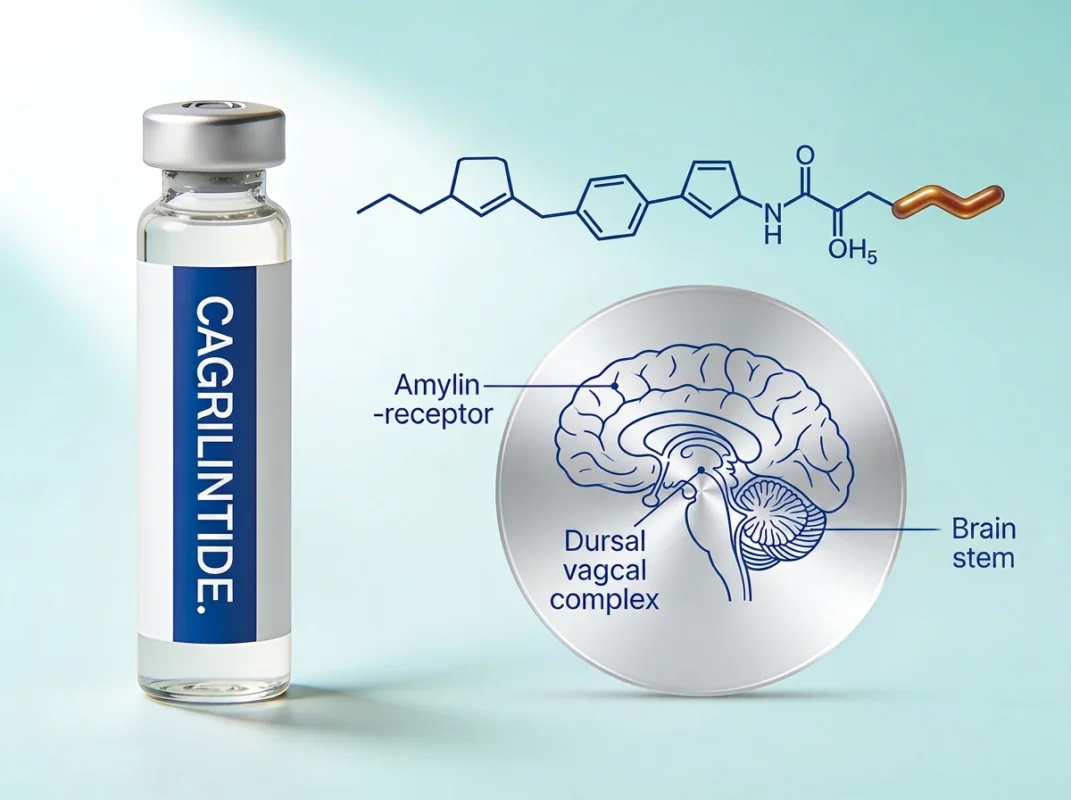
Cagrilintide is a long-acting, lipid-modified analog of human amylin, a 37-amino-acid peptide hormone co-secreted with insulin from pancreatic beta cells. The modifications that distinguish cagrilintide from native amylin give it the stability and duration needed for once-weekly administration in research and clinical settings [Ref. 1].
Amylin itself is one of the body’s satiety signals, and cagrilintide was developed to harness that pathway as a durable, long-acting research and therapeutic candidate — particularly in combination with GLP-1 receptor agonists, whose appetite-suppressing mechanism is separate but complementary [Ref. 1].
Cagrilintide has not been approved by FDA, Health Canada, EMA, MHRA, or any other Western regulatory agency as a standalone product. Its development has focused on the CagriSema combination, which was submitted to the US FDA in late 2025 [Ref. 5]. Research-grade Cagrilintide sold for laboratory research is intended exclusively for that purpose.
Mechanism of Action
Cagrilintide’s mechanism is agonism at the amylin and calcitonin receptor system, producing appetite suppression through brain circuits distinct from the GLP-1 pathway.
Amylin receptor agonism. Amylin signals through receptors formed by the calcitonin receptor (CTR) in combination with receptor activity-modifying proteins (RAMP1, 2, or 3), producing the amylin receptors AMY1–3. Cagrilintide acts as a long-acting agonist at this receptor system [Ref. 2].
Central appetite suppression. Cagrilintide reduces body weight largely through brain amylin receptors — particularly in neuron populations of the brainstem dorsal vagal complex, a key hub for satiety signaling — engaging both homeostatic and hedonic (reward-related) appetite circuits [Ref. 2][Ref. 3].
Additive effect with GLP-1 agonists. Because amylin and GLP-1 suppress appetite through separate but related mechanisms, combining an amylin analog with a GLP-1 receptor agonist produces an additive effect on appetite reduction — the rationale behind the CagriSema combination [Ref. 1].
Compound distinction. Cagrilintide works through the amylin/calcitonin receptor system, mechanistically distinct from the GLP-1 receptor agonism of Semaglutide, the dual GIP/GLP-1 agonism of Tirzepatide, and the triple agonism of Retatrutide. It is the amylin-axis member of the metabolic research cluster.
Research Applications
Cagrilintide research centers on weight management, both as a monotherapy and, more prominently, in combination.
Monotherapy weight-management research. In a phase 2 monotherapy trial, once-weekly cagrilintide produced approximately 10.8% weight loss at 26 weeks, compared with about 3.0% for placebo [Ref. 1].
CagriSema combination research. The most significant application. The phase 3 REDEFINE 1 trial evaluated CagriSema (cagrilintide plus semaglutide) in adults with obesity without type 2 diabetes over 68 weeks and reported approximately 22.7% weight loss, versus about 11.8% for cagrilintide alone, 16.1% for semaglutide alone, and 2.3% for placebo. REDEFINE 2, in adults with type 2 diabetes, reported approximately 15.7% weight loss [Ref. 4].
Broader research domains. Cagrilintide and the amylin axis have additionally been studied across:
- Glycemic control and type 2 diabetes research
- Energy-balance and satiety neurobiology (dorsal vagal complex)
- Comparative and combination pharmacology with incretin agonists
Across all research domains, research-grade Cagrilintide is intended for laboratory research only in the Kinetic Compounds context. The compound has not been approved by FDA, Health Canada, or any other Western regulatory agency as a standalone product.
Dosing & Reconstitution for Research
Researchers working with lyophilized Cagrilintide reconstitute the compound with bacteriostatic water before use. The reconstitution math follows the standard concentration-equals-mass-divided-by-volume principle covered in our reconstitution tutorial.
A 5 mg vial of Cagrilintide reconstituted with 2 mL of bacteriostatic water yields 2.5 mg/mL. A 10 mg vial in 2 mL yields 5 mg/mL. Cagrilintide’s long-acting design is relevant to research scheduling, as it is studied on a once-weekly basis. Researchers can verify their concentration math against our peptide reconstitution calculator.
This article does not provide dosing guidance for any therapeutic purpose. Research-grade Cagrilintide is intended for laboratory research only.
Storage & Handling
Lyophilized Cagrilintide is stable at room temperature during shipping but should be moved to long-term storage at -20°C (-4°F), protected from light, on receipt. Under proper lyophilized conditions, the compound remains stable for 24 months or longer.
Once reconstituted, Cagrilintide should be stored at 2–8°C and used within 28 days. The general storage principles for research peptides apply directly — see our storage and stability guide for detailed protocols including freeze-thaw considerations and aliquoting strategies.
Every vial should be visually inspected before use. The reconstituted solution should be clear and free of particulates. Cloudiness, discoloration, or visible sediment indicates degradation, and the vial should not be used in research.
Sourcing Verified Cagrilintide for Research
As a peptide analog, Cagrilintide can be verified by HPLC for purity and mass spectrometry for identity confirmation. Researchers sourcing Cagrilintide should require a current, batch-specific third-party Certificate of Analysis. The principles of reading a research peptide COA are covered in detail in our reading a Certificate of Analysis article, and our third-party testing methodology is documented in our Janoshik Analytical methodology article.
For the metabolic research peptides in the Kinetic Compounds catalog — including Semaglutide, Tirzepatide, and Retatrutide — every batch is tested through Janoshik Analytical, an independent third-party laboratory, with current reports published on each product page. Our broader testing methodology is documented on our lab testing and COA page.
Researching the amylin axis, incretin pharmacology, or combination weight-management approaches? The Kinetic Compounds catalog covers metabolic research peptides including Semaglutide, Tirzepatide, and Retatrutide — all independently lab-tested with current Certificates of Analysis available on each product page. Explore the full research peptide catalog through our shop.
Related Peptides
Related peptides will load here via PHP snippet.
Available for Research
Research Tools
Quality Promise
very batch independently tested by Janoshik Analytical. 98% purity minimum.
Frequently Asked Questions
What is Cagrilintide?
<p>Cagrilintide is a long-acting, lipid-modified analog of human amylin — a pancreatic hormone co-secreted with insulin that signals satiety. It is designed for once-weekly administration and is studied mainly for weight management.</p>
How does Cagrilintide work?
<p>It acts as an agonist at the amylin/calcitonin receptor system (calcitonin receptor combined with RAMP proteins), suppressing appetite through brainstem circuits in the dorsal vagal complex. This mechanism is separate from, and additive to, GLP-1 receptor agonists.</p>
What is CagriSema?
<p>CagriSema is the combination of cagrilintide and semaglutide (a GLP-1 receptor agonist). Because the two act through complementary appetite pathways, the combination produces greater weight loss than either component alone.</p>
How much weight loss has Cagrilintide shown in trials?
<p>In phase 2 monotherapy, about 10.8% at 26 weeks. In the phase 3 REDEFINE 1 trial, cagrilintide alone reached about 11.8% and the CagriSema combination about 22.7% at 68 weeks, versus 2.3% for placebo.</p>
Is Cagrilintide FDA-approved?
<p>No. Cagrilintide is not approved as a standalone product. Development has focused on the CagriSema combination, which was submitted to the US FDA in late 2025. Research-grade cagrilintide is intended for laboratory research only.</p>
How is Cagrilintide reconstituted for research?
<p>Lyophilized Cagrilintide is reconstituted with bacteriostatic water. A 5 mg vial in 2 mL yields 2.5 mg/mL. It is a long-acting peptide studied on a once-weekly basis. Researchers can verify calculations using our reconstitution calculator.</p>
Is research-grade Cagrilintide legal in Canada?
<p>Research-grade Cagrilintide is legal to purchase and possess in Canada for laboratory research purposes only. The compound is not approved by Health Canada for human therapeutic use.</p>
References
- Cagrilintide: A Long-Acting Amylin Analog for the Treatment of Obesity
- Cagrilintide lowers bodyweight through brain amylin receptors 1 and 3
- A Cross-Species Atlas of the Dorsal Vagal Complex Reveals Neural Mediators of Cagrilintide's Effects on Energy Balance
- CagriSema REDEFINE 1 and REDEFINE 2 phase 3 results
- Novo Nordisk files for FDA approval of CagriSema for weight management
Continue Reading
For Research Use Only Products described on this site are intended for laboratory research purposes only. They are not approved by Health Canada for human consumption, diagnosis, treatment, or prevention of any medical condition.