
Home / Research Articles / FDA PCAC to Review Peptide Compounding: What the July 2026 Hearing Means
FDA PCAC to Review Peptide Compounding: What the July 2026 Hearing Means
Key Takeaways
- HHS Secretary RFK Jr. announced February 27, 2026 that ~14 of 19 previously restricted compounding peptides will move from Category 2 back to Category 1.
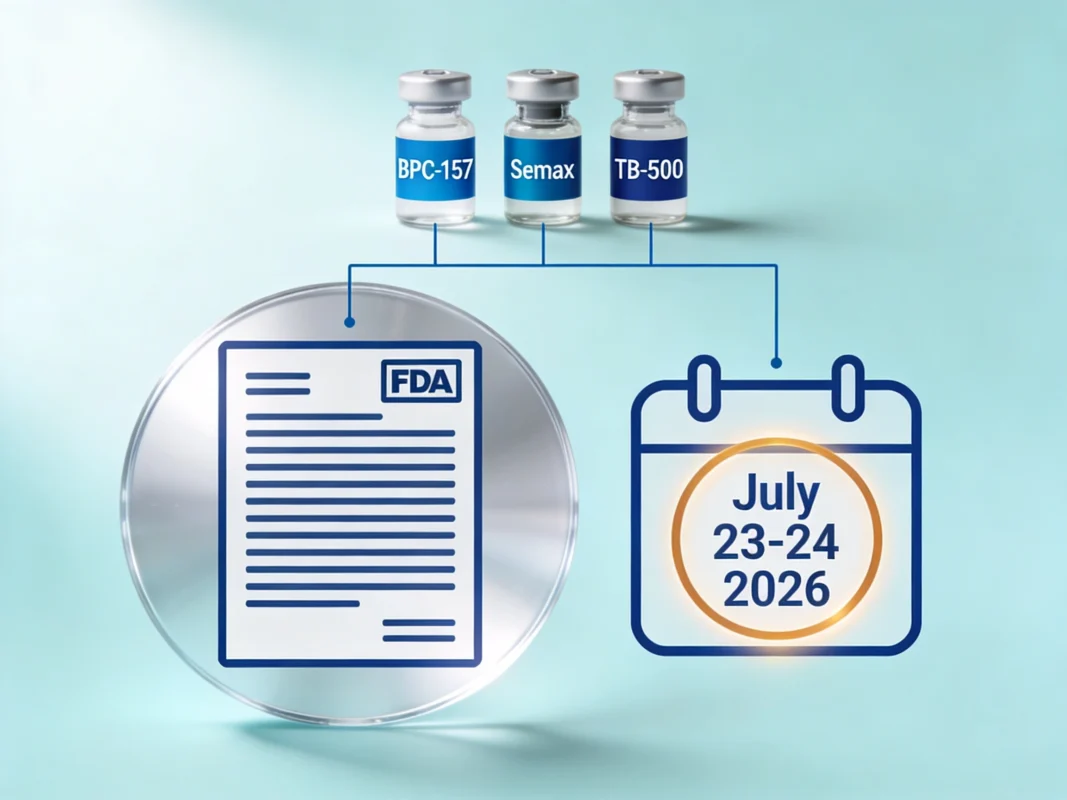
- The FDA's Pharmacy Compounding Advisory Committee meets July 23-24, 2026 at FDA White Oak Campus to formally consider reclassification recommendations for seven peptides.
- Peptides under July 2026 review include BPC-157, TB-500, Epitalon, Semax, Emideltide, and others; an additional 5 peptides will be reviewed before February 2027.
- Stakeholder written comments to docket FDA-2025-N-6895 are due July 9, 2026 to be presented to the committee; the docket remains open through July 22, 2026.
- This reclassification process concerns FDA compounding pharmacy permissions only — it does not constitute FDA approval of any peptide as a pharmaceutical drug.
On April 16, 2026, the U.S. Food and Drug Administration (FDA) published a Federal Register notice announcing that the Pharmacy Compounding Advisory Committee (PCAC) will convene on July 23 and 24, 2026, to evaluate the addition of seven peptides to the Section 503A Bulk Drug Substances List [Ref. 1, Ref. 2]. The hearing represents the most consequential FDA regulatory activity affecting peptide research and compounding since the agency’s 2023 decision to place these substances in restricted Category 2 status.
This article addresses what the PCAC hearing process is, which peptides are under review, what the regulatory landscape looks like now, and what researchers in the peptide research space should understand about the upcoming hearing. The article is informational and process-focused — Kinetic Compounds is not taking a position for or against any specific reclassification outcome, and the article does not predict what the committee will recommend or what the FDA will ultimately decide.
What the PCAC Process Is
The Pharmacy Compounding Advisory Committee is a federal advisory committee within the FDA structure that makes recommendations to the agency on which bulk drug substances should be permitted for use in compounded medications under Section 503A of the Federal Food, Drug, and Cosmetic Act. The committee’s recommendations are advisory rather than binding — the FDA Commissioner and ultimately the Secretary of Health and Human Services make final regulatory decisions, but PCAC recommendations carry substantial weight in the process [Ref. 3].
Section 503A of the FDCA governs traditional pharmacy compounding — the preparation of customized medications by licensed pharmacies for individual patients with valid prescriptions. The statute establishes a “Bulks List” of substances that compounding pharmacies are permitted to use as starting materials. Substances on the Bulks List in Category 1 are permitted for compounding; substances in Category 2 face restrictions due to safety or efficacy concerns identified by the FDA; substances in Category 3 are under active review.
The FDA’s interest in this regulatory area extends across all bulk substances used in pharmacy compounding, but peptides have become a focal point in 2026 because of the growing clinical and research interest in peptide therapeutics, the substantial gray and black market activity around unregulated peptide sales, and recent public statements by Health and Human Services Secretary Robert F. Kennedy Jr. expressing support for expanded patient access to peptide compounds [Ref. 4].
Which Peptides Are Under Review
The July 23-24, 2026 PCAC hearing will consider seven peptides for potential inclusion on the Section 503A Bulks List. Coverage of the FDA Federal Register notice identifies the following peptides among those under review [Ref. 1, Ref. 2, Ref. 3]:
| Peptide | Primary research indication area |
|---|---|
| BPC-157 | Wound healing, ulcerative colitis, inflammatory conditions |
| TB-500 (Thymosin β4) | Wound healing, inflammatory conditions |
| Epitalon | Insomnia, longevity-adjacent research |
| Semax | Cerebral ischemia, cognitive conditions |
| Emideltide | Opioid withdrawal research |
| (Additional compounds) | Various indications including osteoporosis |
(The exact roster of the seven compounds under review is documented in the FDA Federal Register notice and the related industry coverage. The list above includes the most commonly identified compounds across the multiple sources that have covered the hearing announcement.)
A second PCAC meeting scheduled before the end of February 2027 will review five additional peptides, bringing the total number of compounds under regulatory review across the two hearings to 12. The FDA has not yet announced the specific compounds under review at the February 2027 meeting.
Several compounds on the July 2026 review list have substantial coverage in the Kinetic Compounds Research Library: our BPC-157 complete research guide, TB-500 mechanism deep dive, and Semax mechanism deep dive cover the research literature for those compounds in detail.
How Compounds Reach the Bulks List
The pathway from PCAC hearing to changed regulatory status involves several distinct steps that are worth understanding because the outcome is not predetermined by the hearing itself.
Step 1 — Hearing. The committee reviews data, hears public comment, and discusses each substance under consideration. The data reviewed includes available clinical research, safety information, and analytical characterization of each compound.
Step 2 — Committee recommendation. The committee votes on whether to recommend the substance for Category 1 status (permitted for compounding), Category 2 status (restricted), or further review. The recommendation is advisory.
Step 3 — FDA evaluation. The FDA evaluates the PCAC recommendation alongside its own analysis, public comments, and broader regulatory considerations.
Step 4 — Final regulatory action. The FDA either accepts the PCAC recommendation, modifies it, or declines to act. Changes to the Bulks List require formal rulemaking or Secretary-level decision.
The FDA Law Blog analysis of the April 2026 announcement notes that Section 503A(c) provides the Secretary with authority to bypass the standard advisory committee consultation process under specific circumstances, which has prompted some commentary about whether Secretary Kennedy could act independently of the PCAC process [Ref. 2]. As of publication of this article, no such bypass action has been announced.
Public Comment Process
The FDA has established Docket FDA-2025-N-6895 to collect public comments related to the July 2026 hearing. The docket is open until July 22, 2026 [Ref. 3]. Comments received by July 9 will be presented to the committee at the meeting; comments received between July 9 and July 22 enter the docket record but do not feed into the committee deliberations directly.
Public comment in advisory committee proceedings is typically used by researchers, clinicians, patients, pharmaceutical and compounding industry stakeholders, and members of the public to provide input on the substances under review. Comments can address clinical research evidence, safety considerations, manufacturing and quality concerns, patient access issues, or any other relevant matter. The docket is publicly accessible and comments become part of the regulatory record.
A public docket has not yet been announced for the February 2027 second meeting; the FDA typically announces docket information closer to the hearing date for advisory committee meetings.
The Broader Regulatory Landscape in 2026
The PCAC hearing is one element of a broader peptide regulatory landscape in flux through 2026. Several other regulatory developments provide context.
April 30, 2026 GLP-1 outsourcing facility proposal. The FDA proposed removing GLP-1 receptor agonists (Semaglutide, Tirzepatide) from the 503B outsourcing facilities list as the national drug shortage resolved [Ref. 4]. This is a separate regulatory pathway from the 503A pharmacy compounding context but reflects the broader FDA focus on the peptide regulatory environment.
Health Secretary Kennedy public statements. HHS Secretary Robert F. Kennedy Jr. has publicly expressed support for expanded peptide access, including in a February 27, 2026 appearance on Joe Rogan’s podcast where Kennedy described himself as “a big fan” of peptides [Ref. 3]. The political signal from HHS leadership may shape how the FDA acts on PCAC recommendations.
Enforcement against gray-market vendors. The FDA has increased enforcement under the Federal Food, Drug, and Cosmetic Act against vendors and telehealth platforms making unlawful drug claims about unapproved peptide compounds. This enforcement activity is distinct from the regulatory reclassification questions under PCAC review but operates in the same broader policy environment.
These parallel developments suggest that 2026 represents a transitional period in peptide regulation in the United States — with simultaneous tightening of enforcement against unauthorized claims and potential loosening of restrictions on compounded pharmacy preparation. The outcome of the July 2026 PCAC hearing will be one important signal about which direction the broader policy environment ultimately takes.
What This Means for Research-Grade Compounds
Several points of clarification matter for understanding what the PCAC hearing does and does not affect.
The PCAC hearing is about 503A pharmacy compounding, not research-grade compound availability. Section 503A governs how licensed pharmacies prepare compounded medications for individual patients with valid prescriptions. Research-grade compounds sold for laboratory research operate under a separate regulatory framework. Whatever the PCAC recommends, research-grade peptides will continue to be available for laboratory research purposes under existing regulations governing research chemicals.
The hearing does not change the scientific research literature. The peer-reviewed research on each compound under PCAC review — the BPC-157 angiogenesis research documented in our complete research guide, the TB-500 actin sequestration mechanism, the Semax neurotrophic effects — exists independently of the regulatory compounding determination. The scientific literature is what it is regardless of what the committee recommends.
Kinetic Compounds’ position remains unchanged. Kinetic Compounds sells research-grade peptides for laboratory research use only. Every compound ships with a Janoshik Analytical Certificate of Analysis published on the product page. The PCAC hearing process does not change this — research-grade material is intended for research, not clinical use, and the regulatory framework governing research-grade compounds is separate from the 503A compounding framework under PCAC review.
Researchers should not extrapolate regulatory action to research utility. Whatever the FDA ultimately decides about Section 503A status, the decision reflects regulatory considerations about pharmacy compounding for individual patients — not a determination about whether a compound is useful for laboratory research. The scientific research base for these compounds, documented across our research library, is the relevant evaluative framework for research applications.
The Bigger Picture
The July 2026 PCAC hearing and the February 2027 follow-up meeting represent the most substantive FDA engagement with peptide regulatory policy in years. Whatever the committee recommends and whatever the FDA ultimately decides, the regulatory record being created at these hearings will shape the legal and regulatory environment for peptide compounding, research, and clinical use for years to come.
The hearings come at a moment of substantial growth in peptide therapeutic interest — driven by the success of GLP-1 receptor agonists like Semaglutide and Tirzepatide in obesity and metabolic conditions, ongoing Phase 3 development of novel peptides like Retatrutide (covered in our TRIUMPH-1 Phase 3 results article), and substantial public and patient interest in compounds like BPC-157, TB-500, Semax, and others that occupy regulatory gray areas in the current framework.
The Research Library will be updated with coverage of the hearing outcomes when they are announced.
Sourcing Verified Peptides Through the Regulatory Transition
Researchers working with compounds currently under FDA regulatory review can continue to source research-grade material through clearly research-focused channels. Kinetic Compounds tests every batch of every peptide through Janoshik Analytical, an independent third-party laboratory, with batch-specific Certificates of Analysis published on every product page. The principles of evaluating research peptide quality are covered in detail in our reading a Certificate of Analysis article and our Janoshik Analytical methodology article.
Whatever the regulatory outcome of the PCAC hearings, research-grade compound quality is determined by the analytical testing performed on each batch — not by the regulatory category status of the compound class. Researchers should continue to evaluate suppliers based on testing methodology, COA transparency, and third-party verification rather than on regulatory category status.
The Kinetic Compounds Research Library covers many compounds currently under FDA regulatory review: our BPC-157 complete research guide, TB-500 mechanism deep dive, and Semax mechanism deep dive provide the research literature foundation for those compounds. Research-grade material is available through our research peptide catalog with current Certificates of Analysis on every product page.
Available for Research
Research Tools
Quality Promise
very batch independently tested by Janoshik Analytical. 98% purity minimum.
Frequently Asked Questions
What is the FDA PCAC?
<p>The Pharmacy Compounding Advisory Committee (PCAC) is a federal advisory committee that makes recommendations to the FDA on which bulk drug substances should be permitted for use in compounded medications under Section 503A of the Federal Food, Drug, and Cosmetic Act. The committee's recommendations are advisory rather than binding — the FDA makes final regulatory decisions.</p>
When is the PCAC peptide hearing?
<p>July 23-24, 2026, at the FDA's White Oak Campus in Silver Spring, Maryland. A second meeting before the end of February 2027 will review additional peptides.</p>
Which peptides are under review?
<p>Seven peptides are under review at the July 2026 hearing, including BPC-157, TB-500, Epitalon, Semax, and Emideltide, among others. Five additional peptides will be reviewed at the February 2027 meeting, bringing the total under regulatory review across both hearings to 12 compounds.</p>
How can I submit a public comment?
<p>Public comments can be submitted to FDA Docket FDA-2025-N-6895 until July 22, 2026. Comments received by July 9 will be presented to the committee at the meeting; comments received after July 9 enter the regulatory record but do not feed into committee deliberations. Submission is through the regulations.gov portal.</p>
What happens if the committee recommends approval?
<p>A PCAC recommendation is advisory. The FDA evaluates committee recommendations alongside its own analysis and broader regulatory considerations before making final decisions on Section 503A Bulks List composition. Changes to the Bulks List typically require formal rulemaking.</p>
Does this affect research-grade compound availability?
<p>No. Section 503A governs pharmacy compounding for individual patients with prescriptions, which is a separate regulatory framework from research-grade compound availability for laboratory research. Whatever the PCAC recommends, research-grade peptides will continue to be available for laboratory research purposes under existing regulations.</p>
When will the hearing outcomes be known?
<p>The PCAC will vote on recommendations at the July 23-24, 2026 meeting. The committee's recommendations will be public following the meeting. The FDA's response to the recommendations — which determines actual regulatory changes — typically follows over a longer timeline, often months to years depending on the complexity of the regulatory action required.</p>
References
- Ref. 1 — Foley & Lardner LLP (May 2026). "FDA to Consider Lifting Restrictions on Numerous Compounded Peptides."
- Ref. 2 — FDA Law Blog (April 21, 2026). "FDA's Pep(tide) Rally! What Compounders and Industry Need to Know."
- Ref. 3 — Regulatory Affairs Professionals Society (April 17, 2026). "FDA considers adding a dozen peptides to its bulk drug compounding list."
- Ref. 4 — HealthDay / U.S. News & World Report (April 17, 2026). "FDA To Review Whether To Allow More Access To Certain Peptides."
Continue Reading
For Research Use Only Products described on this site are intended for laboratory research purposes only. They are not approved by Health Canada for human consumption, diagnosis, treatment, or prevention of any medical condition.