
Home / Research Articles / Hexarelin: Mechanism, Research, and Applications
Hexarelin: Mechanism, Research, and Applications
Key Takeaways
- Hexarelin is a synthetic hexapeptide growth hormone secretagogue (GHRP) — sequence His-D-2-Me-Trp-Ala-Trp-D-Phe-Lys-NH2, molecular weight ~887 g/mol.
- It is one of the most potent GHRPs, triggering strong GH release via the ghrelin/GHS-R1a receptor with downstream IGF-1 increases.
- Hexarelin also binds the scavenger receptor CD36, producing cardioprotective effects that appear largely independent of growth hormone.
- Research spans GH secretion and GH deficiency plus cardiovascular protection in ischemia-reperfusion and post-myocardial-infarction models.
- Hexarelin is not approved by FDA, Health Canada, EMA, or any Western regulatory agency; research-grade material is for laboratory research only.
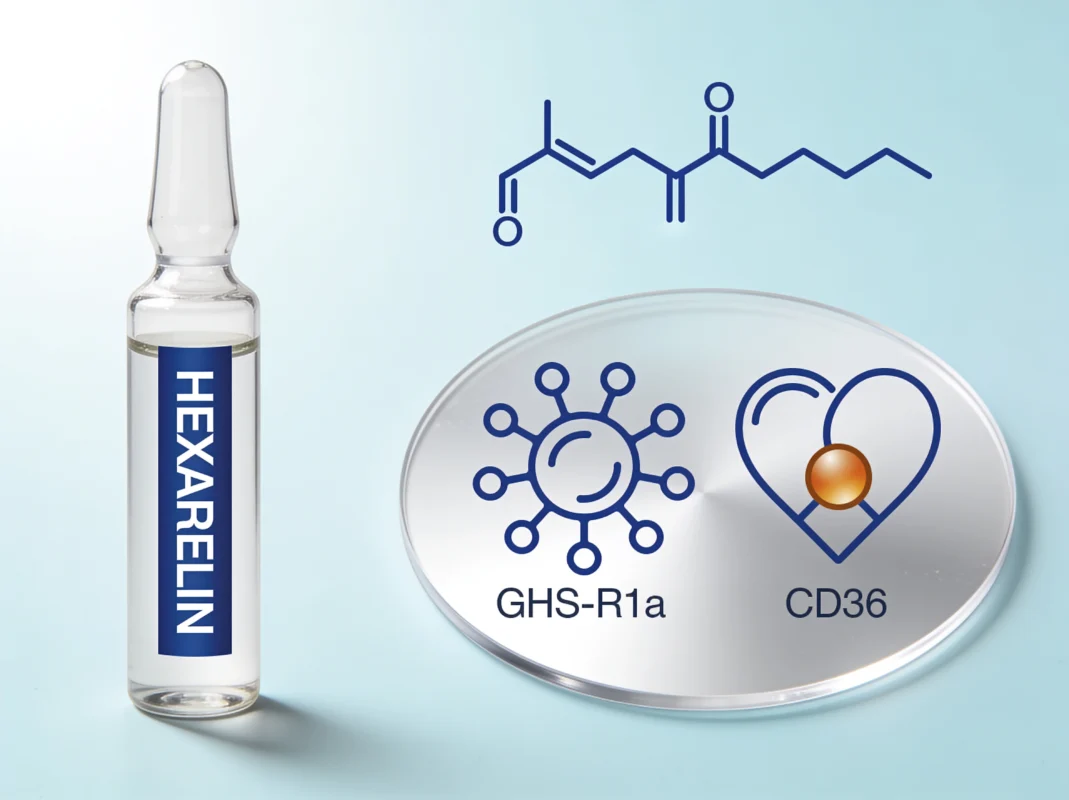
Hexarelin completes the Kinetic Compounds growth-hormone-secretagogue set alongside Ipamorelin, GHRP-6, and the CJC-1295 GHRH analogs. It is one of the most potent growth-hormone-releasing peptides (GHRPs) in the research literature — but its distinguishing feature is a second mechanism entirely: in addition to stimulating growth hormone, Hexarelin acts on the cardiac scavenger receptor CD36, producing cardioprotective effects that appear largely independent of growth hormone. This dual identity makes it a research tool studied in two separate fields, neuroendocrinology and cardiovascular biology.
This article addresses Hexarelin as a research compound: its structure as a synthetic GHRP hexapeptide, its dual GHS-R1a and CD36 mechanism, the research applications spanning growth hormone release and cardiac protection, and the reconstitution and sourcing considerations researchers should understand before working with the compound.
What Is Hexarelin?
Hexarelin is a synthetic growth-hormone-releasing peptide — a hexapeptide (six amino acids), sequence His-D-2-methyl-Trp-Ala-Trp-D-Phe-Lys-NH2, with a molecular weight of approximately 887 g/mol. It belongs to the GHRP family, alongside compounds such as GHRP-6 and GHRP-2.
Hexarelin is recognized as one of the most potent GHRPs, producing robust and sustained growth hormone elevations. Research in healthy subjects has documented peak plasma GH concentrations many fold above baseline following subcutaneous administration, with downstream increases in insulin-like growth factor 1 (IGF-1) [Ref. 3].
What sets Hexarelin apart from most GHRPs is its well-characterized interaction with the receptor CD36, through which it exerts cardiovascular effects that are substantially independent of GH release [Ref. 1]. This makes it mechanistically distinct from GH-selective secretagogues.
Hexarelin has not been approved by FDA, Health Canada, EMA, MHRA, or any other Western regulatory agency for human therapeutic use. Research-grade Hexarelin sold for laboratory research is intended exclusively for that purpose.
Mechanism of Action
Hexarelin acts through two distinct receptors, giving it a dual mechanism that is central to its research interest.
Ghrelin receptor (GHS-R1a) agonism. Hexarelin binds and activates the growth hormone secretagogue receptor type 1a (GHS-R1a), the primary receptor mediating GH release from the pituitary. This high-affinity activation drives potent, pulsatile GH secretion and downstream IGF-1 elevation [Ref. 3].
CD36 receptor and cardioprotection. Hexarelin also binds CD36, a multifunctional glycoprotein expressed in cardiomyocytes and microvascular endothelial cells. Activation of CD36 mediates cardiovascular actions — including effects on coronary perfusion — that are largely independent of growth hormone release [Ref. 1][Ref. 5].
Intracellular signaling. GH release engages a protein kinase C (PKC)-dependent pathway downstream of receptor activation, while the CD36 pathway has been linked to PPAR-gamma activation, connecting Hexarelin to research on atherosclerosis, lipid metabolism, and mitochondrial biogenesis [Ref. 1].
Compound distinction. Among GHRPs, Hexarelin is distinguished by its potent GH-releasing activity combined with a GH-independent cardioprotective mechanism through CD36 — a feature not shared by GH-selective secretagogues such as Ipamorelin.
Research Applications
Hexarelin research falls into two largely separate domains, reflecting its dual mechanism.
Growth hormone secretion research. As a potent GHRP, Hexarelin is studied as a tool for stimulating GH release and as a probe of the GH/IGF-1 axis, including in models of growth hormone deficiency [Ref. 4].
Cardiovascular protection. The most distinctive domain. In myocardial ischemia-reperfusion injury models, Hexarelin treatment has been shown to reduce infarct size and improve left-ventricular function, and it discloses protective activity against cardiovascular damage even in states of growth hormone deficiency — consistent with a CD36-mediated, GH-independent mechanism [Ref. 2][Ref. 1].
Broader research domains. Hexarelin and the CD36 pathway have additionally been studied across:
- Post-myocardial-infarction cardiac function research [Ref. 4]
- Atherosclerosis and lipid-metabolism research (via PPAR-gamma)
- Comparative GHRP pharmacology (Hexarelin vs GHRP-6, Ipamorelin)
The evidence base includes phase 2 clinical research and extensive preclinical cardiovascular work, though the cardiovascular findings have not been translated to human cardiovascular endpoints. Across all research domains, research-grade Hexarelin is intended for laboratory research only in the Kinetic Compounds context.
Dosing & Reconstitution for Research
Researchers working with lyophilized Hexarelin reconstitute the compound with bacteriostatic water before use. The reconstitution math follows the standard concentration-equals-mass-divided-by-volume principle covered in our reconstitution tutorial.
A 5 mg vial of Hexarelin reconstituted with 2 mL of bacteriostatic water yields 2.5 mg/mL. A 10 mg vial in 2 mL yields 5 mg/mL. As a GHRP, Hexarelin is often studied alongside GHRH analogs such as CJC-1295, on the rationale that the two peptide classes engage complementary GH-release pathways. Researchers can verify their concentration math against our peptide reconstitution calculator.
This article does not provide dosing guidance for any therapeutic purpose. Research-grade Hexarelin is intended for laboratory research only.
Storage & Handling
Lyophilized Hexarelin is stable at room temperature during shipping but should be moved to long-term storage at -20°C (-4°F), protected from light, on receipt. Under proper lyophilized conditions, the compound remains stable for 24 months or longer.
Once reconstituted, Hexarelin should be stored at 2–8°C and used within 28 days. The general storage principles for research peptides apply directly — see our storage and stability guide for detailed protocols including freeze-thaw considerations and aliquoting strategies.
Every vial should be visually inspected before use. The reconstituted solution should be clear and free of particulates. Cloudiness, discoloration, or visible sediment indicates degradation, and the vial should not be used in research.
For full handling protocols across the broader peptide catalog, see our storage and reconstitution guide.
Sourcing Verified Hexarelin for Research
Hexarelin’s small, defined hexapeptide structure makes analytical verification by mass spectrometry straightforward, with HPLC confirming purity and MS confirming the expected ~887 Da mass.
A credible Certificate of Analysis for Hexarelin should show HPLC purity expressed as a percentage, mass spectrometry confirmation matching ~887 Da, and a clear distinction between peptide content and peptide mass. The principles of reading a research peptide COA are covered in detail in our reading a Certificate of Analysis article, and our specific third-party testing methodology is documented in our Janoshik Analytical methodology article.
Kinetic Compounds tests every batch of Hexarelin through Janoshik Analytical, an independent third-party laboratory. Current batch reports are published on the Hexarelin product page. Our broader testing methodology is documented on our lab testing and COA page.
For researchers working across the broader GH-axis cluster, Ipamorelin, GHRP-6, and CJC-1295 are mechanistically related research compounds in the Kinetic Compounds catalog. The full research peptide catalog is available through our shop.
Related Peptides
Related peptides will load here via PHP snippet.
Available for Research
Research Tools
Quality Promise
very batch independently tested by Janoshik Analytical. 98% purity minimum.
Frequently Asked Questions
What is Hexarelin?
<p>Hexarelin is a synthetic growth-hormone-releasing peptide (GHRP) — a hexapeptide that potently stimulates GH release. It is distinguished from other GHRPs by also acting on the cardiac receptor CD36.</p>
How does Hexarelin work?
<p>It activates the ghrelin receptor (GHS-R1a) in the pituitary to drive potent GH secretion and downstream IGF-1, and it separately binds CD36 in cardiac tissue to produce cardiovascular effects that are largely independent of growth hormone.</p>
What is special about Hexarelin's cardiac effects?
<p>Hexarelin binds CD36, a glycoprotein in cardiomyocytes and microvascular endothelial cells. Through CD36 it shows cardioprotective effects in ischemia-reperfusion and post-infarction models that appear substantially independent of its GH-releasing activity — a feature most GHRPs lack.</p>
What does Hexarelin research focus on?
<p>Two domains: growth hormone secretion (and GH-deficiency models), and cardiovascular protection (ischemia-reperfusion injury, post-myocardial-infarction cardiac function, and atherosclerosis via the CD36/PPAR-gamma pathway).</p>
How does Hexarelin compare to other GHRPs like Ipamorelin or GHRP-6?
<p>All are GHS-R1a agonists that release GH. Hexarelin is among the most potent and adds a GH-independent cardioprotective mechanism via CD36. Ipamorelin is valued for being more selective with fewer off-target effects. They are often compared in GHRP pharmacology research.</p>
Is Hexarelin approved as a medication?
<p>No. Hexarelin has not been approved by FDA, Health Canada, EMA, MHRA, or any other Western regulatory agency for human therapeutic use. Research-grade Hexarelin is intended for laboratory research only.</p>
Is research-grade Hexarelin legal in Canada?
<p>Research-grade Hexarelin is legal to purchase and possess in Canada for laboratory research purposes only. The compound is not approved by Health Canada for human therapeutic use.</p>
References
- CD36 Mediates the Cardiovascular Action of Growth Hormone-Releasing Peptides in the Heart
- The Growth Hormone Secretagogue Hexarelin Protects Rat Cardiomyocytes From Ischemia/Reperfusion Injury via IL-1 Signaling
- Identification and Characterization of a New Growth Hormone-Releasing Peptide Receptor in the Heart
- The growth hormone secretagogue hexarelin improves cardiac function in rats after experimental myocardial infarction
- Identification of the growth hormone-releasing peptide binding site in CD36: a photoaffinity cross-linking study
Continue Reading
For Research Use Only Products described on this site are intended for laboratory research purposes only. They are not approved by Health Canada for human consumption, diagnosis, treatment, or prevention of any medical condition.