
Home / Research Articles / Janoshik Analytical: How Independent Third-Party Testing Works
Janoshik Analytical: How Independent Third-Party Testing Works
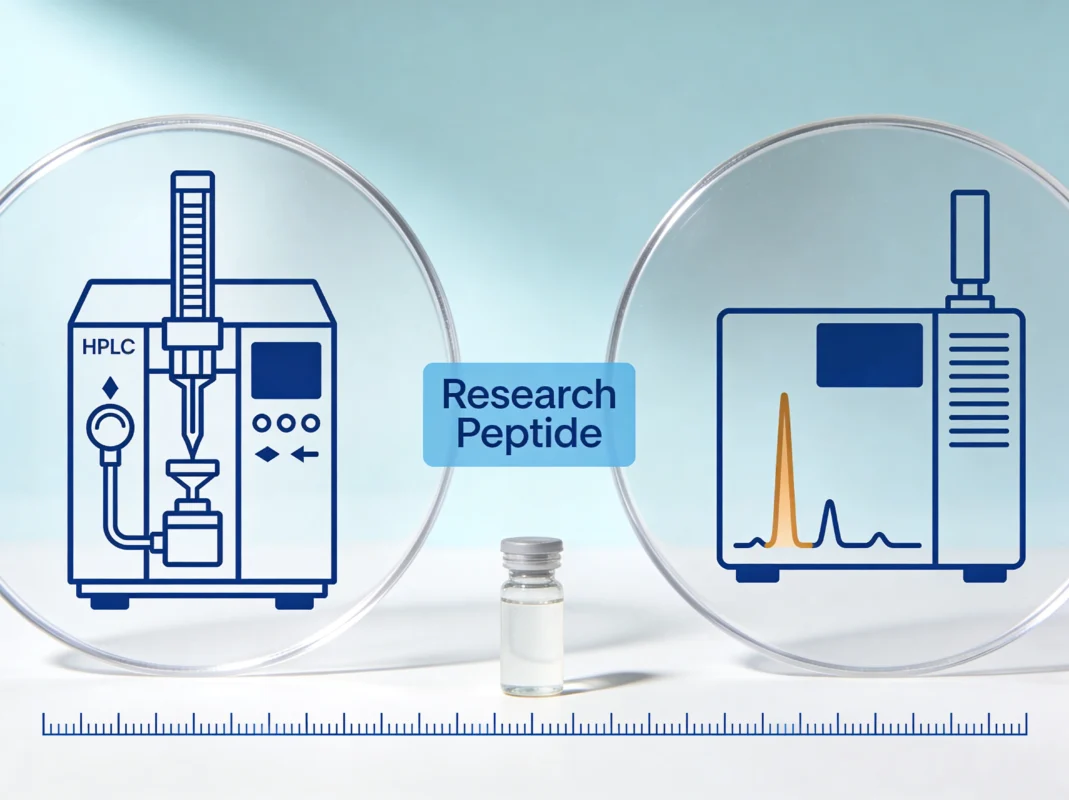
Key Takeaways
- Janoshik Analytical is an independent third-party laboratory specializing in research peptide analytical verification through HPLC purity and mass spectrometry identity confirmation.
- The methodology combines reverse-phase HPLC with UV detection for purity quantification alongside mass spectrometry analysis for molecular weight identity confirmation.
- Each Kinetic Compounds batch undergoes Janoshik testing with published batch-specific Certificate of Analysis available on each product page for full transparency.
- Third-party verification distinguishes credible research peptide vendors from vendors relying solely on internal testing — independent analysis prevents conflict-of-interest bias.
- The methodology meets industry standards for research peptide identity and purity verification — HPLC purity percentages, mass match confirmation, and peptide content distinction.
A Certificate of Analysis is only as credible as the laboratory that produced it. The analytical methodology behind the document — what instruments were used, how samples were prepared, what controls were applied, who had access to the results — determines whether the COA functions as genuine analytical verification or as marketing copy formatted to look like analytical verification. The difference is not visible from the document itself, which is why understanding the methodology that produces credible COAs is essential for any researcher relying on peptide quality documentation.
This article addresses the analytical methodology behind every Kinetic Compounds Certificate of Analysis, with Janoshik Analytical — the independent third-party laboratory that tests every batch of every product — referenced as the specific implementation. The companion reading a Certificate of Analysis article covers how to interpret the COA document itself; this article covers how the COA is produced.
Why Third-Party Testing Differs From In-House Testing
The structural distinction between independent third-party testing and in-house manufacturer testing is the foundational quality consideration. The two are not analytically equivalent — they produce different kinds of documentation backed by different incentive structures.
In-house manufacturer testing is performed by the same organization that produces and sells the peptide. The analytical laboratory is part of the manufacturing operation, with reporting lines that ultimately converge on the same leadership and financial interest in the product. The manufacturer has an inherent conflict of interest: a batch that fails its specifications is a financial loss, and the same people who own that financial loss control the test results. This conflict does not necessarily produce dishonest results — many manufacturers operate in-house labs with full integrity — but the structural conflict exists, and the documentation cannot demonstrate it has been overcome from the outside.
Independent third-party testing is performed by an analytical laboratory with no financial stake in the result. The testing laboratory’s commercial interest is in producing accurate results consistently across all clients — and accuracy is the product they sell. A third-party laboratory that produced selectively favorable results would lose the trust of every client simultaneously, which is a stronger commercial pressure toward integrity than the manufacturer’s incentive toward favorable findings.
This distinction is one of the foundational quality considerations addressed in pharmaceutical analytical standards. FDA guidance on synthetic peptide drug products emphasizes the importance of independent analytical verification for identity confirmation and impurity characterization [Ref. 3]. ICH Q6A — the international harmonisation guideline for drug substance specifications — defines specifications as the testing requirements that drug substances must meet, with the implicit assumption that the testing meeting those requirements is performed reliably and without conflict [Ref. 4].
The Three Tests That Anchor Every COA
Janoshik Analytical’s methodology centers on three independent tests that together verify the essential analytical properties of a research peptide: HPLC purity, mass spectrometry identity, and peptide content quantification. These three tests address three distinct questions, and a credible Certificate of Analysis reports all three as separate measurements.
High-Performance Liquid Chromatography (HPLC)
HPLC separates the peptide sample by passing it through a chromatographic column packed with stationary phase material that interacts differently with different molecules. The peptide of interest and any related impurities elute from the column at characteristic retention times, and a UV detector at the column outlet measures the absorbance of each substance as it elutes. The result is a chromatogram showing peaks at different retention times, with the area under each peak proportional to the amount of that substance in the sample.
HPLC purity is calculated as the percentage of total UV signal accounted for by the main peak. A peptide reported at 99% HPLC purity has 99% of its total UV signal in the main peak, with the remaining 1% distributed across other detectable peaks representing impurities.
A few methodological details matter for credible HPLC analysis:
Column chemistry. Different peptides separate optimally on different column chemistries. Reverse-phase C18 columns are the most common choice for peptide analysis because they provide reliable separation across a wide range of peptide chemistries. The specific column used should be documented in the methodology section of the COA.
Gradient elution. Most peptide HPLC methods use gradient elution — gradually changing the mobile phase composition over the analytical run to elute peptides of different hydrophobicity. The specific gradient program is part of the methodology specification.
Detection wavelength. UV detection at 214 nm captures peptide bond absorbance and is the most common choice. Detection at 220 nm or 280 nm captures different absorbance regions and is used for specific applications. The detection wavelength should be specified on the COA.
The foundational paper by D’Hondt, Bracke, and colleagues on related impurities in peptide medicines documents the analytical considerations for impurity profiling by HPLC and is the canonical reference for HPLC purity reporting in peptide pharmaceutical applications [Ref. 1].
Mass Spectrometry (MS)
HPLC tells you the sample is clean — what fraction of the signal is the main peak. Mass spectrometry tells you what the main peak actually is. Without mass spectrometry, a peak at the expected retention time could in principle be the labeled compound, a closely related sequence, or in rare cases a different compound entirely that happens to elute at the same time.
Mass spectrometry ionizes the sample (typically using electrospray ionization for peptides) and measures the mass-to-charge ratio of the resulting ions in a mass analyzer. The output identifies the molecular weight of the compound in the sample with high precision. A peptide labeled Semaglutide should produce a mass spectrum with a peak at the expected molecular weight of approximately 4,113 Da; a peak at a different mass indicates the vial contains a different compound than labeled.
For pharmaceutical peptide analysis, mass spectrometry is the single most reliable test for catching mislabeled or counterfeit products. The 2024 paper by Hach and colleagues on manufacturing and quality of follow-on GLP-1 polypeptide drugs documents the central role of mass spectrometry in identifying compounded and counterfeit peptide products in the broader regulatory landscape [Ref. 2].
High-resolution mass spectrometry can distinguish between compounds with similar but not identical molecular weights, which matters for peptides where related sequences differ by single amino acid substitutions producing only small molecular weight differences. The mass accuracy specification of the analytical instrument is part of the methodological quality of the analysis.
Peptide Content Quantification
The third test addresses the most consequential and most misunderstood metric: how much of the lyophilized powder in the vial is actually peptide.
Lyophilized peptides are never 100% peptide by mass. The dry powder contains the peptide itself plus counter-ions (typically trifluoroacetate from synthesis), residual moisture, and trace impurities. Peptide content — also called peptide assay or net peptide — is the percentage of the vial’s mass that is actually the peptide of interest.
The most direct measurement method for peptide content is amino acid analysis (AAA), in which the peptide is hydrolyzed into its constituent amino acids and the amino acids are quantified by HPLC against known standards. The total mass of recovered amino acids, corrected for hydrolysis-related losses, gives the absolute peptide content.
Alternative methods include nitrogen content analysis (Kjeldahl or Dumas methods), which measure total nitrogen in the sample and back-calculate peptide content from the known nitrogen content of the peptide structure. These methods are simpler but less specific than AAA, particularly when nitrogen-containing impurities are present.
The peptide content metric matters because it affects every downstream concentration calculation. A 5 mg vial of peptide at 80% peptide content contains 4 mg of actual peptide and 1 mg of counter-ions and residual moisture. A research protocol that assumes 5 mg of peptide is calculating concentrations 20% above actual — a meaningful error in research designed for precise dosing. Suppliers who report HPLC purity but omit peptide content are not providing the information needed for accurate dosing calculations.
What a Janoshik Analytical COA Includes
Every Certificate of Analysis Janoshik Analytical produces for Kinetic Compounds includes the structural elements that distinguish credible analytical documentation from marketing-formatted product specifications.
Batch specificity. The COA references the specific batch number of the tested material, not a generic product. Different batches of the same compound have separate COAs.
Date of analysis. The testing date is recorded and is on or after the batch manufacturing date.
Laboratory identification. Janoshik Analytical is named as the testing laboratory, with sufficient detail for independent verification of the laboratory’s existence and credentials.
Methodology specification. The HPLC column type, mobile phase, gradient program, and detection wavelength are identified. The mass spectrometry ionization method and instrument configuration are identified. These specifications allow another laboratory to attempt to replicate the analysis.
Separate metric reporting. HPLC purity, mass spectrometry molecular weight, and peptide content are reported as separate numbers — not collapsed into a single “purity” claim. The distinction between the three measurements is preserved.
Analyst authorization. The person or process responsible for releasing the results is recorded, providing a verifiable accountability chain for the analytical findings.
These structural elements are documented as standards in the broader analytical chemistry literature on third-party verification methodology [Ref. 5], and they represent the difference between a COA that functions as analytical verification and a document that merely looks like one. The companion reading a Certificate of Analysis article covers how researchers can use these elements to evaluate COA credibility from any source.
Published Versus On-Request COAs
Beyond the methodology, the transparency standard for COA distribution is the second-order quality signal.
On-request COAs are available only when a customer specifically asks for them. The selective availability creates a structural opportunity for suppliers to selectively withhold COAs for batches with disappointing results, since not every customer will request the documentation. The practice is common in lower-quality peptide supply chains and is one of the markers of weak quality processes.
Published COAs on the product page are visible to every potential buyer at the point of evaluation, before purchase. The supplier cannot selectively withhold COAs for problematic batches — every COA is public, current, and tied to the active product. This is the transparency standard Kinetic Compounds applies across the catalog: every product page displays the current batch’s Certificate of Analysis, and COAs are updated as new batches are produced.
The transparency choice has structural implications beyond the obvious. A supplier publishing every COA for every batch is operating without the option to selectively present favorable results, which forces analytical consistency in a way that on-request distribution does not require.
Sourcing Verified Peptides
Every analytical methodology assumes the starting material is being tested honestly and the results are being reported accurately. Kinetic Compounds publishes Janoshik Analytical’s batch-specific Certificates of Analysis on every product page across the catalog — for BPC-157, Semaglutide, Tirzepatide, CJC-1295, and every other product in the full catalog.
The broader testing methodology and quality standards are documented on our lab testing and COA page. The principles of reading a COA from any source are covered in our reading a Certificate of Analysis article. The full research peptide catalog is available through our shop, with current Janoshik Analytical batch reports on every product page.
Every Kinetic Compounds batch ships with a Janoshik Analytical Certificate of Analysis published on the product page. Review our complete testing methodology on the lab testing and COA page, or browse the full research peptide catalog to see current Certificates of Analysis for every product.
Related Peptides
Related peptides will load here via PHP snippet.
Available for Research
Research Tools
Quality Promise
very batch independently tested by Janoshik Analytical. 98% purity minimum.
Frequently Asked Questions
What is Janoshik Analytical?
<p>Janoshik Analytical is an independent third-party laboratory that performs analytical testing on research peptides. Kinetic Compounds partners with Janoshik Analytical to test every batch of every product, with batch-specific Certificates of Analysis published directly on each product page.</p>
Why does third-party testing matter?
<p>Third-party analytical testing is performed by a laboratory with no financial stake in the result, which removes the inherent conflict of interest affecting manufacturer-self-testing. A third-party laboratory's commercial interest is in producing accurate results consistently across all clients, which is a stronger structural incentive toward integrity than the manufacturer's incentive toward favorable findings.</p>
What tests are performed for every batch?
<p>Every batch tested by Janoshik Analytical includes HPLC purity (measuring the percentage of the sample that is the main peak versus impurities), mass spectrometry identity confirmation (verifying the molecular weight matches the expected peptide), and peptide content quantification (measuring the percentage of the vial's mass that is actually peptide versus counter-ions and residual moisture).</p>
Where can I find the Certificate of Analysis for a specific product?
<p>Every Kinetic Compounds product page displays the current batch's Certificate of Analysis. The COA can also be requested directly via [email protected] if a specific historical batch is needed.</p>
Why is peptide content important in addition to purity?
<p>HPLC purity tells you what percentage of the sample is the main peak. Peptide content tells you what percentage of the vial's mass is actually peptide. A 5 mg vial of peptide at 95% HPLC purity and 80% peptide content contains 5 mg of total powder, of which roughly 3.8 mg is the peptide of interest (5 mg × 80% peptide content × 95% purity within the peptide fraction). Both metrics affect downstream dosing calculations — purity alone is insufficient.</p>
Why does Kinetic Compounds publish COAs on product pages instead of providing them on request?
<p>Published COAs cannot be selectively withheld for problematic batches — every COA is visible to every potential buyer at the point of evaluation. On-request distribution creates a structural opportunity for selective withholding, since not every customer will request the documentation. Publishing every COA enforces analytical consistency that on-request distribution does not require.</p>
Can I verify the Certificate of Analysis independently?
<p>The Janoshik Analytical Certificate of Analysis includes the laboratory identification, the analytical methodology, and the specific batch number. Researchers with access to comparable analytical equipment can in principle replicate the analysis on a sample from the same batch. For most research applications, the third-party verification by an independent laboratory provides sufficient confidence without independent replication.</p>
References
- "Related impurities in peptide medicines." Journal of Pharmaceutical and Biomedical Analysis, 101:2-30. — D'Hondt M, Bracke N, Taevernier L, et al. (2014).
- "Manufacturing and Quality of Follow-on/Compounded GLP-1 Polypeptide Drugs." Pharmaceutical Research, 2024. — Hach M, et al. (2024).
- FDA Guidance for Industry: ANDAs for Certain Highly Purified Synthetic Peptide Drug Products. — U.S. Food and Drug Administration (2021).
- ICH Q6A: Specifications: Test Procedures and Acceptance Criteria for New Drug Substances and New Drug Products. — International Council for Harmonisation.
- "Regulatory Guidelines for the Analysis of Therapeutic Peptides and Proteins." Journal of Peptide Science, 2025. — Elsayed YY, et al. (2025).
Continue Reading
For Research Use Only Products described on this site are intended for laboratory research purposes only. They are not approved by Health Canada for human consumption, diagnosis, treatment, or prevention of any medical condition.