
Home / Research Articles / KPV (Lys-Pro-Val): Mechanism, Research, and Applications
KPV (Lys-Pro-Val): Mechanism, Research, and Applications
Key Takeaways
- KPV is a tripeptide (Lys-Pro-Val) corresponding to amino acids 11-13 of α-melanocyte-stimulating hormone, representing the C-terminal active fragment of the parent peptide.
- The mechanism is multi-target anti-inflammatory activity, including modulation of NF-kB signaling, pro-inflammatory cytokine suppression, and effects on multiple immune cell types.
- Research applications span inflammatory bowel disease (IBD) and colitis research, skin inflammation and dermatitis research, mast cell research, and broader inflammatory pathway modulation.
- KPV is not approved by FDA, Health Canada, EMA, or any Western regulatory agency for human therapeutic use and remains research-grade only for laboratory research applications.
- The molecular weight is approximately 343 g/mol — one of the smallest research peptides; the compound is supplied as lyophilized powder for reconstitution with bacteriostatic water.
KPV extends the Kinetic Compounds Healing peptide research cluster with a compound that addresses a fundamentally different aspect of tissue healing than BPC-157 and TB-500. Where BPC-157 and TB-500 emphasize active tissue repair mechanisms — angiogenesis, growth factor expression, actin cytoskeleton modulation, cellular migration — KPV operates on a different axis of the healing process entirely: the resolution of inflammation. As one of the smallest research peptides in active study (just three amino acids), KPV’s mechanism is centered on anti-inflammatory pathway modulation, with substantial peer-reviewed research literature spanning inflammatory bowel disease, skin inflammation, mast cell biology, and broader inflammatory disease research.
This article addresses KPV as a research compound — its structural origin as the C-terminal tripeptide of α-melanocyte-stimulating hormone, the multi-target anti-inflammatory mechanism that distinguishes it from active repair compounds, the research applications spanning inflammatory bowel disease through skin inflammation, and the reconstitution and sourcing considerations researchers should understand before working with the compound.
What Is KPV?
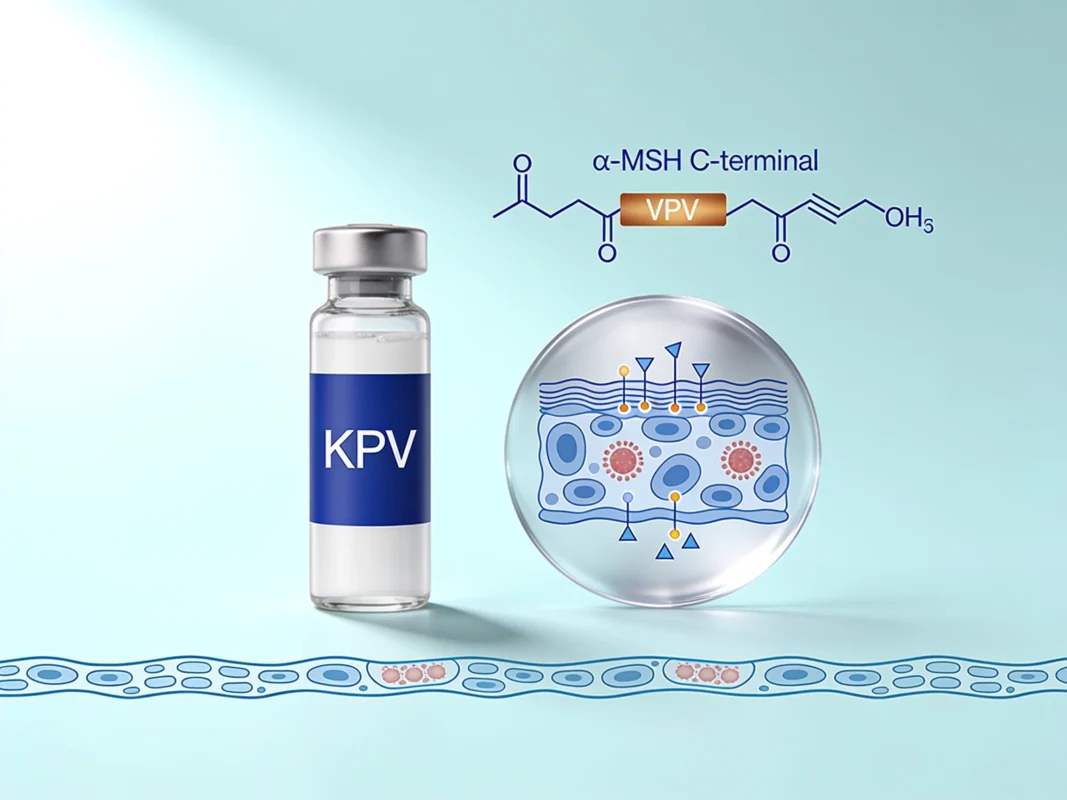
KPV is a synthetic tripeptide consisting of just three amino acids — Lysine-Proline-Valine (Lys-Pro-Val) — corresponding to positions 11-13 of α-melanocyte-stimulating hormone (α-MSH). The molecular weight is approximately 343 g/mol, making it among the smallest research peptides in active investigation.
The structural relationship to α-MSH is foundational to understanding the compound. α-MSH is a 13-amino-acid endogenous peptide produced from the pro-opiomelanocortin (POMC) gene that has multiple physiological roles — including pigmentation, anti-inflammatory effects, energy homeostasis, and immune modulation. Research over several decades has identified that distinct biological activities of α-MSH localize to different regions of the parent molecule. The C-terminal tripeptide (KPV) was identified as carrying substantial anti-inflammatory activity that could be dissociated from α-MSH’s other biological effects — particularly its melanotropic (pigmentation-inducing) activity, which derives from different structural regions [Ref. 1].
This anti-inflammatory activity dissociation is the scientific foundation for KPV’s research interest. Researchers seeking to study anti-inflammatory effects of the melanocortin system without the broader physiological effects of full-length α-MSH can use the isolated tripeptide as a research tool. The dissociation also has practical implications — KPV does not produce melanocyte stimulation or pigmentation effects that have raised consumer wellness concerns about other α-MSH-derived compounds like Melanotan I and Melanotan II.
KPV has not been approved by FDA, Health Canada, EMA, MHRA, or any other Western regulatory agency for human therapeutic use. The compound is currently in preclinical and early clinical research stages, with research interest in inflammatory disease applications driving most current investigation. Research-grade KPV sold for laboratory research is intended exclusively for that purpose.
Mechanism of Action
KPV’s mechanism is multi-target anti-inflammatory activity, operating through several converging pathways without a single dominant receptor target. The mechanistic literature converges on several specific pathways.
NF-kB signaling modulation. The most-discussed mechanism in KPV research. KPV modulates nuclear factor kappa-B (NF-kB) signaling — a master transcription factor pathway that regulates expression of pro-inflammatory cytokines, adhesion molecules, and various inflammatory mediators [Ref. 5]. KPV reduces NF-kB activation in response to inflammatory stimuli, producing downstream reductions in pro-inflammatory gene expression. NF-kB modulation is a particularly significant mechanism because the pathway sits upstream of many specific inflammatory responses — affecting NF-kB produces broad anti-inflammatory effects across multiple cell types.
Pro-inflammatory cytokine suppression. KPV reduces production and release of pro-inflammatory cytokines including TNF-α, IL-6, IL-1β, and IL-8 across multiple research models [Ref. 5]. This effect is mechanistically downstream of NF-kB modulation but represents the functional output of the anti-inflammatory mechanism — reduced cytokine signaling translates to reduced inflammatory responses in tissues.
Mast cell stabilization. KPV has documented effects on mast cell function, reducing histamine release and other mast cell-mediated inflammatory responses [Ref. 4]. Mast cells are particularly important in allergic inflammation, skin inflammation, and certain forms of gastrointestinal inflammation — making mast cell stabilization a mechanism relevant to multiple research domains.
Immune cell modulation. KPV affects multiple immune cell types including neutrophils, lymphocytes, and macrophages, with documented effects on cellular migration, activation states, and inflammatory mediator production. The multi-cell-type effects support the broad anti-inflammatory profile observed across different inflammatory disease research models.
Cellular signaling effects. KPV has documented effects on multiple intracellular signaling pathways beyond NF-kB, including effects on mitogen-activated protein kinase (MAPK) pathways and other inflammation-relevant signaling cascades. These multi-pathway effects contribute to the overall anti-inflammatory mechanism breadth.
Compound distinction from α-MSH. Unlike the parent α-MSH peptide and unlike other α-MSH-derived research peptides (Melanotan I, Melanotan II), KPV does not significantly activate melanocortin receptors (MC1R, MC3R, MC4R, MC5R). The anti-inflammatory mechanism appears to operate independently of melanocortin receptor signaling — making KPV mechanistically distinct from other α-MSH-derived compounds and from sexual function research peptides like PT-141 that act through central melanocortin receptors.
Research Applications
KPV research clusters into several primary domains, with the deepest peer-reviewed literature in inflammatory bowel disease and skin inflammation research.
Inflammatory bowel disease (IBD) and colitis research
The most extensively studied KPV research domain. Multiple peer-reviewed studies have examined KPV in animal models of inflammatory bowel disease — particularly DSS-induced colitis and TNBS-induced colitis in mice [Ref. 2]. The research has documented effects including reduced colonic inflammation, improved disease activity scores, preserved intestinal barrier function, and reduced inflammatory cell infiltration in colonic tissue. The mechanistic basis involves the broad anti-inflammatory effects described above operating in the specific context of intestinal inflammation.
The IBD research domain has been the basis for the most active translational research interest in KPV — including investigation of oral delivery formulations and combination approaches with other compounds. KPV’s small size and structural simplicity makes oral delivery research more tractable than for larger peptides.
Skin inflammation and dermatology research
A substantial research domain. KPV has been studied in atopic dermatitis research models, contact dermatitis models, and broader skin inflammation research [Ref. 3]. The anti-inflammatory effects translate to reduced inflammatory responses in skin tissue, with research findings supporting potential application areas in inflammatory skin disease research.
Topical formulation research has been an active area — KPV’s small molecular weight supports skin penetration in ways that larger peptides cannot achieve through topical application. Research designs examining topical KPV delivery have shown skin absorption sufficient to produce local anti-inflammatory effects.
Mast cell and allergic inflammation research
A focused research domain examining KPV’s effects on mast cell function and allergic inflammatory responses [Ref. 4]. Mast cell stabilization is the primary mechanism studied in this domain, with research examining histamine release suppression, mast cell degranulation modulation, and downstream allergic inflammatory mediator effects.
Broader inflammatory disease research
KPV has been studied across multiple additional inflammatory disease research contexts including:
- Acute lung inflammation and respiratory inflammation research
- Joint inflammation and arthritis research models
- Acute inflammatory response and sepsis research
- Wound healing research (specifically the inflammatory phase of wound healing)
- Ocular inflammation research
These broader research applications reflect KPV’s multi-target anti-inflammatory mechanism translating across multiple tissue contexts.
Combination research with active repair peptides
KPV’s anti-inflammatory mechanism complements the active tissue repair mechanisms of BPC-157, TB-500, and other healing peptides. Combination research designs examining KPV alongside BPC-157 and TB-500 test whether combining inflammation resolution (KPV) with active repair (BPC-157, TB-500) produces complementary effects in tissue healing research models.
The mechanism rationale: tissue healing requires both inflammation resolution (preventing chronic inflammatory damage) AND active tissue repair (rebuilding damaged structures). KPV addresses the first; BPC-157 and TB-500 address the second. The compounds operate through largely non-overlapping mechanisms, making combination research mechanistically feasible. See our BPC-157 vs TB-500 comparison article for context on the active repair compound mechanisms.
Across all research domains, research-grade KPV is intended for laboratory research only in the Kinetic Compounds context. The compound has not been evaluated by FDA, Health Canada, or any other Western regulatory agency for human therapeutic use.
Dosing & Reconstitution for Research
Researchers working with lyophilized KPV reconstitute the compound with bacteriostatic water before use. The reconstitution math follows the standard concentration-equals-mass-divided-by-volume principle covered in our reconstitution tutorial.
A 5 mg vial of KPV reconstituted with 2 mL of bacteriostatic water yields 2.5 mg/mL. A 10 mg vial in 2 mL yields 5 mg/mL. KPV’s very small molecular weight (~343 g/mol) places it among the smallest research peptides in common use — alongside Epitalon at ~390 Da. The small molecular weight means molar concentrations are very high per mg compared to larger research peptides.
A consideration specific to KPV: the compound’s small size and structural simplicity supports research design flexibility — including topical formulation research, oral delivery research, and various administration route research that would be more difficult with larger peptides. Researchers should evaluate the specific research design requirements for their application area.
Researchers can verify their concentration math against our peptide reconstitution calculator, which handles the conversion automatically.
This article does not provide dosing guidance for any therapeutic purpose. Research-grade KPV is intended for laboratory research only.
Storage & Handling
Lyophilized KPV is stable at room temperature during shipping but should be moved to long-term storage at -20°C (-4°F), protected from light, on receipt. Under proper lyophilized conditions, the compound remains stable for 24 months or longer.
Once reconstituted, KPV should be stored at 2–8°C and used within 28 days. The general storage principles for research peptides apply directly — see our storage and stability guide for detailed protocols including freeze-thaw considerations and aliquoting strategies.
Every vial should be visually inspected before use. The reconstituted solution should be clear and free of particulates. Cloudiness, discoloration, or visible sediment indicates degradation, and the vial should not be used in research.
For full handling protocols across the broader peptide catalog, see our storage and reconstitution guide.
Sourcing Verified KPV for Research
KPV’s small size (just three amino acids, ~343 Da) makes mass spectrometry verification exceptionally straightforward. The compound’s molecular weight is small enough to be measured with very high analytical accuracy, and the three-amino-acid sequence is distinctive enough that mislabeling would be immediately detectable through proper analytical testing.
A credible Certificate of Analysis for KPV should show HPLC purity expressed as a percentage, mass spectrometry confirmation matching ~343 Da, and a clear distinction between peptide content and peptide mass. The principles of reading a research peptide COA are covered in detail in our reading a Certificate of Analysis article, and our specific third-party testing methodology is documented in our Janoshik Analytical methodology article.
Kinetic Compounds tests every batch of KPV through Janoshik Analytical, an independent third-party laboratory. Current batch reports are published on the KPV product page. Our broader testing methodology is documented on our lab testing and COA page.
For researchers working across the broader Healing cluster, BPC-157, TB-500, and GHK-Cu are mechanistically distinct but complementary research compounds in the Kinetic Compounds catalog. The full research peptide catalog is available through our shop.
Researching anti-inflammatory pathways, inflammatory bowel disease research, skin inflammation, or broader inflammation modulation? Our complete research peptide catalog covers KPV, BPC-157, TB-500, GHK-Cu, and related research compounds — all independently lab-tested with current Certificates of Analysis available on each product page.
Available for Research
Research Tools
Quality Promise
very batch independently tested by Janoshik Analytical. 98% purity minimum.
Frequently Asked Questions
What is KPV?
<p>KPV is a tripeptide (just three amino acids — Lysine-Proline-Valine) corresponding to positions 11-13 of α-melanocyte-stimulating hormone (α-MSH). The compound was identified as the C-terminal region of α-MSH that carries substantial anti-inflammatory activity dissociable from α-MSH's other biological effects, particularly melanotropic activity.</p>
How is KPV different from α-MSH and Melanotan?
<p>KPV is the C-terminal tripeptide fragment of α-MSH, but the compound does not produce the melanocyte stimulation and pigmentation effects of α-MSH or the α-MSH-derived compounds Melanotan I and Melanotan II. The anti-inflammatory activity of KPV operates independently of melanocortin receptor signaling, making the compound mechanistically distinct from sexual function research peptides like PT-141 that act through central melanocortin receptors.</p>
What does KPV research focus on?
<p>KPV research focuses on anti-inflammatory applications across multiple disease research domains. The most extensive research is in inflammatory bowel disease (IBD) and colitis research, with substantial additional research in skin inflammation, mast cell biology, and broader inflammatory pathway modulation.</p>
How does KPV compare to BPC-157 and TB-500?
<p>KPV addresses a different aspect of tissue healing than BPC-157 and TB-500. KPV emphasizes inflammation resolution through anti-inflammatory mechanism modulation. BPC-157 and TB-500 emphasize active tissue repair through angiogenesis, growth factor signaling, and cytoskeletal modulation. The compounds operate through largely non-overlapping mechanisms, making combination research mechanistically feasible.</p>
Is KPV approved as a medication?
<p>No. KPV has not been approved by FDA, Health Canada, EMA, MHRA, or any other Western regulatory agency for human therapeutic use. The compound is currently in preclinical and early clinical research stages. Research-grade KPV sold for laboratory research is intended for laboratory research only.</p>
How is KPV reconstituted for research?
<p>Lyophilized KPV is reconstituted with bacteriostatic water. A 5 mg vial in 2 mL yields 2.5 mg/mL. Standard peptide reconstitution technique applies — inject bacteriostatic water down the inner wall of the vial, swirl gently. Researchers can verify calculations using our reconstitution calculator.</p>
Is research-grade KPV legal in Canada?
<p>Research-grade KPV is legal to purchase and possess in Canada for laboratory research purposes only. The compound is not approved by Health Canada for human therapeutic use.</p>
References
- "Dissection of the anti-inflammatory effect of the core and C-terminal (KPV) α-melanocyte-stimulating hormone peptides." Journal of Biological Chemistry, 278(28):25901-25908. — Mandrika I, Muceniece R, Wikberg JES (2003).
- "PepT1-mediated tripeptide KPV uptake reduces intestinal inflammation." Gastroenterology, 134(1):166-178. — Dalmasso G, Charrier-Hisamuddin L, Nguyen HT, Yan Y, Sitaraman S, Merlin D (2008).
- "Transdermal Iontophoretic Delivery of Lysine-Proline-Valine (KPV) Peptide Across Microporated Human Skin." Journal of Pharmaceutical Sciences. — Kanikkannan N et al.
- "Inhibition of cellular and systemic inflammation cues in human bronchial epithelial cells by melanocortin-related peptides: mechanism of KPV action and a role for MC3R agonists." Biological Chemistry, 393(8):861-867. — Getting SJ, Kaneva M, Bhadresa Y, Renshaw D, Leoni G, Patel HB, Kerrigan MJ, Loc
- "Melanocortin-derived tripeptide KPV has anti-inflammatory potential in murine models of inflammatory bowel disease." Inflammatory Bowel Diseases, 14(3):324-331. — Kannengiesser K, Maaser C, Heidemann J, Luegering A, Ross M, Brzoska T, Bohm M, Luger TA, Domschke W, Kucharzik T (2008).
Continue Reading
For Research Use Only Products described on this site are intended for laboratory research purposes only. They are not approved by Health Canada for human consumption, diagnosis, treatment, or prevention of any medical condition.