
Home / Research Articles / Melanotan 2 (MT-II): Mechanism, Research, and Applications
Melanotan 2 (MT-II): Mechanism, Research, and Applications
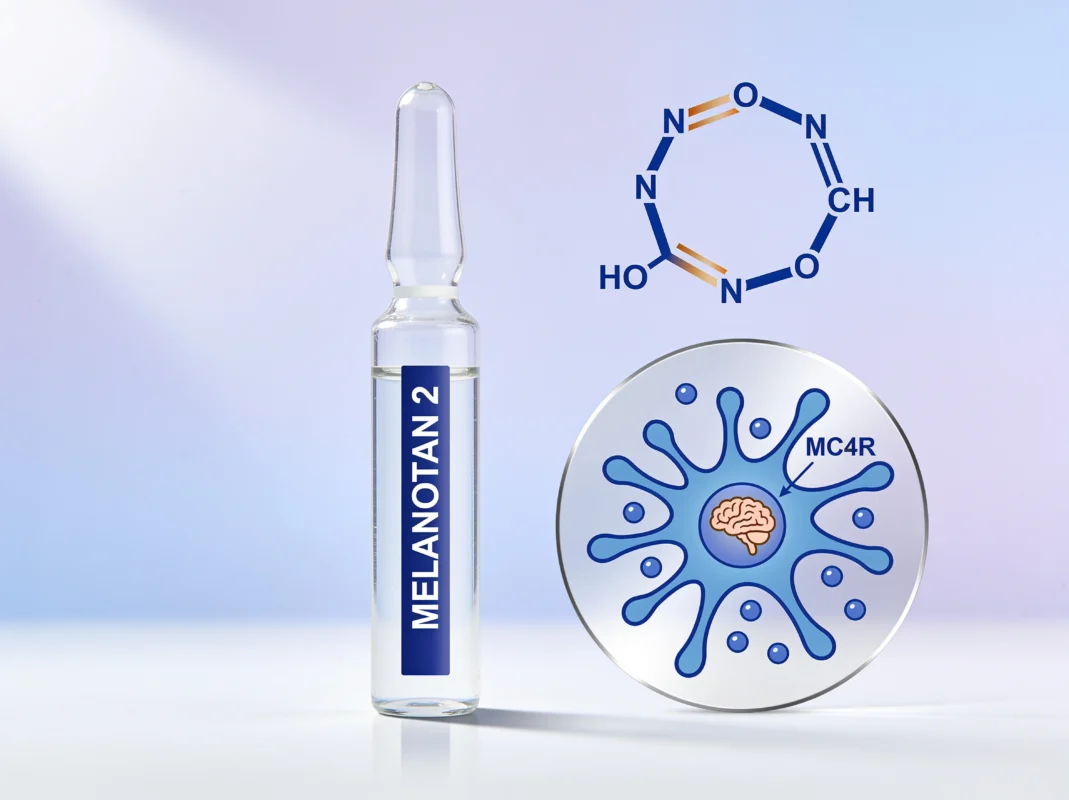
Key Takeaways
- Melanotan 2 (MT-II) is a synthetic cyclic heptapeptide analog of α-MSH — sequence Ac-Nle-cyclo[Asp-His-D-Phe-Arg-Trp-Lys]-NH2, MW ~1024 g/mol.
- It is a non-selective agonist at melanocortin receptors MC1R, MC3R, MC4R, and MC5R; MC1R drives pigmentation and MC4R drives central sexual-arousal effects.
- Melanotan 2 is the structural parent of PT-141 (bremelanotide), which was developed to isolate its sexual-function activity.
- The dermatology literature documents safety concerns: mole changes, atypical melanocytic nevi, and melanoma case reports linked to use; no Phase 2/3 trials are complete.
- Melanotan 2 is not approved by FDA, Health Canada, EMA, or any Western agency for human use — research-grade only, supplied as lyophilized powder.
Melanotan 2 (MT-II) occupies an unusual place in the Kinetic Compounds Sexual Function research cluster: it is the parent compound from which PT-141 (bremelanotide) was derived. Originally synthesized in the 1980s at the University of Arizona as a research tool for studying melanocortin-driven skin pigmentation, Melanotan 2 became notable when researchers observed that it also produced sexual arousal and spontaneous erections in male test subjects — an off-target effect that led directly to the development of PT-141. Melanotan 2 is therefore studied across two domains at once: melanogenesis (pigmentation) and central melanocortin-mediated sexual function.
This article addresses Melanotan 2 as a research compound: its structure as a cyclic heptapeptide analog of α-melanocyte-stimulating hormone (α-MSH), its non-selective melanocortin-receptor mechanism, the research applications spanning pigmentation and sexual-function studies, the documented safety concerns that feature prominently in the dermatological literature, and the reconstitution and sourcing considerations researchers should understand before working with the compound.
What Is Melanotan 2?
Melanotan 2 (MT-II) is a synthetic cyclic heptapeptide analog of α-MSH, sequence Ac-Nle-cyclo[Asp-His-D-Phe-Arg-Trp-Lys]-NH2. The molecular weight is approximately 1024 g/mol (formula C50H69N15O9). It contains the 4–10 melanocortin-receptor binding region shared by α-MSH and ACTH, but is conformationally locked by a lactam bridge between the aspartate and lysine side chains [Ref. 2].
Several structural modifications distinguish Melanotan 2 from native α-MSH: the oxidizable methionine is replaced with norleucine, L-phenylalanine is replaced with D-phenylalanine, and the peptide is cyclized to lock it in its biologically active conformation. These changes make MT-II far more potent and metabolically stable than α-MSH, and they make it a non-selective agonist at the melanocortin receptors MC1R, MC3R, MC4R, and MC5R [Ref. 2].
Melanotan 2 is distinct from Melanotan I (afamelanotide), which is a linear 13-amino-acid α-MSH analog (~1647 g/mol). It is also the structural parent of PT-141 (bremelanotide), which was developed specifically to isolate the sexual-function activity from the pigmentation activity. See our PT-141 (Bremelanotide) article for that lineage.
Melanotan 2 has not been approved by FDA, Health Canada, EMA, MHRA, or any other Western regulatory agency for human therapeutic use. No formal Phase 2 or Phase 3 safety trials have been completed, and controlled human data are very limited. Research-grade Melanotan 2 sold for laboratory research is intended exclusively for that purpose.
Mechanism of Action
Melanotan 2’s mechanism is non-selective melanocortin-receptor agonism, which is also the source of its broad and well-documented side-effect profile.
Non-selective melanocortin agonism. MT-II activates all four peripheral and central melanocortin receptors — MC1R, MC3R, MC4R, and MC5R [Ref. 2]. Because these receptors govern different physiological systems, a single compound produces effects on pigmentation, sexual function, appetite, and other pathways simultaneously.
MC1R and melanogenesis. Activation of MC1R on cutaneous melanocytes triggers sustained cAMP signaling and upregulates the transcription factor MITF, shifting pigment synthesis from red-yellow pheomelanin toward brown-black eumelanin — the basis of the compound’s tanning effect [Ref. 1]. This is the same receptor pathway engaged by selective MC1R agonists studied for photoprotection [Ref. 4].
MC4R and central sexual function. Activation of MC4R in the hypothalamus drives sexual arousal and erectile response. This central effect — observed in early Melanotan 2 research subjects — is what prompted the development of PT-141 as a melanocortin compound focused on sexual function [Ref. 5].
Photoprotective signaling. Beyond cosmetic pigmentation, MC1R signaling is studied for its role in melanocyte homeostasis and protection against UV-induced genotoxicity, making the melanocortin pathway relevant to photobiology research independent of MT-II itself [Ref. 3].
Compound distinction. Melanotan 2 is non-selective across melanocortin receptors, whereas PT-141 was engineered to emphasize the MC4R-mediated sexual-function pathway, and Melanotan I (afamelanotide) is a linear α-MSH analog used as an approved photoprotective agent in a specific rare condition. The three are related but mechanistically and pharmacologically distinct research tools.
Research Applications
Melanotan 2 research clusters into two historical domains — pigmentation and sexual function — alongside a substantial body of safety-focused literature.
Pigmentation and melanogenesis research. The original research application. MT-II was developed as a tool to study melanocortin-driven melanogenesis and as a candidate “sunless tanning” agent, on the rationale that stimulating eumelanin synthesis could increase photoprotective pigmentation without UV exposure [Ref. 1].
Central melanocortin and sexual-function research. The observation that Melanotan 2 induced sexual arousal and erections through central MC4R activation opened a second research domain and led directly to PT-141 (bremelanotide), which is now FDA-approved for a specific sexual-function indication [Ref. 5].
Broader research domains. Melanotan 2 has additionally been referenced across:
- MC4R appetite and energy-balance research
- Photobiology and UV-protection research (melanocortin pathway)
- Comparative melanocortin-receptor pharmacology (MT-II vs MT-I vs PT-141)
Research Safety Considerations
Melanotan 2 is distinguished from most research peptides by a prominent safety literature, and any research framing must reflect it. Because MT-II is non-selective and acts systemically, the dermatological literature documents concerns including darkening and change of existing moles, the appearance of new atypical (dysplastic) melanocytic nevi, melanonychia (nail pigmentation), and case reports describing melanoma temporally associated with use [Ref. 5]. The principal concern raised in that literature is not that MT-II initiates melanoma de novo, but that it may accelerate changes in pre-existing melanocytic lesions. Commonly reported systemic effects in user and case-report data include nausea, facial flushing, and drowsiness. Critically, no formal Phase 2 or Phase 3 safety trials have been completed, so the true incidence of serious adverse events is unknown — a key reason the compound remains research-grade rather than clinically developed.
Across all research domains, research-grade Melanotan 2 is intended for laboratory research only in the Kinetic Compounds context. The compound has not been evaluated by FDA, Health Canada, or any other Western regulatory agency for human therapeutic use.
Dosing & Reconstitution for Research
Researchers working with lyophilized Melanotan 2 reconstitute the compound with bacteriostatic water before use. The reconstitution math follows the standard concentration-equals-mass-divided-by-volume principle covered in our reconstitution tutorial.
A 10 mg vial of Melanotan 2 reconstituted with 2 mL of bacteriostatic water yields 5 mg/mL. A 10 mg vial in 1 mL yields 10 mg/mL. Researchers can verify their concentration math against our peptide reconstitution calculator, which handles the conversion automatically.
This article does not provide dosing guidance for any therapeutic purpose. Research-grade Melanotan 2 is intended for laboratory research only.
Storage & Handling
Lyophilized Melanotan 2 is stable at room temperature during shipping but should be moved to long-term storage at -20°C (-4°F), protected from light, on receipt. Under proper lyophilized conditions, the compound remains stable for 24 months or longer.
Once reconstituted, Melanotan 2 should be stored at 2–8°C and used within 28 days. The general storage principles for research peptides apply directly — see our storage and stability guide for detailed protocols including freeze-thaw considerations and aliquoting strategies.
Every vial should be visually inspected before use. The reconstituted solution should be clear and free of particulates. Cloudiness, discoloration, or visible sediment indicates degradation, and the vial should not be used in research.
For full handling protocols across the broader peptide catalog, see our storage and reconstitution guide.
Sourcing Verified Melanotan 2 for Research
Melanotan 2’s defined cyclic heptapeptide structure makes analytical verification by mass spectrometry straightforward — the expected mass of ~1024 Da and the distinctive sequence and lactam bridge are readily confirmed.
A credible Certificate of Analysis for Melanotan 2 should show HPLC purity expressed as a percentage, mass spectrometry confirmation matching ~1024 Da, and a clear distinction between peptide content and peptide mass. The principles of reading a research peptide COA are covered in detail in our reading a Certificate of Analysis article, and our specific third-party testing methodology is documented in our Janoshik Analytical methodology article.
Kinetic Compounds tests every batch of Melanotan 2 through Janoshik Analytical, an independent third-party laboratory. Current batch reports are published on the Melanotan 2 product page. Our broader testing methodology is documented on our lab testing and COA page.
For researchers working across the broader Sexual Function cluster, PT-141 is a mechanistically related but distinct research compound in the Kinetic Compounds catalog. The full research peptide catalog is available through our shop.
Available for Research
Research Tools
Quality Promise
very batch independently tested by Janoshik Analytical. 98% purity minimum.
Frequently Asked Questions
What is Melanotan 2?
<p>Melanotan 2 (MT-II) is a synthetic cyclic heptapeptide analog of α-MSH and a non-selective agonist at the melanocortin receptors MC1R, MC3R, MC4R, and MC5R. It was originally developed as a research tool for melanocortin-driven pigmentation.</p>
How is Melanotan 2 different from Melanotan I (afamelanotide)?
<p>Melanotan I is a linear 13-amino-acid α-MSH analog (~1647 g/mol) used as an approved photoprotective agent in a specific rare condition. Melanotan 2 is a shorter, cyclic heptapeptide (~1024 g/mol) and is non-selective across melanocortin receptors, producing both pigmentation and sexual-function effects.</p>
How is Melanotan 2 related to PT-141?
<p>PT-141 (bremelanotide) was derived from Melanotan 2 after researchers observed that MT-II produced sexual arousal through central MC4R activation. PT-141 was developed to focus on that pathway and is now FDA-approved for a specific indication.</p>
What does Melanotan 2 research focus on?
<p>Two historical domains: melanocortin-driven pigmentation (melanogenesis via MC1R) and central sexual function (via MC4R). A substantial safety-focused literature also surrounds the compound.</p>
What safety concerns appear in the Melanotan 2 literature?
<p>The dermatological literature documents changes in existing moles, new atypical (dysplastic) melanocytic nevi, melanonychia, and case reports of melanoma temporally associated with use, alongside systemic effects such as nausea, flushing, and drowsiness. No Phase 2/3 safety trials have been completed, so true adverse-event rates are unknown.</p>
Is Melanotan 2 approved as a medication?
<p>No. Melanotan 2 has not been approved by FDA, Health Canada, EMA, MHRA, or any other Western regulatory agency for human therapeutic use, and no Phase 2/3 trials have been completed. Research-grade Melanotan 2 is intended for laboratory research only.</p>
Is research-grade Melanotan 2 legal in Canada?
<p>Research-grade Melanotan 2 is legal to purchase and possess in Canada for laboratory research purposes only. The compound is not approved by Health Canada for human therapeutic use.</p>
References
- Melanocortin 1 receptor mediates melanin production
- The first preparative solution phase synthesis of Melanotan II
- MC1R and Endothelin B Receptors in Melanocyte Homeostasis and Prevention of Sun-Induced Genotoxicity
- Melanogenic effect of dersimelagon, a novel oral melanocortin 1 receptor agonist
- Melanotan II — clinical features and safety
Continue Reading
For Research Use Only Products described on this site are intended for laboratory research purposes only. They are not approved by Health Canada for human consumption, diagnosis, treatment, or prevention of any medical condition.