
Home / Research Articles / MK-677 (Ibutamoren): The Oral Growth Hormone Secretagogue
MK-677 (Ibutamoren): The Oral Growth Hormone Secretagogue
Key Takeaways
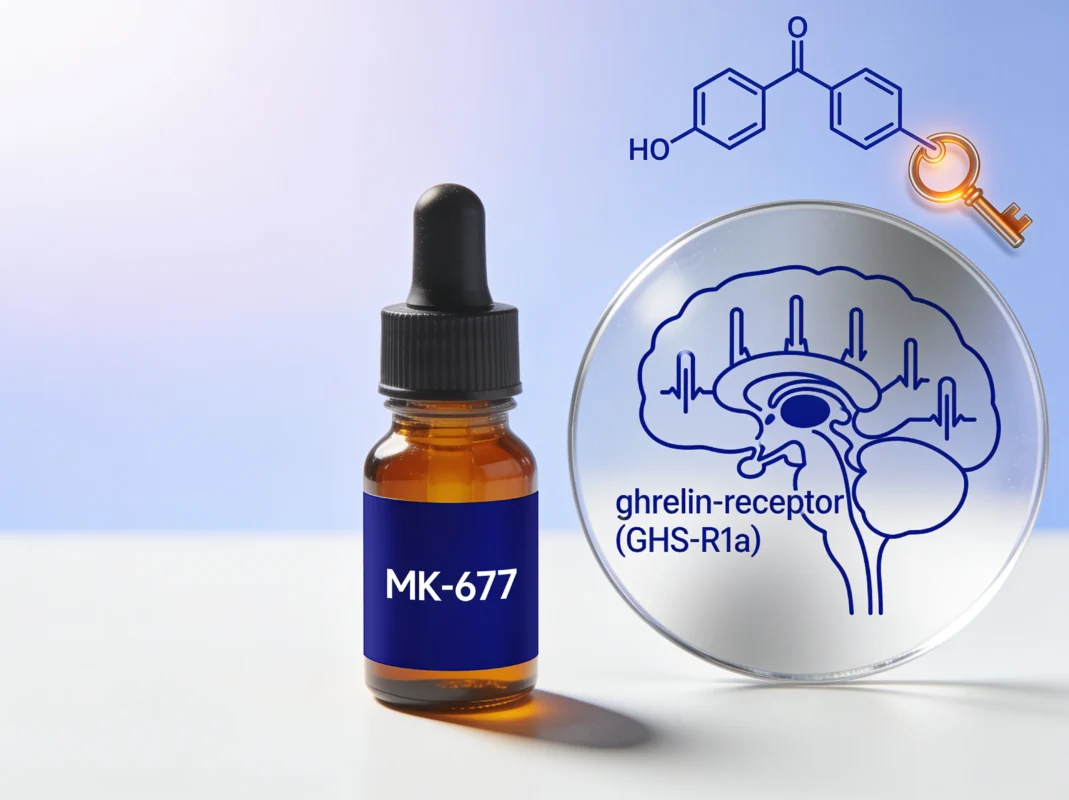
- MK-677 (ibutamoren) is an orally active, non-peptide growth hormone secretagogue and ghrelin-receptor (GHS-R1a) agonist — it is not a peptide. Free base MW ~528 g/mol (mesylate ~625).
- It stimulates pulsatile GH secretion and sustains elevated IGF-1 for up to ~24 hours, supporting once-daily oral dosing with roughly 60-70% oral bioavailability.
- Research covers body composition, bone turnover, and sleep; a 2-year older-adult trial raised fat-free mass but not strength and worsened insulin sensitivity.
- MK-677 is investigational — not approved by FDA, Health Canada, EMA, or any Western regulatory agency; research-grade material is for laboratory research only.
- Unlike injectable GH-axis peptides, MK-677 is orally bioavailable and is typically supplied as an oral solution rather than a lyophilized injectable.
MK-677 (ibutamoren) extends the Kinetic Compounds Growth Hormone research cluster with a compound that achieves GH-axis stimulation by an unusual route: it is taken orally and it is not a peptide. Where injectable GH-secretagogue peptides such as Ipamorelin, CJC-1295, and Hexarelin must be reconstituted and injected, MK-677 is an orally active small molecule that mimics the hormone ghrelin, making it one of the most studied oral growth hormone secretagogues in the research literature.
This article addresses MK-677 as a research compound: its identity as a non-peptide ghrelin-receptor agonist, the mechanism by which it raises growth hormone and IGF-1, the research applications spanning body composition, bone turnover, and sleep, the mixed and sometimes cautionary findings from longer trials, and the handling and sourcing considerations researchers should understand before working with the compound.
What Is MK-677?
MK-677 — also called ibutamoren, and supplied as the mesylate salt ibutamoren mesylate — is an orally active, non-peptide growth hormone secretagogue. The free base has the formula C27H36N4O5S and a molecular weight of approximately 528.7 g/mol; the mesylate salt is approximately 624.8 g/mol (CAS 159752-10-0). It is important to note that, despite often being grouped with research peptides, MK-677 is a small-molecule compound, not a peptide.
MK-677 acts as a selective agonist of the ghrelin receptor (GHS-R1a), with high binding affinity. Unlike injectable peptides, it is orally bioavailable (roughly 60–70%) and has a half-life of approximately 24 hours, which supports once-daily oral dosing in research protocols [Ref. 2].
Because it stimulates the body’s own GH axis rather than supplying exogenous hormone, MK-677 is studied as a tool for raising growth hormone and IGF-1 while preserving the natural pulsatile pattern of secretion [Ref. 1].
MK-677 has not been approved by FDA, Health Canada, EMA, MHRA, or any other Western regulatory agency for human therapeutic use; it remains an investigational compound. Research-grade MK-677 sold for laboratory research is intended exclusively for that purpose.
Mechanism of Action
MK-677’s mechanism is ghrelin-receptor agonism, which engages the growth-hormone axis at multiple points.
Ghrelin receptor (GHS-R1a) agonism. MK-677 binds and activates the ghrelin receptor in the hypothalamus and pituitary, mimicking the action of endogenous ghrelin [Ref. 2]. This is the defining action of the compound.
Growth hormone and IGF-1 elevation. Activation of GHS-R1a stimulates pulsatile growth hormone secretion and sustains elevated IGF-1 levels. Research has documented substantial IGF-1 increases while preserving the natural pulsatile GH pattern rather than flooding the system with continuous hormone [Ref. 1].
Multi-point GH-axis engagement. The mechanism is understood to involve both stimulation of growth-hormone-releasing hormone (GHRH) signaling and attenuation of somatostatin, the hormone that brakes GH release — producing a net increase in GH output [Ref. 1].
Endocrine selectivity and its limits. MK-677 raises GH and IGF-1 without large increases in cortisol, though longer trials have noted small cortisol changes and, importantly, reductions in insulin sensitivity [Ref. 1]. This metabolic effect is central to interpreting its research profile.
Research Applications
MK-677 has a substantial clinical research literature, with results that are informative precisely because they are mixed.
Body composition. In a 2-year double-blind, randomized, placebo-controlled trial in healthy older adults, oral MK-677 increased fat-free mass — but the gains did not translate into improvements in muscle strength or function, and insulin sensitivity worsened [Ref. 1]. Earlier work showed MK-677 could reverse diet-induced nitrogen wasting, shifting nitrogen balance toward anabolism [Ref. 4].
Bone turnover. Oral MK-677 has been shown to increase markers of bone turnover in healthy and functionally impaired elderly adults, consistent with the GH/IGF-1 axis’s role in bone remodeling, though effects on bone mineral density require longer observation [Ref. 3].
Sleep. Because GH secretion is linked to slow-wave sleep, MK-677 has been studied for effects on sleep architecture, with research reporting improvements in sleep quality and increases in slow-wave and REM sleep duration [Ref. 1].
Broader and cautionary findings. MK-677 has additionally been studied across:
- Appetite and energy-balance research (ghrelin-receptor activation increases appetite)
- Nonalcoholic fatty liver disease (active investigation)
- Catabolic and recovery states
- Neurodegeneration — a randomized trial found no clinical effect on Alzheimer’s disease progression [Ref. 5]
The mixed results — fat-free-mass gains without strength benefit, worsened insulin sensitivity, and a negative neurodegeneration trial — are an important part of the MK-677 research picture and a reason it remains investigational. Across all research domains, research-grade MK-677 is intended for laboratory research only in the Kinetic Compounds context.
Forms and Research Handling
Unlike the injectable GH-axis peptides, MK-677 is orally bioavailable and is typically supplied as an oral solution or in capsule form rather than as a lyophilized powder for injection — so the reconstitution math used for injectable peptides does not apply. Researchers should follow the supplier’s stated concentration for oral-solution products and confirm it against the Certificate of Analysis.
This article does not provide dosing guidance for any therapeutic purpose. Research-grade MK-677 is intended for laboratory research only.
Storage & Handling
Oral-solution and powder forms of MK-677 should be stored per the supplier’s instructions, generally cool, dry, and protected from light; refrigeration (2–8°C) is appropriate for reconstituted oral solutions. The general storage principles for research compounds apply — see our storage and stability guide for detailed protocols.
Any solution should be visually inspected before use; cloudiness, discoloration, or visible sediment indicates degradation and the product should not be used in research.
Sourcing Verified MK-677 for Research
Because MK-677 is a non-peptide small molecule, analytical verification relies on HPLC to confirm purity and mass spectrometry confirming the expected mass (~528 Da for the free base, ~625 Da for the mesylate salt). Researchers sourcing MK-677 should require a current, batch-specific third-party Certificate of Analysis. The principles of reading a research COA are covered in detail in our reading a Certificate of Analysis article.
For the growth-hormone-axis research peptides in the Kinetic Compounds catalog — including Ipamorelin, CJC-1295, Tesamorelin, and Hexarelin — every batch is tested through Janoshik Analytical, an independent third-party laboratory, with current reports published on each product page. Our broader testing methodology is documented on our lab testing and COA page.
Researching growth-hormone-axis modulation? The Kinetic Compounds catalog covers GH-secretagogue research peptides including Ipamorelin, CJC-1295, Tesamorelin, and Hexarelin — all independently lab-tested with current Certificates of Analysis available on each product page. Explore the full research peptide catalog through our shop.
Related Peptides
Related peptides will load here via PHP snippet.
Available for Research
Research Tools
Quality Promise
very batch independently tested by Janoshik Analytical. 98% purity minimum.
Frequently Asked Questions
What is MK-677?
<p>MK-677 (ibutamoren) is an orally active, non-peptide growth hormone secretagogue that acts as an agonist at the ghrelin receptor (GHS-R1a). It raises growth hormone and IGF-1 while preserving the natural pulsatile pattern of GH secretion.</p>
Is MK-677 a peptide?
<p>No. Although it is often grouped with research peptides, MK-677 is a small-molecule compound, not a peptide. This is also why it is orally active, unlike injectable GH-axis peptides.</p>
How does MK-677 work?
<p>It activates the ghrelin receptor (GHS-R1a) in the hypothalamus and pituitary, stimulating GHRH signaling and attenuating somatostatin. The net effect is increased pulsatile GH secretion and sustained IGF-1 elevation for up to about 24 hours.</p>
What does MK-677 research show?
<p>Research is mixed. A 2-year older-adult trial increased fat-free mass but not strength and worsened insulin sensitivity; other work shows increased bone turnover markers and improved sleep quality. A randomized trial found no clinical effect on Alzheimer's disease progression.</p>
Is MK-677 approved as a medication?
<p>No. MK-677 is investigational and has not been approved by FDA, Health Canada, EMA, MHRA, or any other Western regulatory agency. Research-grade MK-677 is intended for laboratory research only.</p>
How is MK-677 used in research?
<p>MK-677 is orally bioavailable and is typically supplied as an oral solution or capsule rather than a lyophilized injectable, so injectable-peptide reconstitution math does not apply. Researchers should follow the supplier's stated concentration and confirm it against the Certificate of Analysis.</p>
Is research-grade MK-677 legal in Canada?
<p>Research-grade MK-677 is legal to purchase and possess in Canada for laboratory research purposes only. The compound is not approved by Health Canada for human therapeutic use.</p>
References
- Effects of an oral ghrelin mimetic on body composition and clinical outcomes in healthy older adults: a randomized trial
- Structural basis of human ghrelin receptor signaling by ghrelin and the synthetic agonist ibutamoren
- Oral MK-677 increases markers of bone turnover in healthy and functionally impaired elderly adults
- MK-677, an orally active growth hormone secretagogue, reverses diet-induced catabolism
- Growth hormone secretagogue MK-677: no clinical effect on Alzheimer's disease progression in a randomized trial
Continue Reading
For Research Use Only Products described on this site are intended for laboratory research purposes only. They are not approved by Health Canada for human consumption, diagnosis, treatment, or prevention of any medical condition.