
Home / Research Articles / Selank vs Semax: A Cognitive Peptide Research Comparison
Selank vs Semax: A Cognitive Peptide Research Comparison
Key Takeaways
- Selank and Semax are both Russian-developed synthetic peptides with CNS-active properties, but operate through fundamentally different mechanisms and research domains.
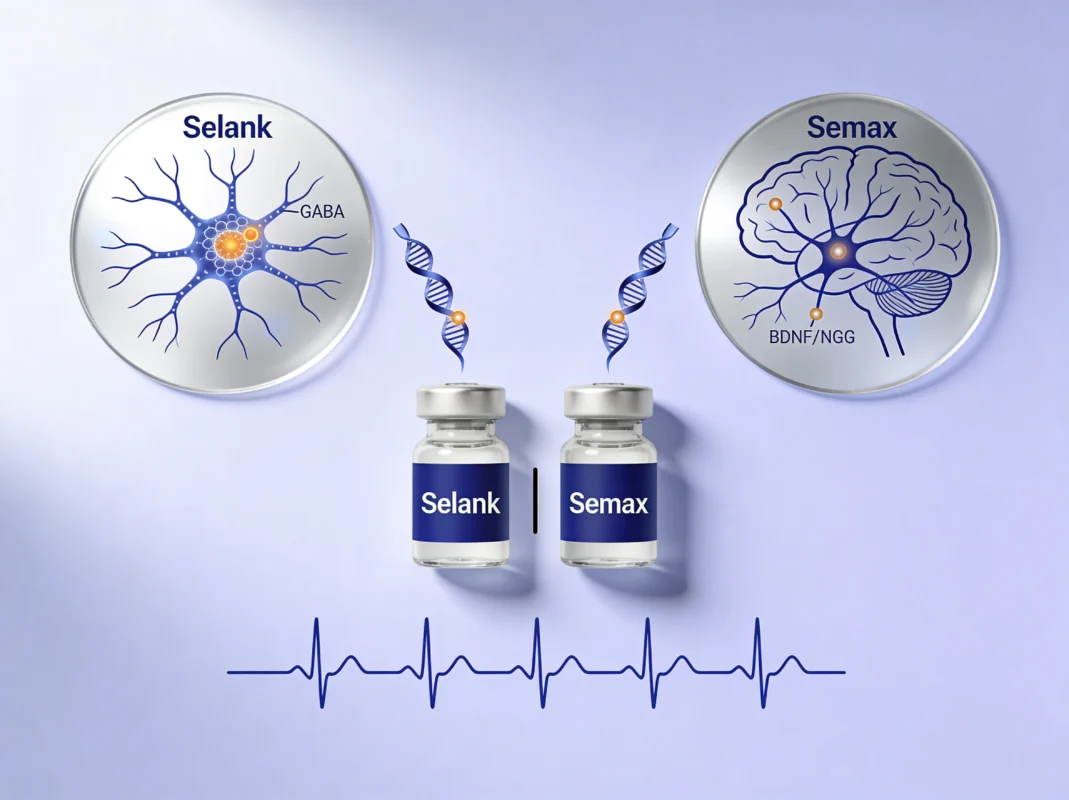
- Selank emphasizes GABAergic modulation and anxiolytic activity; Semax emphasizes BDNF/NGF upregulation and neuroprotective/nootropic activity through different pathways.
- Both compounds are approved as pharmaceutical products in Russia for specific indications but are not approved by FDA, Health Canada, or any Western regulatory agency.
- Research design choice depends on application — anxiety/immune research favors Selank; cognitive/neuroprotective research favors Semax for the respective mechanism emphasis.
- Research-grade material for both compounds is intended for laboratory research only and is distinct from pharmaceutical products approved in other international jurisdictions.
Researchers comparing Selank and Semax are looking at two compounds that share substantial common ground — both synthetic heptapeptides, both developed at the same Russian research institute in the same general timeframe, both approved as prescription medications in the Russian Federation but nowhere in Western markets, both used in central nervous system research — and yet operate through fundamentally different mechanisms and address fundamentally different research questions. The compounds are often discussed together because of their shared institutional origin, but they are research-distinct in ways that matter for protocol selection.
This article compares Selank against Semax across structure, lineage, mechanism, research applications, and the practical question that determines which compound fits a given research design. The complete background on each compound individually is covered in our Selank deep dive and Semax deep dive; this article focuses specifically on the comparison.
At-a-Glance Comparison
| Attribute | Selank | Semax |
|---|---|---|
| Amino acid sequence | Thr-Lys-Pro-Arg-Pro-Gly-Pro | Met-Glu-His-Phe-Pro-Gly-Pro |
| Length | 7 amino acids | 7 amino acids |
| Parent molecule | Tuftsin (Thr-Lys-Pro-Arg) | ACTH (4-10) |
| Molecular weight | ~752 g/mol | ~814 g/mol |
| Developing institute | Institute of Molecular Genetics, Moscow | Institute of Molecular Genetics, Moscow |
| Development era | 1990s | 1980s-1990s |
| Primary research emphasis | Anxiolytic, immunomodulatory | Nootropic, neuroprotective, stroke recovery |
| Key mechanisms | GABA, serotonin, BDNF, immune modulation | BDNF, NGF, melanocortin signaling |
| Russian approval indication | Generalized anxiety disorder | Ischemic stroke recovery, cognitive conditions |
| Russian brand name | Селанк | Семакс |
| Western regulatory approval | None | None |
| Largest published research domain | Anxiolytic behavioral research | Stroke neuroprotection clinical research |
| CAS number | 129954-34-3 | 80714-61-0 |
Shared Origins, Distinct Lineages
The two compounds share a development institute and a structural design philosophy, which is why they’re often grouped together in research peptide discussions. Both were developed at the Institute of Molecular Genetics of the Russian Academy of Sciences in Moscow — Selank emerging from research led by Zozulya, Semenova, and Kozlovskaya in the 1990s, and Semax emerging from earlier work led by Ashmarin in the 1980s and continuing through the 1990s. The structural design approach is consistent across both compounds: take a biologically active fragment of a larger natural peptide, modify the C-terminus for enzymatic stability, and develop the resulting heptapeptide into a research and clinical compound.
But the parent molecules differ in ways that matter for mechanism.
Selank derives from tuftsin — a naturally occurring tetrapeptide (Thr-Lys-Pro-Arg) cleaved from the Fc region of immunoglobulin G with documented immunomodulatory activity. Selank inherits this immunomodulatory lineage along with the anxiolytic effects that emerged from the structural modification work. The compound’s research literature reflects this dual heritage: substantial work on anxiolytic effects (the modern emphasis), alongside immunomodulatory research that traces back to the tuftsin parentage.
Semax derives from amino acids 4-10 of adrenocorticotropic hormone (ACTH) — a 39-amino-acid pituitary peptide best known for its stress hormone signaling effects. The 4-10 fragment carries primarily neurotrophic and cognitive-relevant activity without the full adrenal-axis effects of intact ACTH. Semax’s research emphasis on nootropic and neuroprotective effects flows directly from this ACTH-derived neurotrophic profile.
The lineage distinction explains why the two compounds, despite sharing institutional origin and structural design philosophy, produce different research signatures. They are derivatives of biologically different parent molecules, and the daughter peptides retain different aspects of their parents’ biological activity.
How Selank Works
Selank acts through multiple converging mechanisms across several neurotransmitter and neurotrophic systems, rather than through a single dominant receptor target. The mechanistic literature converges on several pathways.
GABAergic modulation is the most commonly implicated mechanism in Selank’s anxiolytic effects. The compound modulates GABA receptor function and influences GABA-related gene expression in animal models — the same neurotransmitter system targeted by conventional anxiolytics like benzodiazepines. A 2017 study by Filatova and colleagues in Frontiers in Pharmacology documented Selank’s effects on GABAergic neurotransmission gene expression in human IMR-32 cells, providing direct molecular evidence for the GABAergic mechanism [Ref. 1].
Serotonergic modulation contributes to Selank’s broader anxiolytic and antidepressant-relevant profile through effects on serotonin metabolism and receptor function.
BDNF and neurotrophic signaling has emerged as a more recent line of Selank research. A 2019 study by Kolik and colleagues documented Selank effects on BDNF expression in the hippocampus and prefrontal cortex of rats, providing a candidate mechanism for the compound’s neuroprotective effects [Ref. 5].
Immunomodulatory effects trace back to the tuftsin lineage and have been studied in inflammatory and infectious disease research models.
The clinical research base for Selank’s anxiolytic effects includes a 2008 randomized controlled trial by Zozulia and colleagues in patients with generalized anxiety disorder, comparing Selank against medazepam — the trial that supported the Russian regulatory approval [Ref. 2]. Complete mechanistic details are covered in our Selank deep dive.
How Semax Works
Semax also acts through multiple converging mechanisms, but the mechanistic emphasis differs from Selank’s profile.
BDNF and NGF upregulation is the central mechanistic finding in modern Semax research. A 2006 study by Dolotov and colleagues in the Journal of Neurochemistry documented Semax’s specific binding to and upregulation of BDNF in rat basal forebrain — the foundational mechanistic paper that established the neurotrophic profile [Ref. 3]. Subsequent work has extended these findings across hippocampal, cortical, and striatal brain regions.
Melanocortin signaling residual persists from the ACTH lineage. While Semax has minimal direct adrenocortical activity, the compound retains partial relationships to melanocortin signaling pathways that distinguish it from non-ACTH-derived neuropeptides.
Neuroprotection in ischemic models is the largest applied research domain. A 2018 clinical trial by Gusev and colleagues documented Semax efficacy in patients at different stages of ischemic stroke — the foundational clinical research that supported the Russian regulatory approval for stroke applications [Ref. 4]. The neuroprotective effects appear to involve neurotrophic upregulation, anti-inflammatory effects, and modulation of oxidative stress responses operating together.
Cognitive and memory-relevant gene expression modulation extends the neurotrophic effects to behavioral domains relevant for nootropic research.
Complete mechanistic details are covered in our Semax deep dive.
Where They Overlap
Despite the lineage and mechanism differences, the two compounds share substantial ground.
Same institutional origin. Both developed at the Institute of Molecular Genetics of the Russian Academy of Sciences in Moscow, by research groups that overlapped and collaborated extensively.
Same structural design approach. Both heptapeptides derived from biologically active parent molecules with C-terminal Pro-Gly-Pro extensions for enzymatic stability. The structural design philosophy is consistent across both compounds.
Same regulatory geometry. Both approved as prescription medications in the Russian Federation but not approved in any Western market. Both face the same Tier 1.5 regulatory consideration: approved abroad, research-grade in the Kinetic Compounds context.
Multi-target neuropeptidergic mechanism rather than receptor-canonical. Both compounds act through multiple converging mechanisms rather than through a single dominant receptor target. This distinguishes both compounds from receptor-canonical peptides like GLP-1 receptor agonists or GHRH analogs.
Common administration route in Russian clinical research. Both compounds use intranasal administration as the primary route in the Russian prescription product context. Both can also be administered via standard injection routes in laboratory research with animal models.
Both upregulate BDNF. The two compounds approach BDNF through different upstream pathways, but both have documented effects on BDNF expression that contribute to their respective neuroprotective profiles [Ref. 3, Ref. 5].
Where They Differ
The distinctions matter more than the overlap for research selection.
Parent molecule lineage. Selank derives from tuftsin (an immunoglobulin fragment); Semax derives from ACTH (a pituitary stress hormone). The daughter peptides inherit different aspects of their parents’ biology.
Primary mechanism emphasis. Selank’s mechanism centers on GABAergic and serotonergic modulation; Semax’s mechanism centers on BDNF/NGF neurotrophic signaling. Both are multi-target, but the primary emphasis differs.
Primary research application. Selank’s research emphasis is anxiolytic and immunomodulatory; Semax’s research emphasis is nootropic, neuroprotective, and stroke recovery. The clinical research base reflects these distinct emphases — Selank’s largest clinical work is in generalized anxiety disorder; Semax’s largest clinical work is in ischemic stroke recovery.
Approved indication in Russia. Selank is approved for anxiety conditions; Semax is approved for ischemic stroke recovery and cognitive conditions. The approvals reflect the different primary research applications.
Behavioral pharmacology profile. In animal model research, Selank produces anxiolytic effects in models like elevated plus maze and open field; Semax produces cognitive enhancement effects in learning and memory models like water maze and passive avoidance. The compounds have different behavioral signatures even when administered in comparable protocols.
Choosing Between Them for Specific Research Applications
Practical guidance based on what each compound’s literature actually supports.
Anxiolytic research — Selank. The deepest clinical and preclinical literature for anxiolytic effects, including a randomized controlled trial in generalized anxiety disorder that supported Russian regulatory approval.
Stroke neuroprotection research — Semax. The largest body of clinical research for neuroprotective effects, including the trials that supported Russian regulatory approval for stroke applications.
Cognitive enhancement and memory research — Semax. The nootropic research emphasis is supported by behavioral pharmacology in animal models and clinical research in cognitive conditions.
Immunomodulatory research — Selank. The tuftsin lineage and associated immunomodulatory effects are unique to Selank within this comparison.
HPA axis and stress research — Selank. The anxiolytic research base extends to broader stress research models, including HPA axis dysregulation paradigms.
Neurotrophic research broadly — Either, with Semax slightly favored if BDNF/NGF effects are the primary endpoint. Both compounds upregulate BDNF, but Semax has the more direct neurotrophic mechanistic literature.
Combined / sequential research — Some research designs administer both compounds either simultaneously or sequentially to study complementary CNS effects. Combination research is not standard in the published literature but is feasible given the distinct mechanisms.
Comparing approved versus research-grade material — Both compounds have approved Russian Federation prescription versions and research-grade versions sold for laboratory research. Researchers should source through clearly research-focused channels for laboratory work; patients in Russia or CIS countries should obtain prescription product through pharmaceutical channels.
Sourcing Verified Cognitive Research Peptides
Both compounds are relatively small (~752 Da for Selank, ~814 Da for Semax), which makes mass spectrometry verification straightforward. The 62 Da molecular weight difference is distinct enough that mass spectrometry can reliably distinguish the two compounds — a product labeled Selank that actually contains Semax (or vice versa) would be obvious on a mass spectrum.
A credible Certificate of Analysis for either compound should show HPLC purity expressed as a percentage, mass spectrometry confirmation matching the expected molecular weight for the specific compound, and a clear distinction between peptide content and peptide mass. The principles of reading a research peptide COA are covered in detail in our reading a Certificate of Analysis article.
Kinetic Compounds tests every batch of both compounds through Janoshik Analytical, an independent third-party laboratory. Current batch reports are published directly on each product page. Our broader testing methodology is documented on our lab testing and COA page and our Janoshik Analytical methodology article.
For prescription Selank or Semax intended for human therapeutic use in the Russian Federation context, patients should obtain Селанк or Семакс through pharmaceutical channels in the relevant jurisdictions. Research-grade material is not a substitute for prescription product in any clinical context.
Researching cognitive and CNS-active peptides? Our complete research peptide catalog covers Selank, Semax, and related compounds — all independently lab-tested with current Certificates of Analysis available on each product page.
Related Peptides
Related peptides will load here via PHP snippet.
Available for Research
Research Tools
Quality Promise
very batch independently tested by Janoshik Analytical. 98% purity minimum.
Frequently Asked Questions
What is the main difference between Selank and Semax?
<p>Selank derives from tuftsin (an immunoglobulin fragment) and emphasizes anxiolytic and immunomodulatory mechanisms. Semax derives from ACTH (4-10) and emphasizes nootropic and neuroprotective mechanisms — particularly in stroke recovery research. Both are synthetic heptapeptides developed at the same Russian institute, but they address different research questions through different primary mechanisms.</p>
Can Selank and Semax be combined in research?
<p>Combination protocols with both compounds are not standard in the published literature, but the distinct mechanisms make combination research mechanistically feasible. Selank's GABAergic and immunomodulatory effects don't overlap with Semax's BDNF/NGF neurotrophic effects, so combining them would produce complementary rather than redundant pathway activation. Researchers considering combination protocols should design carefully and not extrapolate combination effects from individual-compound data.</p>
Which compound is approved as a medication?
<p>Both compounds are approved as prescription medications in the Russian Federation — Selank (Селанк) for anxiety conditions, Semax (Семакс) for ischemic stroke recovery and cognitive applications. Neither compound is approved by FDA, Health Canada, EMA, MHRA, or any other Western regulatory agency. Research-grade material in both cases is intended for laboratory research only and is distinct from any prescription product.</p>
How are these compounds different from other research peptide classes?
<p>Both compounds are central nervous system research peptides with multi-target neuropeptidergic mechanisms, which distinguishes them from receptor-canonical compounds covered in other Kinetic Compounds research areas. Compared with healing peptides like BPC-157 and TB-500, or GH peptides like CJC-1295 and Ipamorelin, Selank and Semax operate through different mechanisms in different tissue systems for different research applications.</p>
How are these compounds reconstituted for research?
<p>Both are lyophilized peptides reconstituted with bacteriostatic water. A 5 mg vial in 2 mL yields 2.5 mg/mL. The molecular weight difference (~62 Da) is small enough that the reconstitution math is essentially identical between the two compounds. Our reconstitution tutorial covers the procedure and our reconstitution calculator handles the math.</p>
Are both compounds legal in Canada?
<p>Research-grade Selank and Semax are both legal to purchase and possess in Canada for laboratory research purposes only. Neither compound is approved by Health Canada for human therapeutic use.</p>
Where can I find Certificates of Analysis for both compounds?
<p>Kinetic Compounds publishes batch-specific Certificates of Analysis from Janoshik Analytical on each product page. COAs can also be requested directly via [email protected].</p>
References
- Ref. 1 — Filatova E, Kasian A, Kolomin T, et al. (2017). "GABA, Selank, and Olanzapine Affect the Expression of Genes Involved in GABAergic Neurotransmission in IMR-32 Cells." Frontiers in Pharmacology, 8:89.
- Ref. 2 — Zozulia AA, Neznamov GG, Siuniakov TS, et al. (2008). "Efficacy and possible mechanisms of action of a new peptide anxiolytic selank in patients with generalized anxiety disorders and neurasthenia." Zhurnal Nevrologii i Psikhiatrii im S.S. Korsakova, 108(4):38-48.
- Ref. 3 — Dolotov OV, Karpenko EA, Inozemtseva LS, et al. (2006). "Semax, an analogue of ACTH(4-10), binds specifically and increases levels of brain-derived neurotrophic factor protein in rat basal forebrain." Journal of Neurochemistry, 97 Suppl 1:82-86.
- Ref. 4 — Gusev EI, Martynov MY, Kostenko EV, et al. (2018). "Efficacy of Semax in patients at different stages of ischemic stroke." Zhurnal Nevrologii i Psikhiatrii im S.S. Korsakova, 118(3 Pt 2):61-68.
- Ref. 5 — Kolik LG, Konstantinopolsky MA, Nadorova AV, Kruglov SV (2019). "Selank Administration Affects the Expression of Some Genes Involved in GABAergic Neurotransmission and Ethanol-Induced Memory Impairment via BDNF Regulation in the Hippocampus and Prefrontal Cortex of Rats." Bulletin of Experi
Continue Reading
For Research Use Only Products described on this site are intended for laboratory research purposes only. They are not approved by Health Canada for human consumption, diagnosis, treatment, or prevention of any medical condition.