
Home / Research Articles / Semaglutide vs Retatrutide: A GLP-1 Research Comparison
Semaglutide vs Retatrutide: A GLP-1 Research Comparison
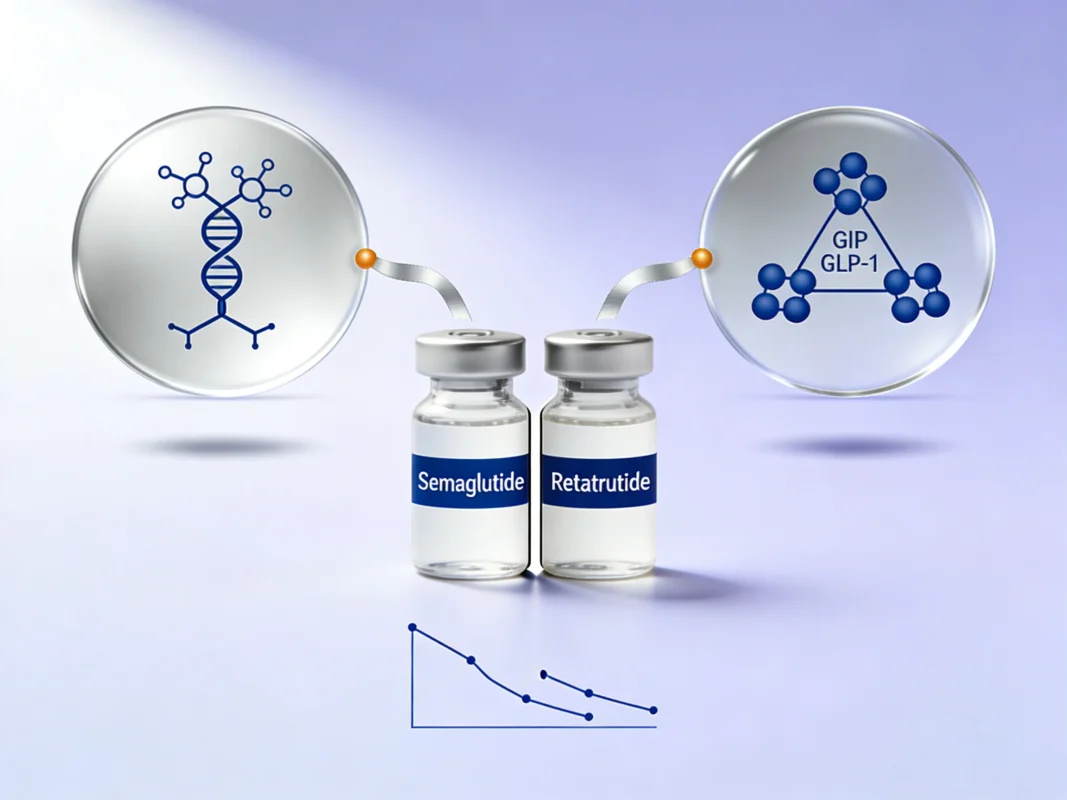
Key Takeaways
- Semaglutide is a selective GLP-1 receptor agonist (single-agonist); Retatrutide is a triple-agonist co-activating GIP, GLP-1, and glucagon receptors simultaneously.
- Semaglutide is FDA-approved as Ozempic, Wegovy, Rybelsus; Retatrutide is investigational with Phase 3 trials ongoing and TRIUMPH-1 topline announced May 2026.
- Weight loss differs substantially — Semaglutide ~15-17% at 68 weeks (STEP 1, Wegovy 2.4mg) vs Retatrutide 25.0% at 80 weeks with up to 30% in severe obesity (TRIUMPH-1).
- The compounds differ in mechanism complexity, regulatory status, evidence maturity, and pharmacological scope — Retatrutide adds hepatic and energy expenditure effects via glucagon.
- Both compounds are designed for once-weekly subcutaneous administration; research-grade material for both is intended for laboratory research only, not therapeutic use.
Researchers comparing Semaglutide against Retatrutide are looking at two compounds that represent fundamentally different generations of incretin pharmacology. Both compounds act on the GLP-1 receptor as part of their mechanism. Both produce substantial weight loss in clinical research populations. Both are designed for once-weekly subcutaneous administration. But the underlying pharmacology, the regulatory status, the clinical evidence base, and the research applications differ in ways that matter substantially for any research design choosing between them.
This article compares Semaglutide against Retatrutide across mechanism, regulatory status, clinical evidence, and the practical question that determines which compound fits a given research design. The complete background on each compound individually is covered in our Semaglutide deep dive and Retatrutide deep dive; this article focuses specifically on the head-to-head comparison.
For a broader three-way comparison including Tirzepatide — the dual GIP/GLP-1 receptor agonist that sits mechanistically between Semaglutide and Retatrutide — see our Semaglutide vs Tirzepatide vs Retatrutide trilateral comparison.
At-a-Glance Comparison
| Attribute | Semaglutide | Retatrutide |
|---|---|---|
| Mechanism class | Selective GLP-1 receptor agonist | GIP/GLP-1/glucagon triple-agonist |
| Receptor targets | GLP-1 only | GIP + GLP-1 + glucagon (three receptors) |
| Generation | First-generation incretin (current standard) | Third-generation incretin (investigational) |
| Molecular weight | ~4,113 g/mol | ~4,731 g/mol |
| Number of amino acids | 31 | 39 |
| Half-life | ~165 hours (~7 days) | Similar extended half-life, designed for once-weekly dosing |
| Administration | Subcutaneous (Ozempic, Wegovy); oral (Rybelsus) | Subcutaneous, once-weekly (clinical trial design) |
| Regulatory status | FDA-approved as Ozempic, Wegovy, Rybelsus | Investigational — Phase 3 trials ongoing |
| Maximum approved obesity dose | 2.4 mg weekly (Wegovy) | N/A — not approved |
| Phase 3 weight loss benchmark | ~15-17% at 68 weeks (STEP 1, Wegovy 2.4 mg) | 25.0% at 80 weeks on 12 mg; up to 30% at 104 weeks in severe obesity subgroup (TRIUMPH-1) |
| Cardiovascular outcomes data | Established (SUSTAIN-6, SELECT) | Pending — TRIUMPH program ongoing |
| Manufacturer | Novo Nordisk | Eli Lilly |
| Year first approved (any indication) | 2017 (FDA approval as Ozempic) | Not yet approved |
Different Mechanisms, Different Generations
The most significant single difference between Semaglutide and Retatrutide is the receptor mechanism. Both compounds engage the GLP-1 receptor, but Semaglutide does so as a selective agonist while Retatrutide does so as one of three coordinated receptor activations.
Semaglutide is a selective GLP-1 receptor agonist — a modified version of native human GLP-1 with structural changes (specifically, an Aib substitution at position 2 and a C18 fatty acid chain attached via a γGlu-2xOEG linker to lysine at position 26) that increase enzymatic stability and extend half-life [Ref. 2, Ref. 3]. The compound binds the GLP-1 receptor with high affinity and produces the cascade of physiological effects characteristic of GLP-1 signaling — including stimulation of glucose-dependent insulin secretion, suppression of glucagon secretion, slowing of gastric emptying, and central nervous system effects on appetite and food intake.
Retatrutide is a triple-agonist — a single molecule designed to bind and activate three distinct receptors simultaneously: the GIP receptor, the GLP-1 receptor, and the glucagon receptor [Ref. 1, Ref. 4]. The structural design integrates pharmacophore elements from all three native peptides (GIP, GLP-1, and glucagon) into a single 39-amino-acid synthetic backbone, with strategic substitutions and modifications producing the desired multi-receptor binding profile. The triple-receptor mechanism produces effects extending beyond GLP-1 signaling alone — adding GIP-mediated effects on insulin secretion and adipose tissue metabolism, and adding glucagon-mediated effects on hepatic glucose production and energy expenditure.
The mechanism difference produces different downstream effects. The single-receptor agonism of Semaglutide produces a well-characterized pharmacological profile with extensive post-approval research. The triple-receptor co-activation of Retatrutide produces a more complex pharmacological profile that combines elements from each of the three target pathways — with potentially additive or synergistic effects on body weight, glycemic control, lipid metabolism, and energy expenditure.
The complete mechanistic detail is covered in our Semaglutide deep dive and Retatrutide deep dive.
Clinical Evidence Comparison
The clinical evidence bases for the two compounds differ substantially in maturity, depth, and regulatory significance.
Semaglutide has an extensive clinical evidence base accumulated over a decade of Phase 3 trials and approximately seven years of post-approval real-world use. The pivotal Phase 3 trials include:
- SUSTAIN program (type 2 diabetes) — Phase 3 trials supporting the original Ozempic approval, including SUSTAIN-6 cardiovascular outcomes trial demonstrating cardiovascular risk reduction [Ref. 3]
- STEP program (obesity) — Phase 3 trials supporting Wegovy approval for obesity. STEP 1 demonstrated approximately 15-17% body weight reduction at 68 weeks on Wegovy 2.4 mg [Ref. 2]
- SELECT (cardiovascular outcomes in non-diabetic obesity) — demonstrated cardiovascular risk reduction in patients with obesity but without diabetes
- FLOW (kidney disease in diabetes) — supporting expanded indication for kidney outcomes
Retatrutide has a substantial but more limited clinical evidence base, with Phase 3 trials ongoing and topline Phase 3 results only recently announced.
- Phase 2 NEJM publication (2023) — Jastreboff et al. published 48-week Phase 2 data showing up to 24.2% body weight reduction on 12 mg, establishing the compound’s exceptional efficacy profile and informing the Phase 3 design [Ref. 4]
- TRIUMPH-1 — Phase 3 obesity trial with topline results announced by Eli Lilly on May 21, 2026 [Ref. 5]. The 2,339-participant trial showed average 25.0% body weight reduction at 80 weeks on 12 mg, with a 532-participant severe obesity subgroup extended to 104 weeks reaching up to 30% body weight reduction
- TRIUMPH program broader — additional trials examining type 2 diabetes (TRANSCEND-T2D-1), cardiovascular endpoints, and other indications are ongoing
The TRIUMPH-1 detailed data is being presented at the ADA 86th Scientific Sessions June 5-8, 2026 — see our ADA 2026 preview article and TRIUMPH-1 Phase 3 results article for complete coverage of the most current Retatrutide clinical data.
Where They Overlap
Despite the substantial mechanism and regulatory differences, Semaglutide and Retatrutide share significant common ground.
GLP-1 receptor activation. Both compounds activate the GLP-1 receptor, though as part of different overall mechanisms (single-agonist for Semaglutide, one of three for Retatrutide).
Once-weekly administration design. Both compounds are designed for once-weekly subcutaneous administration through molecular modifications that extend systemic half-life beyond what native GLP-1 (~minutes) would allow.
Substantial weight loss effects. Both compounds produce clinically meaningful weight loss — though the magnitude differs substantially in head-to-head trial comparison.
Glycemic control effects. Both compounds improve glucose-dependent insulin secretion and produce reductions in HbA1c in research populations with type 2 diabetes.
Similar adverse event categories. Both compounds have similar adverse event profiles in their clinical trial populations — primarily gastrointestinal symptoms (nausea, diarrhea, vomiting, constipation) particularly during dose escalation. The magnitude and frequency differs between the compounds (Retatrutide showing higher discontinuation rates in TRIUMPH-1), but the categories of adverse events are similar.
Subcutaneous injection administration. Both compounds (in their primary approved or investigated formulations) require subcutaneous injection — though Semaglutide additionally has an oral formulation (Rybelsus) using SNAC absorption enhancement technology.
Research applications overlap. Both compounds are studied in research contexts addressing obesity, type 2 diabetes, cardiometabolic risk, and broader incretin pharmacology research questions.
Where They Differ
The distinctions matter more than the overlap for research selection.
Receptor mechanism complexity. Semaglutide produces effects through a single, well-characterized receptor (GLP-1R). Retatrutide produces effects through three coordinated receptor activations (GIP-R, GLP-1R, glucagon-R). Research design considerations differ substantially — particularly for studies examining receptor-specific effects, downstream signaling pathways, or comparative pharmacology across the incretin class.
Weight loss magnitude. The most clinically significant difference. Semaglutide produces approximately 15-17% body weight reduction at maximum approved obesity doses (Wegovy 2.4 mg, STEP 1). Retatrutide produced 25.0% body weight reduction at 80 weeks on 12 mg in TRIUMPH-1, with up to 30% in the severe obesity escalation subgroup [Ref. 5]. The roughly 50-75% larger weight loss effect represents the most substantial single-compound efficacy advance in obesity pharmacology to date.
Glucagon-mediated effects. Retatrutide’s glucagon receptor activation produces effects on hepatic glucose production, energy expenditure, and lipid metabolism that Semaglutide cannot produce through GLP-1 receptor activation alone. This is mechanistically significant — research designs examining hepatic effects, energy expenditure, or comprehensive lipid endpoints may favor Retatrutide for the mechanism breadth.
GIP-mediated effects. Retatrutide’s GIP receptor activation adds effects on insulin secretion potentiation and adipose tissue metabolism that Semaglutide does not directly produce. Research designs examining GIP-mediated pathways, adipose tissue mechanisms, or comparative incretin biology may favor Retatrutide for this reason.
Regulatory status and evidence maturity. Semaglutide has approved pharmaceutical indications, extensive Phase 3 evidence, and substantial post-approval real-world data. Retatrutide has Phase 2 evidence published in NEJM and Phase 3 topline data announced — but is not yet approved by any regulatory agency and is not yet available as a prescription pharmaceutical product. The regulatory asymmetry is substantial.
Cardiovascular outcomes data. Semaglutide has established cardiovascular outcomes evidence (SUSTAIN-6, SELECT) supporting cardiovascular risk reduction claims in specific patient populations. Retatrutide’s cardiovascular outcomes evidence is pending — the TRIUMPH program includes cardiovascular endpoints but the data has not yet read out.
Compound availability. Semaglutide is available as approved pharmaceutical products (Ozempic, Wegovy, Rybelsus) through normal pharmaceutical distribution. Retatrutide is not available as an approved pharmaceutical product anywhere in the world. Research-grade material for both compounds is available for laboratory research only.
Choosing Between Them for Specific Research Applications
Practical guidance based on what each compound’s literature actually supports.
Established GLP-1 mechanism research — Semaglutide. The decade of clinical research and approximately seven years of post-approval real-world data make Semaglutide the most extensively characterized GLP-1 receptor agonist in the modern incretin class. Research designs requiring well-characterized GLP-1 effects favor Semaglutide.
Triple-agonist mechanism research — Retatrutide. The triple-agonist mechanism is unique to Retatrutide in the current research landscape (no other approved or near-approval compound combines all three receptor activations). Research designs examining triple-agonism specifically must use Retatrutide.
Maximum weight loss effects research — Retatrutide. The TRIUMPH-1 data establishes Retatrutide as the highest-efficacy obesity research compound publicly available. Research designs prioritizing weight loss magnitude favor Retatrutide.
Cardiovascular outcomes research with established data — Semaglutide. The SUSTAIN-6 and SELECT cardiovascular outcomes trials provide the most extensive cardiovascular research basis for any compound in the incretin class.
Hepatic effects research — Retatrutide. The glucagon receptor co-activation in Retatrutide’s mechanism produces hepatic effects (glucose production modulation, hepatic lipid metabolism) that Semaglutide cannot produce through GLP-1 alone. Research designs examining hepatic endpoints — including metabolic dysfunction-associated steatotic liver disease (MASLD) research — favor Retatrutide.
Energy expenditure research — Retatrutide. Glucagon receptor activation produces measurable increases in energy expenditure that contribute to weight loss through mechanisms distinct from appetite reduction. Research designs examining the energy expenditure side of the energy balance equation favor Retatrutide.
Comparative incretin pharmacology research — both compounds. The mechanism distinction (single-agonist vs triple-agonist) makes head-to-head research valuable for understanding the additional contributions of GIP and glucagon receptor activation beyond GLP-1 alone. Research designs explicitly examining the comparative pharmacology favor including both compounds.
Translational research relevance — Semaglutide. The approved indications and substantial real-world data make Semaglutide more translationally relevant for research contexts examining real-world clinical questions.
Mechanism-of-action research with novel endpoints — Retatrutide. The triple-receptor mechanism provides more potential pathways for mechanism-of-action research designs — particularly when examining downstream signaling, tissue-specific effects, or interactions across the three receptor systems.
Tirzepatide as third comparator. Researchers comparing Semaglutide and Retatrutide may also consider Tirzepatide, the dual GIP/GLP-1 receptor agonist that sits mechanistically between the two. The three-way comparison is covered in our trilateral comparison article.
Sourcing Verified Research-Grade Compounds
For researchers studying GLP-1-class compounds in laboratory contexts, both Semaglutide and Retatrutide are available through the Kinetic Compounds catalog with batch-specific Certificates of Analysis from Janoshik Analytical published on each product page.
Both compounds are relatively similar in molecular weight (~4,113 g/mol for Semaglutide, ~4,731 g/mol for Retatrutide), which makes the difference detectable by mass spectrometry but small enough that mass spectrometry verification must be performed with reasonable analytical precision. A credible Certificate of Analysis for either compound should show HPLC purity expressed as a percentage, mass spectrometry confirmation matching the expected molecular weight for the specific compound, and a clear distinction between peptide content and peptide mass. The principles of reading a research peptide COA are covered in detail in our reading a Certificate of Analysis article, and our specific third-party testing methodology is documented in our Janoshik Analytical methodology article.
Kinetic Compounds tests every batch of both compounds through Janoshik Analytical, an independent third-party laboratory. Our broader testing methodology is documented on our lab testing and COA page.
Research-grade material is intended exclusively for laboratory research and is not a substitute for any approved pharmaceutical product. Semaglutide is available as approved pharmaceutical products (Ozempic, Wegovy, Rybelsus) through normal pharmaceutical distribution channels for patients with appropriate medical indications; this is a fundamentally different supply chain from research-grade material.
Researching GLP-1 mechanism, triple-agonist pharmacology, or comparative incretin research? Our complete research peptide catalog covers Semaglutide, Retatrutide, Tirzepatide, and related GLP-1-class research compounds — all independently lab-tested with current Certificates of Analysis available on each product page.
Available for Research
Research Tools
Quality Promise
very batch independently tested by Janoshik Analytical. 98% purity minimum.
Frequently Asked Questions
What is the main difference between Semaglutide and Retatrutide?
<p>The fundamental mechanism difference: Semaglutide is a selective GLP-1 receptor agonist (single-agonist), while Retatrutide is a triple-agonist co-activating GIP, GLP-1, and glucagon receptors simultaneously. The clinical implication is substantial — Retatrutide produces approximately 50-75% greater weight loss in head-to-head trial benchmarks (25% vs ~17% at maximum approved doses), reflecting the additional contributions of GIP and glucagon receptor activation beyond GLP-1 alone.</p>
Is Retatrutide better than Semaglutide?
<p>The compounds are different rather than directly "better/worse." Semaglutide is an approved pharmaceutical product with extensive clinical evidence; Retatrutide is investigational with Phase 3 trials ongoing. Retatrutide produces greater weight loss in clinical research but also produces higher gastrointestinal adverse event rates and higher trial discontinuation rates. The compounds address different research questions and have different regulatory standings. Direct comparison favors Retatrutide on weight loss magnitude and favors Semaglutide on evidence maturity, regulatory approval, and car</p>
When will Retatrutide be FDA-approved?
<p>Retatrutide has not received FDA approval and the timeline depends on completion of the Phase 3 TRIUMPH program. Topline TRIUMPH-1 obesity data was announced May 21, 2026 with detailed presentation at the ADA 86th Scientific Sessions June 5-8, 2026. Additional Phase 3 trials (TRANSCEND-T2D-1 for type 2 diabetes, cardiovascular endpoints, others) are ongoing. FDA approval typically follows after Phase 3 trial completion and submission of New Drug Application — likely several years from the May 2026 topline announcement.</p>
Can Semaglutide and Retatrutide be combined in research?
<p>Combination protocols with both compounds are not standard in the published clinical research, and combining a selective GLP-1 agonist (Semaglutide) with a triple-agonist that already includes GLP-1 activation (Retatrutide) would produce redundant GLP-1 signaling without the mechanism diversification that motivates combination protocols. Researchers studying GLP-1 receptor effects would typically use one compound or the other rather than both simultaneously.</p>
How do these compounds compare to Tirzepatide?
<p>Tirzepatide sits mechanistically between Semaglutide and Retatrutide. Where Semaglutide is single-agonist (GLP-1 only) and Retatrutide is triple-agonist (GIP, GLP-1, glucagon), Tirzepatide is dual-agonist (GIP + GLP-1). The three compounds together represent three generations of incretin pharmacology — first-generation single-agonist (Semaglutide), second-generation dual-agonist (Tirzepatide), third-generation triple-agonist (Retatrutide). Our trilateral comparison article covers the three-way comparison in detail.</p>
Are these compounds available without prescription?
<p>Semaglutide is available as approved pharmaceutical products (Ozempic, Wegovy, Rybelsus) only by prescription from a healthcare provider for patients with appropriate medical indications. Retatrutide is not available as an approved pharmaceutical product anywhere in the world — the compound is currently investigational. Research-grade material for both compounds is legal to purchase in Canada and many other jurisdictions for laboratory research purposes only, distinct from any pharmaceutical product or medical use.</p>
How are these compounds reconstituted for research?
<p>Both are lyophilized peptides reconstituted with bacteriostatic water. A 5 mg vial of either compound in 1 mL yields 5 mg/mL. The reconstitution math is essentially identical between the two compounds despite the small molecular weight difference. Our reconstitution tutorial covers the procedure and our reconstitution calculator handles the math.</p>
References
- "Tirzepatide versus Semaglutide Once Weekly in Patients with Type 2 Diabetes." New England Journal of Medicine, 385(6):503-515. — Frías JP, Davies MJ, Rosenstock J, Pérez Manghi FC, Fernández Landó L, Bergman BK, Liu B, Cui X, Brown K, on behalf of the SURPASS-2 Investigators (2021).
- "Once-Weekly Semaglutide in Adults with Overweight or Obesity." New England Journal of Medicine, 384(11):989-1002. — Wilding JPH, Batterham RL, Calanna S, Davies M, Van Gaal LF, Lingvay I, McGowan BM, Rosenstock J, Tran MTD, Wadden TA, Wharton S, Yokote K, Zeuthen N, Kushner RF, on behalf of the STE
- "Semaglutide and Cardiovascular Outcomes in Patients with Type 2 Diabetes." New England Journal of Medicine, 375(19):1834-1844. — Marso SP, Bain SC, Consoli A, Eliaschewitz FG, Jódar E, Leiter LA, Lingvay I, Rosenstock J, Seufert J, Warren ML, Woo V, Hansen O, Holst AG, Pettersson J, Vilsbøll T, on
- "Triple-Hormone-Receptor Agonist Retatrutide for Obesity — A Phase 2 Trial." New England Journal of Medicine, 389(6):514-526. — Jastreboff AM, Kaplan LM, Frías JP, Wu Q, Du Y, Gurbuz S, Coskun T, Haupt A, Milicevic Z, Hartman ML (2023).
- "Retatrutide reduced average body weight by up to 30% over 88 weeks (24% over 80 weeks) in adults with severe obesity in Phase 3 TRIUMPH-1 study." Eli Lilly and Company press release. — Eli Lilly and Company (May 21, 2026).
Continue Reading
For Research Use Only Products described on this site are intended for laboratory research purposes only. They are not approved by Health Canada for human consumption, diagnosis, treatment, or prevention of any medical condition.