
Home / Research Articles / Storage & Stability of Research Peptides: A Practical Guide
Storage & Stability of Research Peptides: A Practical Guide
Key Takeaways
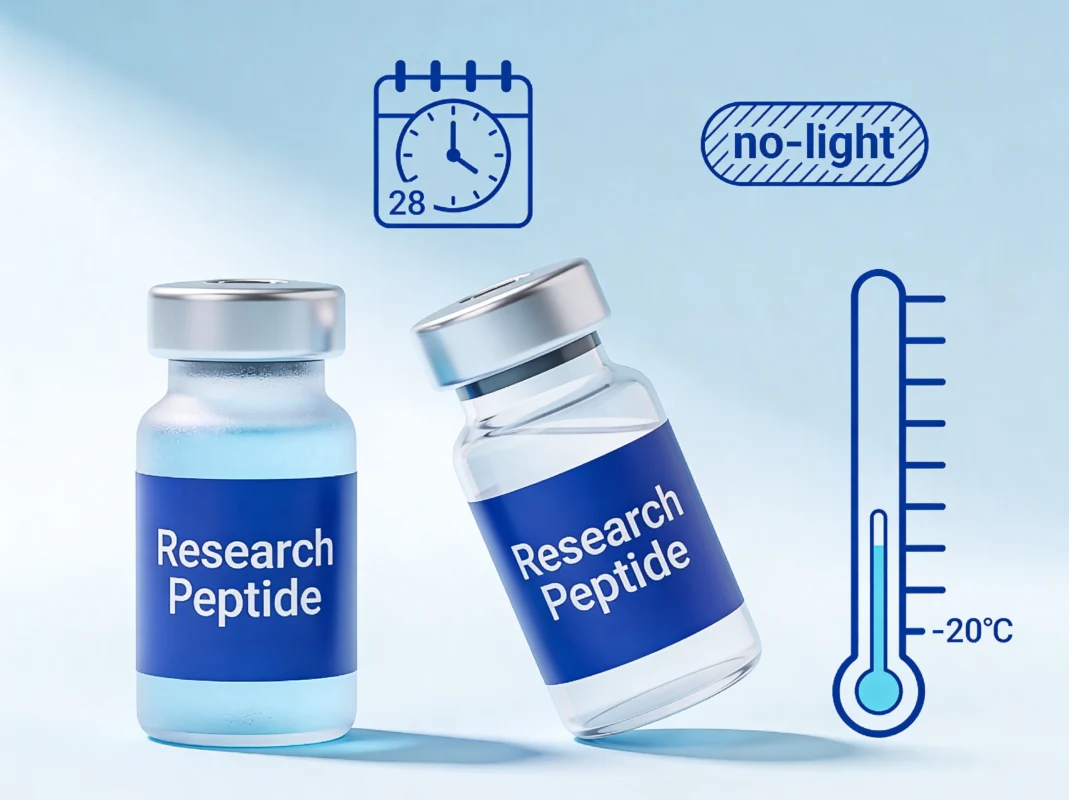
- Lyophilized research peptides should be stored at -20°C protected from light for long-term stability lasting 24 months or longer under proper conditions.
- Reconstituted peptides should be stored at 2-8°C protected from light and used within 28 days; freeze-thaw cycles should be minimized through proper aliquoting strategies.
- Visual inspection before research use is essential — solutions should be clear and free of particulates; cloudiness, discoloration, or sediment indicates degradation.
- Different peptide classes have different stability profiles — smaller peptides typically more stable than larger ones; peptides with disulfide bonds require specific handling.
- Proper storage protocols preserve peptide structural integrity, maintain biological activity, and ensure research results reflect compound properties rather than degradation effects.
Research peptides are not robust molecules. They are sequence-specific proteins with three-dimensional structures that depend on hydrogen bonding, hydrophobic interactions, and disulfide bridges — and these structural features are vulnerable to heat, light, oxidation, and the physical stresses of freeze-thaw cycling. A peptide that arrives at a research laboratory with documented 99% HPLC purity can lose meaningful structural integrity within days under poor storage conditions, and the loss is not always visible to the naked eye. Solutions that look the same can produce different research results because the peptide content has degraded between sessions.
This article covers the storage and stability principles that protect research peptide integrity across the typical timeline of laboratory work — from shipping arrival through long-term lyophilized storage, reconstitution, working stock storage, and the inevitable end-of-life decision point. The companion article on reconstitution covers the procedural mechanics of converting lyophilized peptides to working solutions; this article covers what happens to those peptides during storage at every stage.
What Degrades Peptides
Several distinct degradation mechanisms affect research peptide stability, and storage protocols are designed to minimize each.
Temperature. Heat accelerates molecular motion, which destabilizes protein structure and promotes degradation reactions. Higher storage temperatures shorten peptide shelf life roughly exponentially — a peptide stable for 24 months at -20°C may be stable for only 6 months at 4°C, and only weeks at room temperature. The Wang 1999 comprehensive review of liquid protein pharmaceutical stability documents these temperature-dependent degradation kinetics in detail [Ref. 1].
Light. Specifically ultraviolet and high-energy visible light. Light exposure can drive direct bond-breaking in certain amino acid residues (tryptophan, tyrosine, phenylalanine, and methionine are particularly susceptible) and can also accelerate oxidation reactions in the presence of dissolved oxygen. Storage in opaque containers, refrigerator interiors, or dedicated dark storage areas mitigates photodegradation.
Oxidation. Atmospheric oxygen dissolved in solutions or trapped in vial headspaces can oxidize susceptible amino acid residues, particularly methionine and cysteine. Lyophilized peptides have minimal water and minimal oxidative activity, but reconstituted peptides in aqueous solution are continuously exposed to dissolved oxygen and are more vulnerable to oxidative degradation over time.
Freeze-thaw cycling. Repeated freezing and thawing of aqueous peptide solutions produces multiple destabilizing effects: ice crystal formation can physically damage peptide structure, pH shifts during freezing concentrate residual buffer components into smaller liquid pockets, and the thawing process itself can promote protein aggregation [Ref. 1, Ref. 3]. The Manning 2010 review of protein pharmaceutical stability synthesizes the broader literature on freeze-thaw mechanisms and their impact on peptide integrity [Ref. 3].
Microbial contamination. Reconstituted peptides stored in aqueous solution are susceptible to microbial growth without preservation. Bacteriostatic water — the standard diluent for research peptide reconstitution — contains 0.9% benzyl alcohol as a preservative that inhibits microbial growth across multiple vial withdrawals over the 28-day in-use window [Ref. 2]. Sterile water without preservative does not provide this protection and is appropriate only for single-use research applications.
Lyophilized Storage
Unreconstituted lyophilized peptide vials are the most stable form for long-term storage. The freeze-dried powder contains minimal water — typically below 1% residual moisture — which dramatically slows the chemical degradation reactions that affect aqueous solutions.
Temperature. Long-term storage at -20°C (-4°F) is the standard for research peptides. Most lyophilized research peptides remain stable for 24 months or longer at -20°C, and some peptides have demonstrated stability for several years under proper conditions. -80°C storage is acceptable but generally unnecessary for routine research work — the additional stability gain over -20°C is small, and the access friction is higher.
Light protection. Lyophilized peptides should be stored away from direct light. Most -20°C freezers provide adequate light protection, but vials stored in transparent containers or near doors that open frequently may benefit from additional shielding in opaque containers.
Humidity. While the lyophilized powder itself has minimal residual moisture, exposure to atmospheric humidity can introduce water that destabilizes the peptide. Vials should remain sealed with their original closures until reconstitution. If vials must be repeatedly removed from cold storage for inspection or handling, allow them to equilibrate to room temperature inside their sealed packaging before opening — opening cold vials in humid air can cause condensation on cold surfaces, which is the mechanism for moisture introduction.
Shipping conditions. Lyophilized peptides shipped at ambient temperature for short periods (typically several days) tolerate the temperature excursion well — the lyophilized form is stable enough that brief room-temperature exposure during transit does not meaningfully affect long-term stability. Once received, vials should be moved to -20°C storage promptly rather than held at room temperature beyond the shipping window.
Reconstituted Peptide Storage
Once reconstituted with bacteriostatic water, the peptide enters a more vulnerable phase of its lifecycle and storage requirements tighten considerably.
Temperature. Reconstituted peptides should be stored at 2–8°C — standard refrigerator temperature. Most laboratory refrigerators operate in this range, but the temperature range should be verified periodically. Refrigerator doors and shelves near doors experience temperature excursions every time the unit is opened; the most stable storage location is typically the back of the middle shelf, away from the door and away from cooling vents.
Light protection. Reconstituted peptides should remain protected from light throughout the in-use window. Most refrigerator interiors provide adequate light protection when the door is closed, but vials should not be left out on bench tops between uses.
In-use window. The bacteriostatic water’s 0.9% benzyl alcohol preservative provides reliable microbial protection across a 28-day in-use window when storage conditions are maintained. Beyond 28 days, both microbial growth and chemical degradation become risks. Some peptides may have shorter or longer stability windows depending on their specific chemistry — always check the product page or Certificate of Analysis for compound-specific information.
Aliquoting strategy. Researchers planning to use a reconstituted vial across multiple sessions should consider aliquoting the working stock into smaller volumes immediately after reconstitution. Aliquoting allows individual volumes to be frozen and thawed only once each, rather than subjecting the entire working stock to repeated freeze-thaw cycles. This is particularly important for peptides being used over weeks of research work — the aliquoting strategy can extend functional stability significantly compared to repeated withdrawal from a single working vial.
End-of-life decisions. At the 28-day window, the working stock should be discarded and fresh stock reconstituted from lyophilized vials if research continues. Beyond the window, peptide content cannot be reliably verified against the original Certificate of Analysis — the analytical assumptions break down outside the validated stability window, and any research data generated from beyond-window stock is harder to interpret reproducibly.
Freeze-Thaw Cycling
Freeze-thaw cycles are the single most consequential storage variable for reconstituted peptide stability, and they merit specific attention.
Each freeze-thaw cycle produces a small but measurable loss of peptide integrity through several mechanisms operating in combination. As the solution freezes, water crystallizes into ice while solutes (including the peptide itself) concentrate into shrinking volumes of remaining liquid. This freeze-concentration produces locally elevated peptide concentrations and pH excursions that can promote aggregation. As the solution thaws, partial denaturation that occurred during freezing may not fully reverse, and aggregated peptide does not always re-dissolve. The cumulative effect across repeated cycles is progressive loss of functional peptide content [Ref. 1, Ref. 3].
The practical implications for research work:
Single working vial used across multiple sessions is the highest-cycling scenario and the most degradation-prone. Each session that opens the vial subjects the contents to a temperature transition. While not all of these transitions involve full freezing, the cumulative effect over weeks of repeated access is meaningful.
Aliquoted working stock addresses this directly. By dividing the reconstituted volume into smaller aliquots immediately after reconstitution, each aliquot can be frozen and thawed only once. The functional stability advantage compared to repeated single-vial access can be substantial — a peptide that loses meaningful activity after 5–10 freeze-thaw cycles in a single vial may retain full activity through 28 days when aliquoted properly.
Aliquot volume selection depends on research session size. Smaller aliquots minimize freeze-thaw cycling but increase the operational burden of more frequent thaws. A common compromise is to aliquot at the per-session volume, so each thawed aliquot is used completely within a single session.
Light Protection
Light protection is often overlooked in research peptide storage protocols because the effect is invisible — a degraded solution looks the same as a fresh solution. But photodegradation is real and cumulative, and minimizing light exposure across the peptide’s lifecycle is a low-cost stability protection.
The primary photodegradation risks are ultraviolet light and high-energy visible light. Standard laboratory fluorescent and LED lighting contains some UV and high-energy visible wavelengths, though far less than direct sunlight. The most consequential light exposure for most research peptides comes from:
- Bench-top storage between sessions, where vials sit in laboratory light for extended periods
- Storage in transparent containers without additional shielding
- Storage near refrigerator doors with frequent opening
- Long-duration window exposure if any peptide handling occurs near natural light
Mitigations are straightforward: store reconstituted peptides inside the refrigerator (not on the bench) between uses, use opaque containers or opaque outer wrapping for additional shielding, and minimize the time vials spend in laboratory light during active research work.
Storage Decisions Across the Peptide Lifecycle
The full lifecycle of a research peptide vial includes several distinct storage phases, each with its own requirements.
Phase 1 — Shipping receipt. Move lyophilized vials to -20°C storage within 24 hours of receipt. Brief room-temperature exposure during transit is acceptable; extended room-temperature storage after receipt is not.
Phase 2 — Long-term lyophilized storage. -20°C, protected from light, sealed in original packaging. Stable for 24 months or longer for most research peptides.
Phase 3 — Pre-reconstitution preparation. Allow vial to equilibrate to room temperature inside sealed packaging before opening — typically 10–15 minutes — to prevent condensation on cold surfaces when the vial is opened.
Phase 4 — Reconstitution. Standard aseptic technique using bacteriostatic water as the diluent. The procedural mechanics are covered in detail in our reconstitution tutorial.
Phase 5 — Reconstituted working stock storage. 2–8°C refrigeration, protected from light, in original vial. If used across multiple sessions, consider aliquoting into smaller volumes immediately after reconstitution to minimize freeze-thaw exposure.
Phase 6 — Aliquot storage (if applicable). -20°C freezing for aliquots not in active use. Working aliquot at 2–8°C in refrigerator. Each aliquot used only once per thaw.
Phase 7 — End-of-life. At 28-day in-use window for the working stock, discard and reconstitute fresh material from the lyophilized supply if research continues.
For full handling and reconstitution protocols across the broader peptide catalog, see our storage and reconstitution guide, which covers compound-specific considerations for each peptide in the Kinetic Compounds catalog.
Pharmaceutical Compounding Standards
The principles in this article align with broader pharmaceutical compounding standards for sterile preparations [Ref. 4], adapted for the laboratory research context where the goal is reproducible measurement rather than therapeutic preparation. The core requirements — temperature control, light protection, aseptic technique, defined in-use windows, and freeze-thaw management — apply across both contexts, though research work has somewhat more flexibility in execution.
Researchers working with research peptides for the first time often underestimate the storage protocols’ impact on research reproducibility. The same vial of peptide produces different results across research sessions if storage between sessions degrades the working stock. Consistent storage protocols — applied across every vial in every session — are the foundation of reproducible peptide research.
Sourcing Verified Research Peptides
Every storage protocol assumes the starting material is verified peptide of known purity and identity. A Certificate of Analysis specifying HPLC purity, mass spectrometry identity confirmation, and peptide content is the foundation that makes the storage decisions meaningful — without that baseline, there’s no clear definition of what is being preserved.
Kinetic Compounds tests every batch of every peptide through Janoshik Analytical, an independent third-party laboratory. Current batch reports are published on each product page. Our broader testing methodology is documented on our lab testing and COA page, and the principles of reading a research peptide COA are covered in detail in our reading a Certificate of Analysis article. Research-grade bacteriostatic water for reconstitution is also available, formulated to pharmaceutical standards for multi-dose vial use.
Maintaining consistent storage protocols is foundational to reproducible research. Our complete research peptide catalog ships every product with a Certificate of Analysis published on the product page, and our research-grade bacteriostatic water is formulated to pharmaceutical standards for the standard 28-day in-use window.
Related Peptides
Related peptides will load here via PHP snippet.
Available for Research
Research Tools
Quality Promise
very batch independently tested by Janoshik Analytical. 98% purity minimum.
Frequently Asked Questions
What temperature should I store lyophilized peptides at?
<p>Long-term storage at -20°C (-4°F), protected from light, in original sealed packaging. Most research peptides remain stable at this temperature for 24 months or longer. -80°C storage is acceptable but generally unnecessary for routine research work.</p>
What temperature should I store reconstituted peptides at?
<p>2–8°C (standard refrigerator temperature), protected from light. The 28-day in-use window when reconstituted with bacteriostatic water assumes consistent refrigeration at this range.</p>
Can I store reconstituted peptides at room temperature?
<p>No, not for any extended period. Room temperature dramatically accelerates degradation reactions and supports microbial growth. Brief room temperature exposure during active research sessions is acceptable, but vials should return to refrigeration between uses.</p>
ow long does a reconstituted peptide vial last?
<p>Typically 28 days when stored at 2–8°C protected from light, when bacteriostatic water is used as the diluent. The 28-day window is established by the benzyl alcohol preservative's microbial protection and is the standard in-use window across most research peptide work. Some peptides have shorter or longer stability — check the product page or COA for compound-specific information.</p>
Why is freeze-thaw cycling bad for peptides?
<p>Each cycle produces a small but cumulative loss of peptide integrity through ice crystal damage, pH shifts during freezing, and protein aggregation during thawing. The effect compounds across multiple cycles. Aliquoting the working stock immediately after reconstitution — so each aliquot is frozen and thawed only once — minimizes the cumulative damage.</p>
Should I aliquot every reconstituted vial?
<p>Aliquoting is most beneficial when a single reconstituted vial will be used across many sessions over weeks. If a vial will be fully consumed within a few sessions, aliquoting adds operational overhead without proportional stability benefit. The decision depends on research session size and total expected use.</p>
What about light protection — does it really matter?
<p>Yes, though the effect is invisible. Ultraviolet and high-energy visible light can drive photodegradation in susceptible amino acid residues, and the damage is cumulative across the peptide's lifecycle. Storing reconstituted peptides inside the refrigerator (not on the bench) between uses is the simplest and most effective light protection.</p>
References
- "Instability, stabilization, and formulation of liquid protein pharmaceuticals." International Journal of Pharmaceutics, 185(2):129-188. — Wang W (1999).
- "Antimicrobial Preservatives for Protein and Peptide Formulations: An Overview." Pharmaceutics, 15(2):563. — Stroppel L, Schultz-Fademrecht T, Cebulla M, Blech M, Marhöfer RJ, Selzer PM, Garidel P (2023).
- "Stability of protein pharmaceuticals: an update." Pharmaceutical Research, 27(4):544-575. — Manning MC, Chou DK, Murphy BM, Payne RW, Katayama DS (2010).
- USP <797>: Pharmaceutical Compounding — Sterile Preparations. — United States Pharmacopeia.
- "Trends in Light and Temperature Sensitivity Recommendations among Licensed Biotechnology Drug Products." Pharmaceutical Research, 40(7):1727-1735. — Kim JJ, Patel K, Wood C, Wang W, Wang Y (2023).
Continue Reading
For Research Use Only Products described on this site are intended for laboratory research purposes only. They are not approved by Health Canada for human consumption, diagnosis, treatment, or prevention of any medical condition.