
Home / Research Articles / SS-31 (Elamipretide): Mechanism, Research, and Applications
SS-31 (Elamipretide): Mechanism, Research, and Applications
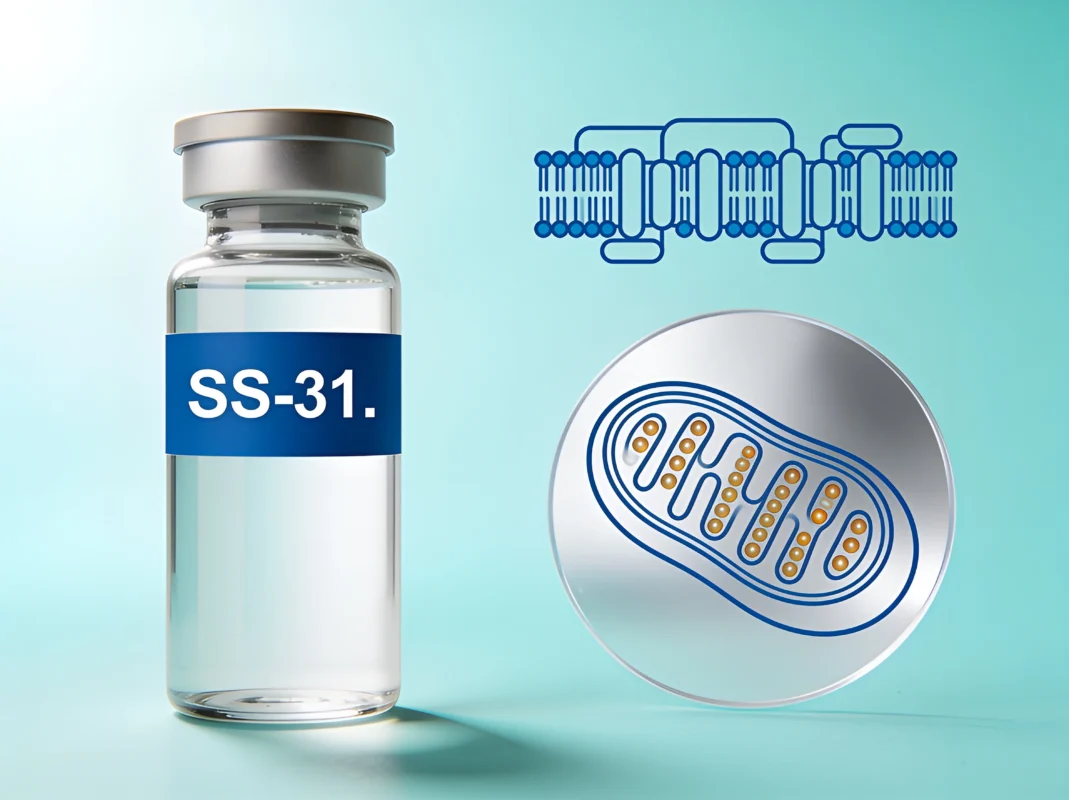
Key Takeaways
- SS-31 (elamipretide; also MTP-131, Bendavia) is a synthetic mitochondria-targeting tetrapeptide — D-Arg-Dmt-Lys-Phe-NH2, MW ~640 g/mol.
- Its mechanism is binding cardiolipin in the inner mitochondrial membrane, stabilizing cristae and electron-transport supercomplexes to support ATP output and cut ROS at the source.
- Research spans primary mitochondrial myopathy, cardiac and heart-failure models, and Barth syndrome.
- Elamipretide received FDA accelerated approval (Forzinity) in September 2025 for Barth syndrome; research-grade SS-31 is not the approved drug.
- It accumulates strongly at the inner mitochondrial membrane and is supplied as lyophilized powder for reconstitution with bacteriostatic water.
SS-31 (elamipretide) anchors the mitochondrial corner of the Kinetic Compounds Longevity research cluster. Where mitochondrial-derived peptides such as MOTS-c and Humanin are short peptides encoded within mitochondrial DNA that act as signaling molecules, SS-31 is a synthetic mitochondria-targeting tetrapeptide designed to concentrate at the inner mitochondrial membrane and act directly on its structure. It is one of the most clinically advanced mitochondrial peptides in research, and in September 2025 its pharmaceutical form became the first approved therapy for the ultra-rare mitochondrial disease Barth syndrome.
This article addresses SS-31 as a research compound: its structure as a cell-permeable cationic-aromatic tetrapeptide, the cardiolipin-binding mechanism that stabilizes mitochondrial cristae and the electron transport chain, the research applications spanning mitochondrial myopathy through heart failure and Barth syndrome, its recent regulatory approval, and the reconstitution and sourcing considerations researchers should understand before working with the compound.
What Is SS-31?
SS-31 is a synthetic mitochondria-targeting tetrapeptide — four amino acids, sequence D-Arg-Dmt-Lys-Phe-NH2 (where Dmt is 2′,6′-dimethyltyrosine). The molecular weight is approximately 640 g/mol (formula C32H49N9O5, CAS 736992-21-5). It is also known by the research designation SS-31 and the development names MTP-131, Bendavia, and elamipretide.
SS-31 belongs to a class of small peptides with an alternating cationic-aromatic motif, originally discovered during research on opioid-receptor peptides — though SS-31 itself has little to no opioid activity. Despite carrying a net positive charge (+3), it crosses the plasma membrane in an energy-independent manner and accumulates 1,000- to 5,000-fold at the inner mitochondrial membrane, where it exerts its effects [Ref. 1].
SS-31 differs fundamentally from the mitochondrial-derived peptides MOTS-c and Humanin: those are encoded within mitochondrial DNA and act as endogenous signaling molecules, whereas SS-31 is a synthetic compound that physically targets and stabilizes the inner mitochondrial membrane. See our MOTS-c article for the mitochondrial-derived peptide mechanism.
In September 2025, the FDA granted accelerated approval to elamipretide (brand name Forzinity, Stealth BioTherapeutics) as the first therapy for Barth syndrome, an ultra-rare genetic mitochondrial disorder, in eligible patients [Ref. 5]. This approval is specific to Barth syndrome; elamipretide is not approved for general anti-aging, athletic, or other uses. Research-grade SS-31 sold for laboratory research is not the approved pharmaceutical product (Forzinity) and is intended exclusively for laboratory research. It has not otherwise been approved by Health Canada, EMA, or MHRA for general human use.
Mechanism of Action
SS-31’s mechanism is built on a single specific molecular interaction — binding cardiolipin — from which its structural and bioenergetic effects follow.
Cardiolipin binding. SS-31 binds selectively to cardiolipin, a phospholipid found almost exclusively in the inner mitochondrial membrane. The electrostatic attraction between the peptide’s positive charges and cardiolipin’s negative charges drives its strong mitochondrial accumulation [Ref. 2].
Cristae stabilization. Cardiolipin is essential for maintaining the curvature of the inner-membrane cristae — the tightly folded structures where ATP synthase and the electron transport chain are densely packed. By binding cardiolipin, SS-31 helps preserve cristae architecture [Ref. 1].
Electron-transport-chain organization and ATP. Cardiolipin organizes the electron transport chain into supercomplexes — respirasomes assembling Complexes I, III, and IV — that improve electron-transfer efficiency. By stabilizing cardiolipin, SS-31 supports efficient oxidative phosphorylation and preserves ATP production [Ref. 1].
Reactive oxygen species reduction at the source. Unlike conventional antioxidants that scavenge reactive oxygen species (ROS) after they form, SS-31 reduces ROS generation at the source by improving electron-transport efficiency and reducing electron leakage — preserving beneficial redox signaling while lowering pathological oxidative stress [Ref. 2].
Compound distinction. SS-31 acts on mitochondrial membrane structure directly, a different mode of action from mitochondrial-derived signaling peptides (MOTS-c, Humanin) and from antioxidant small molecules. Its selectivity for cardiolipin is what makes it a mitochondria-targeted research tool rather than a general antioxidant.
Research Applications
SS-31 research clusters around conditions of mitochondrial dysfunction, with the most advanced work in rare mitochondrial disease and cardiac research.
Primary mitochondrial myopathy. In primary mitochondrial myopathy research, subcutaneous SS-31 produced dose-dependent improvements in six-minute walk distance, with headache and dizziness the most commonly reported adverse events [Ref. 1].
Cardiac and heart-failure research. Under the development names Bendavia and MTP-131, SS-31 has been studied in cardiac research including ischemia-reperfusion injury and heart failure, where intravenous administration improved echocardiographic markers of cardiac function during infusion [Ref. 1].
Barth syndrome. The most advanced application. The TAZPOWER trial evaluated elamipretide in Barth syndrome, a disorder of mitochondrial cardiolipin metabolism. While the 12-week randomized portion did not meet its primary endpoints, the open-label extension showed functional improvements over longer treatment, and these longer-term data supported the September 2025 accelerated approval [Ref. 3][Ref. 4].
Broader research domains. SS-31 has additionally been studied across:
- Age-related mitochondrial dysfunction and skeletal-muscle aging research
- Renal ischemia and acute kidney injury models
- Neurodegeneration and mitochondrial-stress research
- Ophthalmic research (mitochondrial contributions to retinal disease)
Combination and comparative research with cluster siblings. Within the mitochondrial/longevity domain, SS-31 (a synthetic membrane-targeting peptide) and MOTS-c (a mitochondrial-derived signaling peptide) act through different mechanisms, making comparative research designs informative. See our MOTS-c article for context.
Across all research domains, research-grade SS-31 is intended for laboratory research only in the Kinetic Compounds context. The approved pharmaceutical form (Forzinity) is a separate, regulated product for a specific indication.
Dosing & Reconstitution for Research
Researchers working with lyophilized SS-31 reconstitute the compound with bacteriostatic water before use. The reconstitution math follows the standard concentration-equals-mass-divided-by-volume principle covered in our reconstitution tutorial.
A 10 mg vial of SS-31 reconstituted with 2 mL of bacteriostatic water yields 5 mg/mL. A 50 mg vial in 2 mL yields 25 mg/mL. Researchers can verify their concentration math against our peptide reconstitution calculator, which handles the conversion automatically.
This article does not provide dosing guidance for any therapeutic purpose. Research-grade SS-31 is intended for laboratory research only.
Storage & Handling
Lyophilized SS-31 is stable at room temperature during shipping but should be moved to long-term storage at -20°C (-4°F), protected from light, on receipt. Under proper lyophilized conditions, the compound remains stable for 24 months or longer.
Once reconstituted, SS-31 should be stored at 2–8°C and used within 28 days. The general storage principles for research peptides apply directly — see our storage and stability guide for detailed protocols including freeze-thaw considerations and aliquoting strategies.
Every vial should be visually inspected before use. The reconstituted solution should be clear and free of particulates. Cloudiness, discoloration, or visible sediment indicates degradation, and the vial should not be used in research.
For full handling protocols across the broader peptide catalog, see our storage and reconstitution guide.
Sourcing Verified SS-31 for Research
SS-31’s small, defined tetrapeptide structure makes analytical verification by mass spectrometry exceptionally straightforward — the expected mass of ~640 Da and the distinctive sequence including the unusual dimethyltyrosine residue are readily confirmed.
A credible Certificate of Analysis for SS-31 should show HPLC purity expressed as a percentage, mass spectrometry confirmation matching ~640 Da, and a clear distinction between peptide content and peptide mass. The principles of reading a research peptide COA are covered in detail in our reading a Certificate of Analysis article, and our specific third-party testing methodology is documented in our Janoshik Analytical methodology article.
Kinetic Compounds tests every batch of SS-31 through Janoshik Analytical, an independent third-party laboratory. Current batch reports are published on the SS-31 product page. Our broader testing methodology is documented on our lab testing and COA page.
For researchers working across the broader mitochondrial and longevity research area, MOTS-c is a mechanistically distinct but complementary research compound in the Kinetic Compounds catalog. The full research peptide catalog is available through our shop.
Related Peptides
Related peptides will load here via PHP snippet.
Available for Research
Research Tools
Quality Promise
very batch independently tested by Janoshik Analytical. 98% purity minimum.
Frequently Asked Questions
What is SS-31?
<p>SS-31 (elamipretide; also known as MTP-131 or Bendavia) is a synthetic mitochondria-targeting tetrapeptide, sequence D-Arg-Dmt-Lys-Phe-NH2. It concentrates at the inner mitochondrial membrane and binds cardiolipin.</p>
How does SS-31 work?
<p>SS-31 binds cardiolipin, a phospholipid of the inner mitochondrial membrane. This stabilizes the folded cristae and the electron-transport-chain supercomplexes, supporting efficient ATP production while reducing reactive oxygen species generation at the source.</p>
Is SS-31 (elamipretide) FDA-approved?
<p>Elamipretide received FDA accelerated approval (brand name Forzinity) in September 2025 as the first therapy for Barth syndrome, in eligible patients. That approval is specific to Barth syndrome. Research-grade SS-31 sold for laboratory research is not the approved pharmaceutical product and is for laboratory research only.</p>
What does SS-31 research focus on?
<p>Conditions of mitochondrial dysfunction: primary mitochondrial myopathy, cardiac and heart-failure models (ischemia-reperfusion), Barth syndrome, and broader aging, renal, and neurodegeneration research.</p>
How does SS-31 differ from MOTS-c?
<p>SS-31 is a synthetic peptide that physically targets and stabilizes the inner mitochondrial membrane. MOTS-c is a mitochondrial-derived peptide encoded in mitochondrial DNA that acts as an endogenous signaling molecule. They work through different mechanisms.</p>
How is SS-31 reconstituted for research?
<p>Lyophilized SS-31 is reconstituted with bacteriostatic water. A 10 mg vial in 2 mL yields 5 mg/mL. Researchers can verify calculations using our reconstitution calculator.</p>
Is research-grade SS-31 legal in Canada?
<p>Research-grade SS-31 is legal to purchase and possess in Canada for laboratory research purposes only. The research-grade compound is not the approved pharmaceutical product and is not approved by Health Canada for general human use.</p>
References
- Elamipretide: A Review of Its Structure, Mechanism of Action, and Therapeutic Potential
- The mitochondria-targeted peptide SS-31 binds lipid bilayers and modulates surface electrostatics
- A phase 2/3 randomized clinical trial of elamipretide in Barth syndrome (TAZPOWER)
- Long-term efficacy and safety of elamipretide in Barth syndrome: 168-week TAZPOWER extension
- FDA approves elamipretide HCl as first treatment for Barth syndrome (September 2025)
Continue Reading
For Research Use Only Products described on this site are intended for laboratory research purposes only. They are not approved by Health Canada for human consumption, diagnosis, treatment, or prevention of any medical condition.