Home / Research Articles / NAD+ (Nicotinamide Adenine Dinucleotide): Mechanism, Research, and Applications
NAD+ (Nicotinamide Adenine Dinucleotide): Mechanism, Research, and Applications
Key Takeaways
- NAD+ (nicotinamide adenine dinucleotide) is an essential coenzyme — not a peptide — central to cellular energy metabolism; molecular weight ~663 g/mol.
- It mediates redox reactions (NAD+/NADH) across glycolysis, fatty-acid oxidation, and oxidative phosphorylation, powering cellular energy production.
- NAD+ is the required substrate for sirtuins and PARPs, linking it to DNA repair, gene regulation, and aging/longevity pathways.
- NAD+ levels decline with age; raising NAD+ extends lifespan in worms and mice and is studied in metabolic, cognitive, and muscle aging.
- NAD+ is a naturally occurring coenzyme, not an approved anti-aging drug; research-grade material is for laboratory research only.
NAD+ anchors the metabolic foundation of the Kinetic Compounds Longevity research area. Unlike the mitochondrial peptides SS-31 and MOTS-c or the bioregulator Epitalon, NAD+ is not a peptide at all — it is a small-molecule coenzyme that every cell depends on to convert nutrients into usable energy. Its research significance comes from a striking observation: NAD+ levels fall with age, and that decline is mechanistically tied to many of the hallmarks of aging, which has made restoring NAD+ one of the most active areas in longevity science.
This article addresses NAD+ as a research compound: its identity as an essential redox coenzyme, the mechanisms by which it powers metabolism and serves as a substrate for sirtuins and PARPs, the research applications spanning aging and mitochondrial function, and the handling and sourcing considerations researchers should understand before working with the compound.
What Is NAD+?
NAD+ (nicotinamide adenine dinucleotide) is an essential coenzyme found in every living cell, with a molecular weight of approximately 663 g/mol. It is important to note that NAD+ is a small-molecule dinucleotide, not a peptide — though it is often grouped with research peptides in longevity contexts.
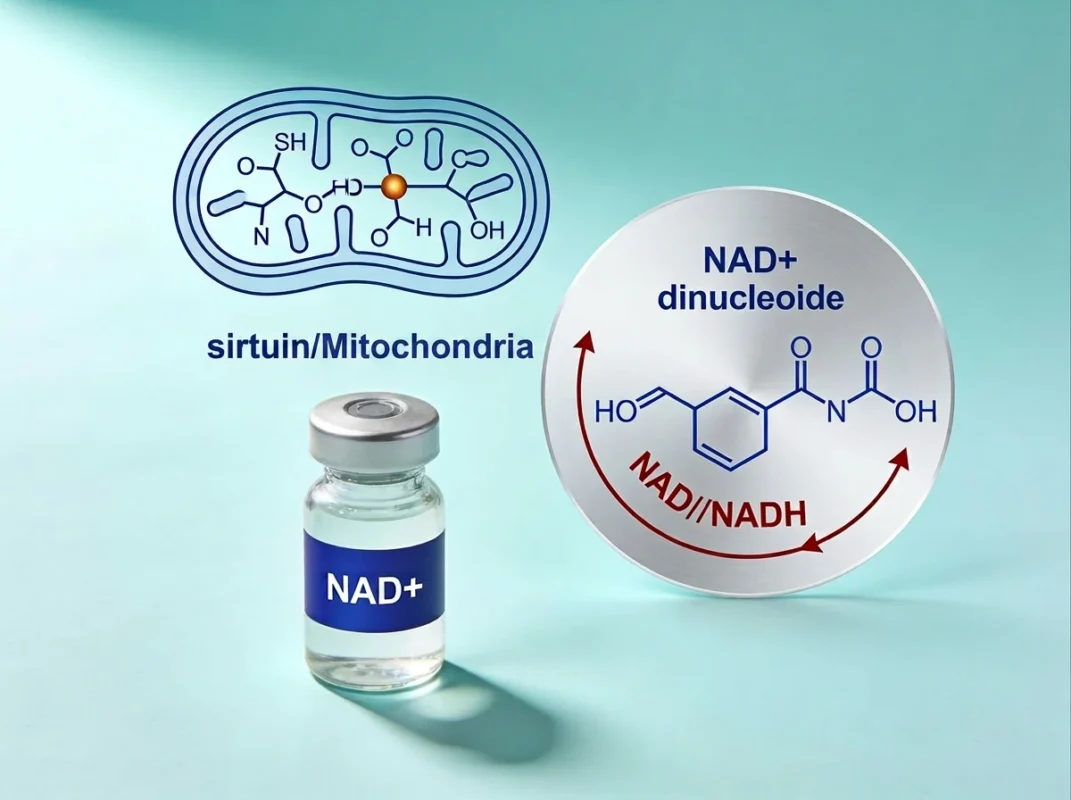
NAD+ exists in two interconverting forms: the oxidized form (NAD+) and the reduced form (NADH). This pair shuttles electrons between metabolic reactions, which is the basis of NAD+’s role as the cell’s central energy-currency cofactor [Ref. 3].
NAD+ availability declines with age, reducing the activity of NAD+-dependent enzymes and impairing communication between the cell nucleus and its mitochondria. This age-related decline is associated with reduced metabolic capacity and is implicated in cognitive decline, sarcopenia, and metabolic disease [Ref. 5].
NAD+ is a naturally occurring coenzyme rather than an approved pharmaceutical. It has not been approved by FDA, Health Canada, EMA, MHRA, or any other Western regulatory agency as a drug for anti-aging or related uses. Research-grade NAD+ sold for laboratory research is intended exclusively for that purpose.
Mechanism of Action
NAD+ acts through two broad roles: as a redox cofactor in metabolism, and as a consumable substrate for a set of regulatory enzymes.
Redox cofactor in energy metabolism. NAD+ mediates electron-transfer (redox) reactions by cycling between NAD+ and NADH, supporting the core energy-producing pathways — glycolysis, fatty-acid (beta) oxidation, and oxidative phosphorylation in the mitochondria [Ref. 3]. Without adequate NAD+, the cell’s capacity to generate ATP is constrained.
Substrate for sirtuins. NAD+ is the required substrate for the sirtuins, a family of enzymes that remove acyl groups from proteins to regulate gene expression, stress responses, and metabolism. The coupling of NAD+ breakdown to sirtuin activity is the mechanistic link that translates energy status into the regulation of aging and longevity [Ref. 1].
Substrate for PARPs and DNA repair. NAD+ is also consumed by poly(ADP-ribose) polymerases (PARPs) during DNA repair. PARP activation in response to DNA damage can consume large amounts of NAD+, creating competition for the limited NAD+ pool between DNA repair, sirtuins, and other NAD+-consuming enzymes such as CD38 [Ref. 2].
NAD+ decline and mitochondrial communication. Because sirtuins (particularly mitochondrial sirtuins) depend on NAD+, falling NAD+ with age reduces sirtuin activity and disrupts nucleus-to-mitochondria signaling — a pathway central to age-related mitochondrial dysfunction [Ref. 1][Ref. 5].
Compound distinction. NAD+ is a foundational metabolic cofactor rather than a receptor-targeting compound; it complements mitochondria-targeting peptides such as SS-31 (which stabilizes the inner membrane) and MOTS-c (a mitochondrial-derived signaling peptide) by addressing the cell’s underlying energy-cofactor supply.
Research Applications
NAD+ research is concentrated in aging biology and metabolism, supported by a large and growing clinical literature on NAD+ and its precursors.
Aging and longevity. The central domain. Interventions that raise NAD+ levels have extended lifespan in worms and mice, and NAD+ decline is tied to multiple hallmarks of aging, making NAD+ restoration a major longevity research focus [Ref. 1][Ref. 2].
Mitochondrial function. NAD+ metabolism is closely linked to mitochondrial health; NAD+ decline parallels mitochondrial dysfunction across tissues, and NAD+ modulation is studied in mitochondrial and age-related disorders [Ref. 2].
NAD+ precursors (NMN and NR). Much human research uses NAD+ precursors — nicotinamide mononucleotide (NMN) and nicotinamide riboside (NR) — which raise NAD+ levels. Systematic review of clinical studies indicates oral NMN/NR is generally safe and well tolerated at the doses studied [Ref. 4].
Broader research domains. NAD+ and its metabolism have additionally been studied across:
- Neurodegeneration and cognitive-decline models
- Metabolic disease and insulin sensitivity
- Muscle aging and sarcopenia
- DNA-repair and cellular-stress research
Across all research domains, research-grade NAD+ is intended for laboratory research only in the Kinetic Compounds context. The compound has not been evaluated by FDA, Health Canada, or any other Western regulatory agency as a therapeutic.
Forms and Research Handling
NAD+ for research is supplied as a lyophilized powder or solution. Where lyophilized, it is reconstituted with bacteriostatic water following the standard concentration-equals-mass-divided-by-volume principle in our reconstitution tutorial; a 100 mg vial in 2 mL yields 50 mg/mL. Researchers can verify their math against our peptide reconstitution calculator. Note that NAD+ precursors such as NMN and NR are typically studied as oral compounds rather than reconstituted injectables.
This article does not provide dosing guidance for any therapeutic purpose. Research-grade NAD+ is intended for laboratory research only.
Storage & Handling
Lyophilized NAD+ should be stored cool and dry, protected from light, with long-term storage at -20°C (-4°F) on receipt. NAD+ is sensitive to moisture and heat, so minimizing exposure is important. Once in solution, NAD+ should be refrigerated at 2–8°C and used promptly. See our storage and stability guide for detailed protocols.
Any solution should be visually inspected before use; cloudiness, discoloration, or visible sediment indicates degradation and the product should not be used in research.
Sourcing Verified NAD+ for Research
As a defined small molecule, NAD+ is verified by HPLC for purity and mass spectrometry confirming the expected ~663 Da mass. Because NAD+ degrades with moisture and heat, batch freshness and proper handling are as important as initial purity.
A credible Certificate of Analysis for NAD+ should show HPLC purity expressed as a percentage and mass spectrometry confirmation. The principles of reading a research COA are covered in detail in our reading a Certificate of Analysis article, and our specific third-party testing methodology is documented in our Janoshik Analytical methodology article.
Kinetic Compounds tests every batch of NAD+ through Janoshik Analytical, an independent third-party laboratory. Current batch reports are published on the NAD+ product page. Our broader testing methodology is documented on our lab testing and COA page.
For researchers working across the broader longevity and mitochondrial research area, SS-31, MOTS-c, and Epitalon are mechanistically distinct but complementary research compounds in the Kinetic Compounds catalog. The full research peptide catalog is available through our shop.
Available for Research
Research Tools
Quality Promise
very batch independently tested by Janoshik Analytical. 98% purity minimum.
Frequently Asked Questions
What is NAD+?
<p>NAD+ (nicotinamide adenine dinucleotide) is an essential coenzyme present in every cell. It cycles between oxidized (NAD+) and reduced (NADH) forms to shuttle electrons in metabolism, and it serves as a substrate for enzymes such as sirtuins and PARPs.</p>
Is NAD+ a peptide?
<p>No. NAD+ is a small-molecule dinucleotide coenzyme, not a peptide, although it is often grouped with research peptides in longevity contexts.</p>
How does NAD+ work?
<p>It plays two roles: as a redox cofactor (NAD+/NADH) powering glycolysis, fatty-acid oxidation, and oxidative phosphorylation; and as a consumable substrate for sirtuins (gene/metabolic regulation) and PARPs (DNA repair). Competition for the NAD+ pool links energy status to aging pathways.</p>
What does NAD+ research focus on?
<p>Aging and longevity (lifespan extension in model organisms), mitochondrial function, metabolic disease, neurodegeneration, and muscle aging. Much human work uses the NAD+ precursors NMN and NR.</p>
What are NMN and NR?
<p>Nicotinamide mononucleotide (NMN) and nicotinamide riboside (NR) are NAD+ precursors that raise cellular NAD+ levels. Systematic reviews of clinical studies indicate oral NMN/NR is generally safe and well tolerated at the doses studied.</p>
Is NAD+ approved as a medication?
<p>No. NAD+ is a naturally occurring coenzyme and has not been approved by FDA, Health Canada, EMA, or any other Western regulatory agency as an anti-aging or therapeutic drug. Research-grade NAD+ is intended for laboratory research only.</p>
Is research-grade NAD+ legal in Canada?
<p>Research-grade NAD+ is legal to purchase and possess in Canada for laboratory research purposes only. It is not approved by Health Canada as a therapeutic product.</p>
References
- It takes two to tango: NAD+ and sirtuins in aging/longevity control
- Emerging therapeutic roles for NAD+ metabolism in mitochondrial and age-related disorders
- The role of NAD+ metabolism and its modulation of mitochondria in aging and disease
- NAD+ supplementation for anti-aging and wellness: a PRISMA-guided systematic review
- Age-Associated Changes in Oxidative Stress and NAD+ Metabolism in Human Tissue
Continue Reading
For Research Use Only Products described on this site are intended for laboratory research purposes only. They are not approved by Health Canada for human consumption, diagnosis, treatment, or prevention of any medical condition.